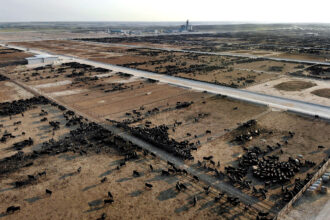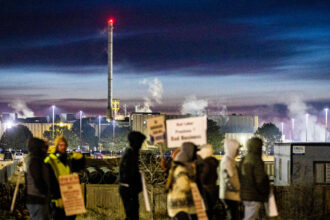


Rising food prices. Supply chain disruptions. Wars. More extreme weather.
The confluence of these factors in 2026 has prompted researchers, advocacy groups and farmers around the world to more forcefully question the architecture of an increasingly stressed global food system—and the money, both public and private, that supports it.
Coinciding with harvest season in much of the world this month, critics and activists are using a handful of agriculture- and food-focused events to home in on the structural problems of a system they say disadvantages developing countries, fattens rich ones and fails to “feed the world” as it claims to.
“It does produce food,” said Jeff Conant, a deputy director with the advocacy group Friends of the Earth. “It also undeniably produces something on the order of a third of the world’s greenhouse gas emissions. It produces illness. It produces dispossession of land-based peoples. It produces obesity and it produces wealth for the corporate elites at the expense of the rest of us.”
This month, Friends of the Earth and more than a dozen advocacy groups published a report tracking the profits of the world’s largest food companies. “It is not, in fact, a food system,” Conant said. “It’s an agribusiness financial complex.”
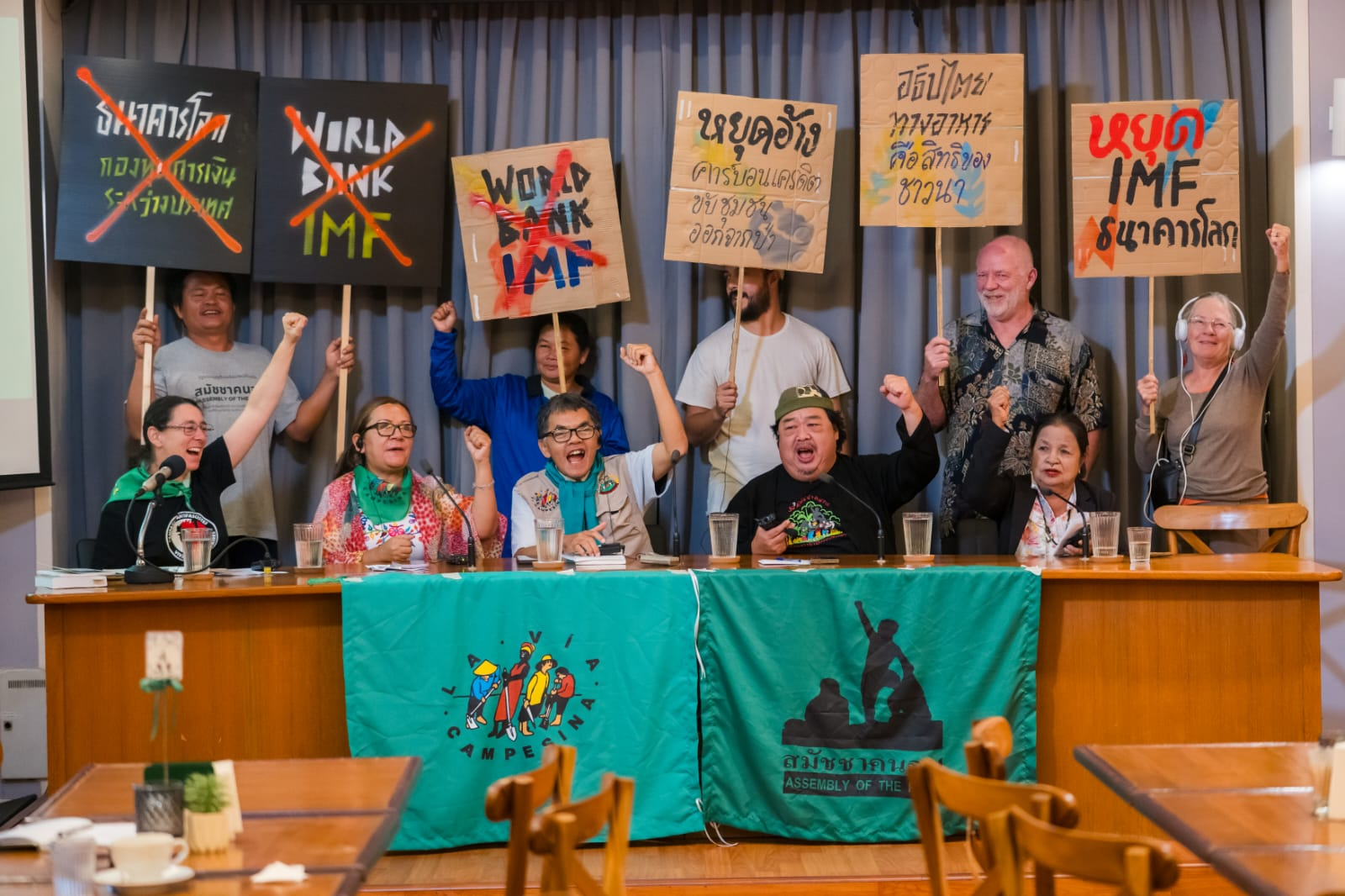
On Friday—the United Nations’ “World Food Day”— hundreds of farmers from around the world protested against the World Bank and International Monetary Fund, accusing the institutions of undercutting public support for agriculture and worsening hunger.
The protest, organized by La Via Campesina, a grassroots movement of small-scale farmers, came as the institutions concluded their weeklong annual gathering in Bangkok.
Earlier this month, farmers and advocacy groups convened, also in Bangkok, under the movement’s newly coined slogan, “Feed the People, Not the Debts!” The issue, they say, is that low-income countries spend so much money on debt payments they can’t feed their own citizens or invest in agricultural improvements to make food production more resilient.
“We owe 12.23 trillion Kenyan shillings,” said Kenyan farmer Susan Owiti, who traveled to Bangkok to join the protest. “This is a crisis. So what we are saying is we don’t need more debts. What we want is a trade framework that is based on food sovereignty.”
As climate-fueled weather events batter the world’s farms, the ongoing war in Ukraine cuts grain exports and fertilizer shipments remain stalled in the Strait of Hormuz, food prices have soared, making the situation especially fraught.
“Farmers are increasingly integrated into a global supply chain that controls fuel, fertilizer and grain. Every time a disruption happens—COVID, Ukraine, the war in West Asia and others—it leads to a major increase in input prices, pushing us further into debt,” said Zainal Arifin Fuat, a farmer from Indonesia and member of La Via Campesina, at the Bangkok conference. “Then the World Bank and IMF approach us with more loans, which come with even stricter conditions.”
The World Bank did not answer questions from Inside Climate News.
According to a 2023 report from the United Nations, about 3.3 billion people—more than half the world’s population—live in countries, mostly in the Global South, that spend more on interest payments than health or education. This “crushing debt crisis,” as U.N. Secretary General Antonio Guterres has called it, prompted Guterres and many economists to urge overhauls of IMF and World Bank lending policies, which they argued have favored developed countries.
The debt makes it harder for countries to feed themselves while coping with repeated climate-driven droughts, heatwaves and flooding.
In a workshop on food prices held for journalists last week, Raj Patel, a research professor at the University of Texas at Austin and food systems expert, explained that the indebtedness of countries in the Global South locks them into a food-impoverishing pattern. In order to pay back loans in U.S. dollars, he said, countries are forced to grow crops for export rather than using their land to grow food for their own consumption. When selling into the international market, farmers get hammered by exchange rates, which ultimately means the countries have to cut spending on healthcare and education.
“Debt repayment is actively siphoning off the fiscal space countries need to fund the very transition required to survive climate change,” Patel explained to Inside Climate News. “The protesters are calling out the architecture that demands austerity in the Global South to maintain liquidity in the North.”
The beneficiaries of this northern liquidity are the world’s largest agricultural and food companies.
In the new report, “Food, Land and Money,” Friends of the Earth and fellow advocacy groups take a broad swipe at the corporate agribusinesses that have dominated the global food economy, from the 1950s, when the term “agribusiness” was coined by Harvard economists, to the present.
A handful of businesses control the global food system, the report says, using huge swaths of the planet and its resources to grow commodities that don’t actually provide sustenance but instead have become financial instruments.
The report identifies the 100 food and agriculture companies with the largest revenues and then points to the global financial institutions that underpin them.
The top-earning “agrifood” businesses made $4.5 trillion in revenue in 2022, the report found—with the top 10, including Walmart, Cargill and Costco, making up nearly one-third of the total. The report goes on to note that only a handful of financial institutions effectively own the food system, with giant asset managers Vanguard, BlackRock and State Street owning more than one-fifth of the shares in the top 100 companies. The top 20 grain, fertilizer, meat and dairy companies paid shareholders nearly $54 billion between 2021 and 2022—more than the $52.5 billion that the United Nations says it would cost to feed the 230 million people most at risk of starvation.
This story is funded by readers like you.
Our nonprofit newsroom provides award-winning climate coverage free of charge and advertising. We rely on donations from readers like you to keep going. Please donate now to support our work.
Donate NowCargill, Costco, Vanguard, BlackRock and State Street did not respond to a request for comment. Walmart pointed to its Environmental, Social and Governance (ESG) report online. The nearly 140-page report notes the company’s 10-year effort to source 20 key commodities more sustainably, including regenerative practices for beef, soy and corn.
The authors point out that, despite the concentration and dominance of giant agribusiness, most people in the Global South get their food from outside of its supply chains.
Still, millions of the world’s farmers are beholden to that system in one way or another. Patel, who contributed to the report, noted that public money, including from the World Bank, is being used to attract private agribusiness. “Public institutions take on some risk to encourage commercial investment,” he explained. “The question is whose security improves. A lender can become better protected while a farmer remains exposed to volatile prices and debt.”
The report acknowledges the food industry’s longtime claim of efficiency, but says “the system is so concentrated, centralized and brittle that it deepens our vulnerability to the very crises it helps create” while feeding less than one-third of the world’s people.
The authors place the blame for the system’s environmental consequences—emissions, land use, pollution—squarely with the financial institutions that support it.
“To put it simply,” Conant said. “If we want to change the food system, we have to change the money system.”
Some countries are working to shore up their ability to produce food, attempting to excise themselves from the volatilities of the system and the system itself.
At a conference on food and agriculture in September, the director general of the Organization of Eastern Caribbean States, Didacus Jules, catchily emphasized his region’s need for greater self reliance.
“A nation can defer a constitutional reform or postpone a highway. It cannot postpone dinner,” Jules said. “Food sovereignty is not romance. It is the right and the ability to decide what we grow, what we eat and on what terms we trade.”
About This Story
Perhaps you noticed: This story, like all the news we publish, is free to read. That’s because Inside Climate News is a 501c3 nonprofit organization. We do not charge a subscription fee, lock our news behind a paywall, or clutter our website with ads. We make our news on climate and the environment freely available to you and anyone who wants it.
That’s not all. We also share our news for free with scores of other media organizations around the country. Many of them can’t afford to do environmental journalism of their own. We’ve built bureaus from coast to coast to report local stories, collaborate with local newsrooms and co-publish articles so that this vital work is shared as widely as possible.
Two of us launched ICN in 2007. Six years later we earned a Pulitzer Prize for National Reporting, and now we run the oldest and largest dedicated climate newsroom in the nation. We tell the story in all its complexity. We hold polluters accountable. We expose environmental injustice. We debunk misinformation. We scrutinize solutions and inspire action.
Donations from readers like you fund every aspect of what we do. If you don’t already, will you support our ongoing work, our reporting on the biggest crisis facing our planet, and help us reach even more readers in more places?
Please take a moment to make a tax-deductible donation. Every one of them makes a difference.
Thank you,