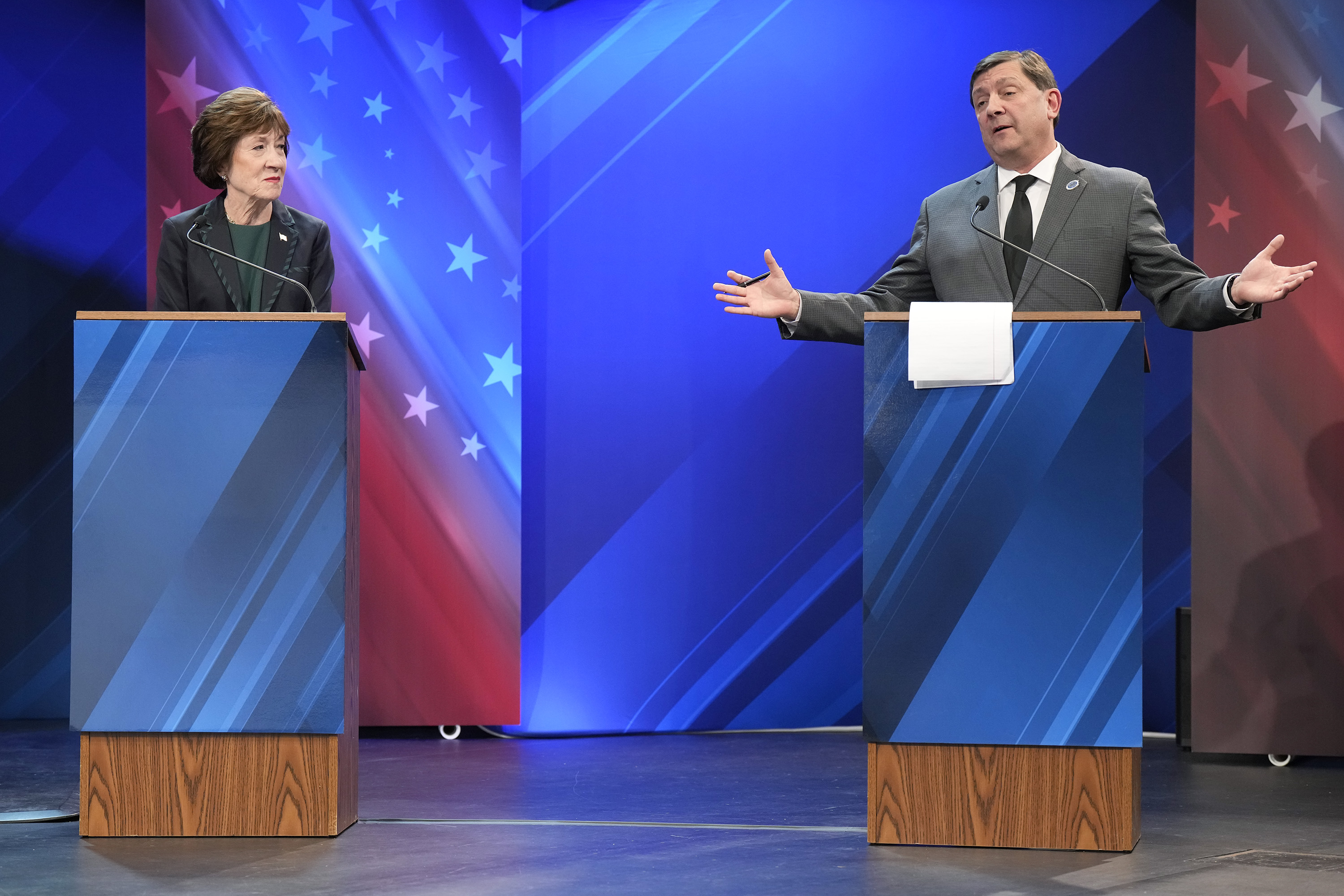


Over the course of two weeks in October, Maine’s incumbent Republican Sen. Susan Collins and her Democrat challenger, former state Senate President Troy Jackson, met for four debates. Each debate focused heavily on energy affordability, and each exchange followed roughly the same script: When Jackson brought up the high costs of heating a home with oil, Collins volleyed back by talking about the high costs of powering it with electricity, and vice versa.
With Jackson trying to link Collins to the Iran War that has caused heating oil prices to skyrocket, and Collins in turn blaming state policies enacted under Jackson’s Senate majority leadership for rising electricity rates, experts say it’s unclear whether either gained a major advantage on this issue during the debates.
“We don’t have a whole lot of indication the debates have moved anyone,” said Mark Brewer, chair of the Political Science Department at the University of Maine.
In addition to trading blame for a phenomenon that, at least on the power side, analysts say has multiple overlapping causes, the candidates revealed a stark contrast in their proposals for getting costs under control.
Collins emphasized more U.S. drilling and imports of fossil fuels, while Jackson said he would prioritize large clean energy projects and ongoing electrification. The implications for fighting climate change are significant.
The race, deemed crucial to Senate control, has been most recently rated a “toss-up” by the New York Times. Jackson leads by two points in most polls, reflecting a statistical tie.
Heating Fuel and the Iran War
Mainers already contending with a a host of affordability challenges were walloped with a new one when they went to fill their heating fuel tanks ahead of winter: The cost of heating fuel is up over 80 percent from just a year ago, which will put the average cost of heating a home with fuel this winter, as about half of Maine does, at over $4,000.
The high cost of fuel and gasoline has been directly linked to blockages of the Strait of Hormuz following the U.S.-Israel initiation of war with Iran in February. It’s a war Collins initially backed before opposing it beginning in late April and that has claimed the lives of dozens of Americans and likely thousands of Iranian civilians.
Jackson unrelentingly linked Collins to the war during the debates, pointing to her five votes against resolutions to bring troops home in the first months of the war. Collins explained these votes in the debates by saying the 1973 War Powers Resolution recognizes the president’s wide discretion during the first 60 days of overseas conflicts, which is largely true, but ignores that that same law leaves Congress the avenue Democrats tried to use to end hostilities.
Collins also pointed to her nine votes since April in favor of ending the war and criticized Trump in the third debate. “The President did not have a good plan. He should have anticipated the closure of the Strait of Hormuz,” she said.
Collins emphasized how she has tried to blunt rising costs for consumers: pushing for the early distribution of financial support for low-income Mainers to buy heating fuel and the release of national reserves. The low-income heating assistance program is one that Trump has tried to end.
Trump’s signature 2025 budget law ended consumer tax credits for electric vehicles and heat pumps that could have helped more households afford to transition off fossil fuels. Heat pumps continue to offer a much more affordable way to heat a home in Maine than oil, propane or kerosene, despite rising electricity costs.
Collins helped advance that “One Big Beautiful Bill” on a procedural vote before voting against it. Collins’s campaign did not return multiple requests for comment.
Jackson also blamed high electricity prices on the Iran War, even though the increases predate the war by several years. Jackson’s campaign did not respond to questions on this point.
Electricity Costs and State Policies
If the war’s not primarily behind high power bills, what is?
“If you look at the policies that have driven up the cost of living in Maine, you have to look at Augusta,” Collins argued. She pointed specifically to a program that requires utilities to buy power from rooftop and community solar arrays at guaranteed prices.
That program is a piece of the puzzle—but a relatively small one, according to Maine’s Office of the Public Advocate, an official appointed to represent the interests of ratepayers.
State Republicans have criticized the program, known as net energy billing, in recent years, saying it cuts power costs for largely well-to-do households who can afford to install solar panels, while increasing them for everyone else. Maine Democrats have defended it as making it easier for anyone who wants to save money by going solar.
Collins specifically pointed to Jackson’s leadership when the program was expanded greatly in 2019 and his vote against eliminating the program entirely in 2023, a move the Public Advocate said would save the average household $275 per year.
Instead, the legislature modified the program by ending new applications for larger projects and effectively reducing the compensation for some existing ones. Jackson defended this compromise.
“It did cost more than it should have, but we reformed it twice,” he said in one debate.
According to an analysis prepared for the state Public Utilities Commission, the program cost Maine’s ratepayers $193 million on net in 2025.
Maine’s current public advocate, Heather Sanborn, found those costs explain about 14 percent of the increase in electric bills since 2020—a number dwarfed by the impacts of rising electricity supply costs (45 percent) and costs to build electric poles and wires and repair them after storms (27 percent).
Sanborn, who voted for the 2019 law as a state senator, explained in an interview that the recent reforms should limit the costs of net energy billing going forward, though not eliminate them.
“The goal of the reforms was to cap any further increases in stranded costs,” she said, using the catch-all category that includes net energy billing. “But we can’t really forecast exactly whether they will decline or stay flat in any given year, because it’s very dependent on the wholesale market.”
What’s driving the high supply costs? Sanborn blamed two things: the method by which the state procures electricity and high prices for natural gas, which powers about half of electric generation in New England. She acknowledged the latter factor was largely due to constrained gas pipelines into New England, as well as geopolitical conflicts like the Russian invasion of Ukraine in 2022.
“When the natural gas system in the U.S. gets a cold, New England gets the flu,” Sanborn said.
Those pipeline constraints are largely the result of decisions over the past two decades by state courts and Democratic state leaders—albeit in New York and Massachusetts, not Maine.
This story is funded by readers like you.
Our nonprofit newsroom provides award-winning climate coverage free of charge and advertising. We rely on donations from readers like you to keep going. Please donate now to support our work.
Donate NowJackson did not acknowledge these causes, other than the invasion of Ukraine. Collins, for her part, said she supported expanding pipelines into New England, as well as major federal permitting reforms that would realistically be necessary to do so.
Jackson has not said whether he would support permitting reforms now being debated in Congress.
Fundamental Differences
Both candidates said America needs to become energy independent but differed on how to get there.
Jackson promoted renewable energy projects as the best solution. “We can actually get off of this boom and bust cycle [of fossil fuel prices] and lower our energy costs,” he said in final debate, spotlighting a large proposed onshore wind project and transmission line from Northern Maine he has championed as one means of doing so.
Collins, in contrast, criticized the Biden Administration for revoking permits for the heavy crude-carrying Keystone XL pipeline and expressed support for more drilling in the Gulf of Mexico, as well as the aforementioned gas pipelines.
“Reducing greenhouse gases does make a lot of sense, but we’ve got to have an all of the above approach to energy,” she said.
But expanding drilling and preventing the worst impacts of climate change don’t go together.
“If we still want to aim for a 2 degrees [Celsius] change in global mean temperature…then we certainly need to start changing our energy sources as soon as possible and moving towards net zero as soon as possible,” said Karen McKinnon, a climate scientist at UCLA. “I would not say that expanding oil and gas drilling and using more fossil fuels is compatible with that goal.”
About This Story
Perhaps you noticed: This story, like all the news we publish, is free to read. That’s because Inside Climate News is a 501c3 nonprofit organization. We do not charge a subscription fee, lock our news behind a paywall, or clutter our website with ads. We make our news on climate and the environment freely available to you and anyone who wants it.
That’s not all. We also share our news for free with scores of other media organizations around the country. Many of them can’t afford to do environmental journalism of their own. We’ve built bureaus from coast to coast to report local stories, collaborate with local newsrooms and co-publish articles so that this vital work is shared as widely as possible.
Two of us launched ICN in 2007. Six years later we earned a Pulitzer Prize for National Reporting, and now we run the oldest and largest dedicated climate newsroom in the nation. We tell the story in all its complexity. We hold polluters accountable. We expose environmental injustice. We debunk misinformation. We scrutinize solutions and inspire action.
Donations from readers like you fund every aspect of what we do. If you don’t already, will you support our ongoing work, our reporting on the biggest crisis facing our planet, and help us reach even more readers in more places?
Please take a moment to make a tax-deductible donation. Every one of them makes a difference.
Thank you,