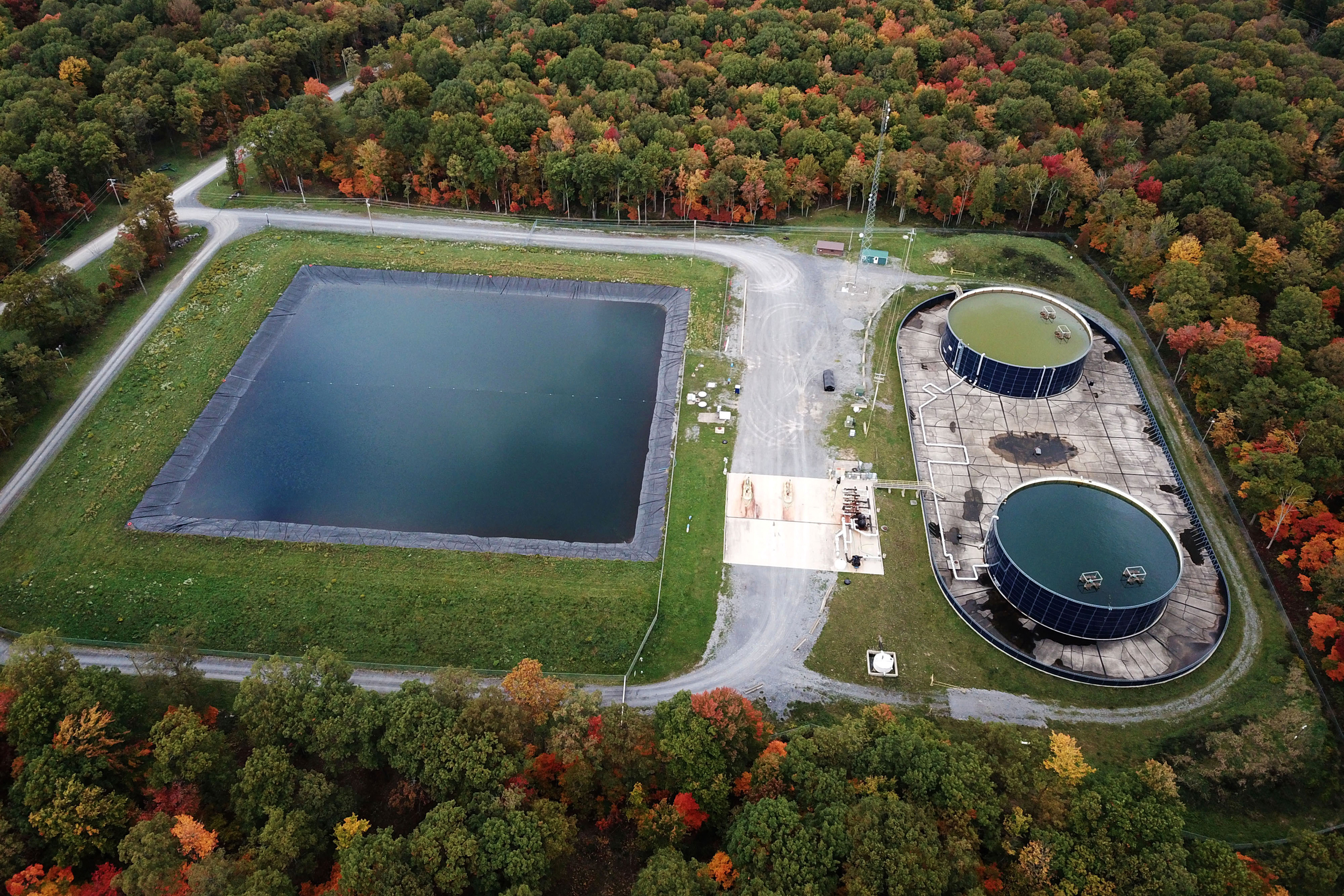


If you’re an ordinary resident of Pennsylvania and you want to dispose of potentially toxic waste, the Department of Environmental Protection will direct you to specialized dropoff locations: recycling programs or local events where officials collect things like propane tanks and pharmaceuticals.
If you’re in the oil and gas business, your options may become much more expansive this year. The DEP quietly issued a new permit in May that experts warn will make it easier for the industry to dump toxic, radioactive waste directly onto roadways.
“It’s ridiculous on its face, in my view,” said David Hess, a former DEP secretary who maintains the PA Environment Digest blog, tracking environmental actions across the state.
The new permit means companies could reclassify conventional, or non-fracked, oil and gas wells as “mineral brine” wells, which would allow them to sell radioactive wastewater as a product. It can then be spread across roads to control dust and eliminate ice in the winter. Any oil or gas produced from those wells could also be sold as waste.
Pennsylvania produces more gas than any other state in the nation besides Texas, and alongside that gas comes millions of gallons of toxic wastewater. This waste, also known as brine because of its high salt content, contains heavy metals and radioactive elements such as radium. For decades, “roadspreading,” slathering oil and gas wastewater across roads to de-ice them and reduce dust, spread pollutants throughout the state.
Even setting aside environmental and health concerns and the bizarre regulatory framework that undergirds this dumping, when it comes to reducing dust, the brine “doesn’t do what it purports to do,” said Charlie Palladino, a policy advocate at the environmental nonprofit Earthworks. Siri Lawson, a resident of Farmington Township in Warren County who blames exposure to oil and gas waste for her ongoing respiratory problems, was more direct: “It seemed to make the dust worse,” she said.
Academic research backs this up, suggesting that the wastewater controls dust no better than rainwater. It can also inadvertently damage paved roads, “turning them into something that looks like Swiss cheese,” said Hess.
A study from Penn State found that roadspreading releases roughly four times more radium into the surrounding environment than wastewater facilities and 200 times more than isolated spills. The practice was common until 2018, when Lawson filed an appeal with the state’s Environmental Hearing Board.
DEP officials came to the conclusion that they should use a stricter permitting system, suspending approvals for roadspreading statewide. That didn’t stop the practice entirely, though. Although the agency banned roadspreading wastewater from fracked wells, its efforts to place similar restrictions on conventional operators failed—in large part because of the political power these companies hold in Northwestern Pennsylvania. Conventional well owners could take advantage of a loophole: Waste could be designated a “coproduct,” comparable to commercial dust-suppression products, and sold.
Lawson has continued to document trucks dumping waste, describing the oily residue the water leaves behind, which sometimes tints the roads an eerie blue. At a 2024 state Senate hearing, Karen Feridun, co-founder of the environmental advocacy organization Better Path Coalition, testified that DEP records show over 3.5 million gallons of wastewater had been dumped on Pennsylvania roads between 2018 and 2024.
The DEP submitted testimony that staff had reached out to all operators who listed roadspreading as an end use for their wastewater in 2022 and 2023. As of 2023, only two operators still actively listed roadspreading as an end use, and neither responded to the DEP’s calls to halt operations. This is likely an undercount, said Hess, “because the [conventional well] industry just does not comply with anything. I mean, DEP itself issued a report in December 2022 that said this industry has a history of non-compliance.”
An August report from FracTracker Alliance found that roughly 70 percent of Pennsylvania’s conventional oil and gas wells reported oil and gas waste production but no waste—a massive gap in regulatory oversight, said Hess. When the DEP told a company called BCD Properties that its oil and gas wastewater was invalid as a coproduct, the company filed an appeal. The case was ultimately settled privately, but two weeks before the settlement, DEP issued the new permit that opened up another loophole.
BCD Properties was initially trying to sell wastewater from its Danylko 4 well in McKean County. The new permit issued for the Danylko 6 well is roughly 500 feet away—it draws from the same geologic formation and will still bring up oil and gas—but it’s been established as a “mineral brine” well. What this means is that the company will be able to sell brine as its primary product, then sell whatever oil and gas is extracted as “waste.”
The result is “extremely concerning,” said Palladino. In order to sell their brine, operators are expected to test it and decide on their own whether it’s comparable to commercial products and meets health and human safety standards—this is called a “coproduct designation.” When DEP began looking more closely at oil and gas companies’ coproduct designations, they found that none of the waste met basic safety thresholds. .
“So now this [permit] comes along, and it creates this artificial distinction between a waste brine … [and] this new category called mineral brine, when it’s the same stuff, coming from the same formation,” said Palladino.
BCD Properties did not respond to requests for comment from Inside Climate News, nor did the Pennsylvania Independent Oil and Gas Association. The trade group said last year that DEP has long conducted analysis of roadspreading and found it safe, only to change course in recent years.
Unless something changes, there is little to stop conventional operators across the state from reclassifying their oil and gas wells as brine wells. Wastewater treatment and underground injection wells are expensive—dumping brine on the road is much cheaper, and it’s often profitable when sold to local governments.
This story is funded by readers like you.
Our nonprofit newsroom provides award-winning climate coverage free of charge and advertising. We rely on donations from readers like you to keep going. Please donate now to support our work.
Donate NowIn response to questions from Inside Climate News, DEP said a brine well permit will not necessarily allow a company to roadspread. However, the agency told state senators at an October hearing that a company called Seneca Minerals Co. is a regulated brine well operator and has been roadspreading. Seneca had converted a spent oil well into a brine well in 2007.
DEP said it is drafting brine spreading regulations to clarify the process.
A spokesperson said the agency has not received any new applications for brine wells since the Danylko 6 well was permitted. But the Pennsylvania Grade Crude Development Advisory Council, a state advisory body that works on behalf of the oil and gas industry, specifically requested in an April meeting with the DEP that these mineral brine wells be permitted.
FracTracker filed an appeal and the Pennsylvania House Environmental & Natural Resource Protection Committee held a hearing on the matter in early October. This well was not entirely an anomaly, DEP explained. Seneca Mineral had been producing brine from three wells for roughly 70 years, 2.4 million gallons of which was spread across “dozens of municipalities” in 2025. The Danylko 6 well was permitted, DEP claimed, because there was “a concern that a well like that could be drilled with no regulatory oversight.”
“If I’m hearing your testimony correct—you really don’t have control over how this is going to be used,” Rep. Greg Vitali, a Democrat who represents parts of Delaware and Montgomery counties, said at the hearing. “My concern is, doesn’t this mineral brine permit just make it worse? You’re opening up this legitimate pathway for a substance that is identical in composition to something you’re prohibiting.”
Rep. Dallas Kephart, a Republican representing parts of Cambria and Clearfield counties, complained that well operators would not be able to afford to truck their waste to disposal sites, given the current cost of gasoline. Hess pointed out that was not an increased cost: Unless they were illegally dumping waste, they should already be trucking it to disposal sites.
Given DEP’s understaffing issues, Hess said, “they’re digging their hole that much deeper” by opening up a new category of wells to regulate. A December 2025 report from the Environmental Integrity Project found that DEP’s budget and staffing levels have failed to keep up with the natural gas boom over the past 20 years. Staffing numbers have stagnated as thousands of additional wells have been drilled. Enforcement actions, meanwhile, have dropped 57 percent from 2016 to 2024. As the agency’s testimony before the House Environmental Committee demonstrates, even when the department does issue enforcement actions, they are frequently ignored.
By permitting this mineral brine well, some experts say the department is codifying its own toothlessness into law. “There’s a generous interpretation of what DEP is trying to do, and then there’s the reality of years of underreporting, lack of enforcement and really just this open secret that illegal dumping of brine on Pennsylvania roadways—which one would have to assume impacts the waters of the commonwealth—has been happening at a pretty broad scale,” said Shannon Smith, executive director of FracTracker. “So how long do we want to keep being overly generous to DEP about the lack of getting a regulatory framework together?”
Scientists and policy experts have stressed for years that Pennsylvania’s handling of oil and gas waste is startling in its laxity. There is no good rationale to spread it across the land, Hess said, especially when the state already has a network of oil and gas waste disposal sites.
“There’s a reason we keep waste in places that are permitted specifically to handle waste,” said Palladino. “As opposed to just dumping it on public roads.”
About This Story
Perhaps you noticed: This story, like all the news we publish, is free to read. That’s because Inside Climate News is a 501c3 nonprofit organization. We do not charge a subscription fee, lock our news behind a paywall, or clutter our website with ads. We make our news on climate and the environment freely available to you and anyone who wants it.
That’s not all. We also share our news for free with scores of other media organizations around the country. Many of them can’t afford to do environmental journalism of their own. We’ve built bureaus from coast to coast to report local stories, collaborate with local newsrooms and co-publish articles so that this vital work is shared as widely as possible.
Two of us launched ICN in 2007. Six years later we earned a Pulitzer Prize for National Reporting, and now we run the oldest and largest dedicated climate newsroom in the nation. We tell the story in all its complexity. We hold polluters accountable. We expose environmental injustice. We debunk misinformation. We scrutinize solutions and inspire action.
Donations from readers like you fund every aspect of what we do. If you don’t already, will you support our ongoing work, our reporting on the biggest crisis facing our planet, and help us reach even more readers in more places?
Please take a moment to make a tax-deductible donation. Every one of them makes a difference.
Thank you,