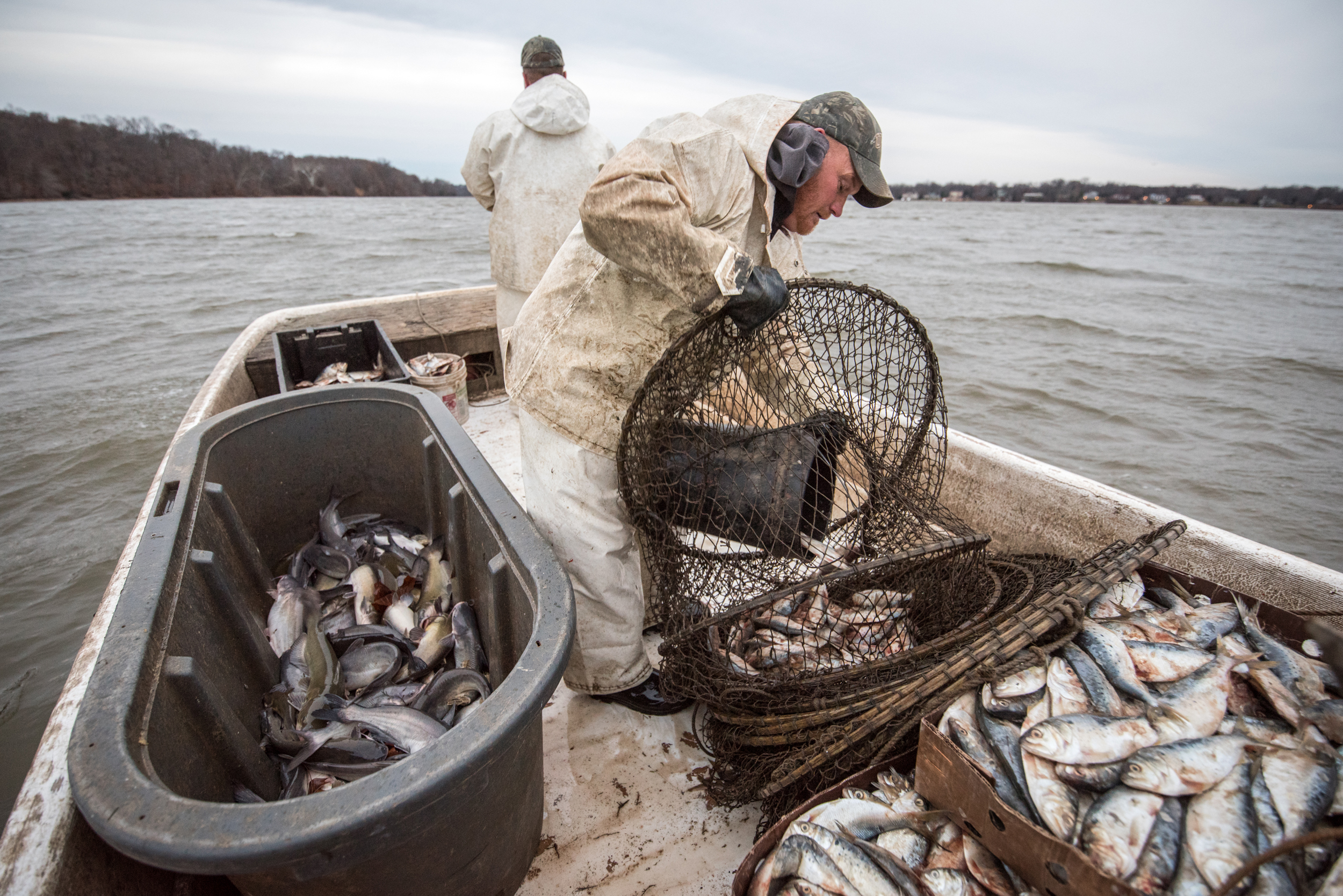


Atlantic fisheries managers this week agreed to lower the cap on industrial menhaden fishing in Chesapeake Bay but stopped well short of imposing deeper coastwide cuts.
At its annual meeting, held from Nov. 9–12 in Newport, Rhode Island, the Atlantic States Marine Fisheries Commission’s Menhaden Management Board reduced the coastwide catch limit by about 9 percent in 2027 and another 9 percent in 2028. The Chesapeake Bay cap was also reduced by 27 percent in 2027 and 34 percent by 2028.
Menhaden are small, oily fish that filter plankton and in turn feed predators along the coast, from ospreys to striped bass and bluefish. The Chesapeake Bay is a critical nursery for the species.
The multibillion dollar aquaculture industry has made the omega-3 and fatty acid-filled menhaden a prime commodity for producing fishmeal to feed farmed fish, fish oil and other products, a process known as reduction fishing.
Industrial fleets, aided by spotter planes and small aluminium chase boats, are deployed to encircle dense schools of menhaden with a vertical wall of netting, including in the lower Chesapeake Bay. Though researchers have not proven these industrial fleets are the cause of predators’ food depletion, some conservationists point to them as an important factor.
Ospreys’ declining population have become the most obvious warning sign.
As Inside Climate News previously reported, researchers have documented acute food stress and poor breeding performance in the Bay. The 2026 survey by the Center for Conservation Biology at William & Mary found that 81 percent of monitored nesting pairs in the Bay’s saltier waters failed to raise a chick this year. Ospreys in fresher parts of the Bay, where other fish are available, have fared better, according to Bryan Watts, the center’s director.
Under the new limits, the coastwide total allowable catch, covering the commercial fishery from Maine to Florida, including the Bay, will drop from 186,840 metric tons this year to 170,000 metric tons in 2027 and to 155,000 metric tons in 2028. That follows a 20 percent reduction in 2026.
The commission said it measured the ecological benefits of leaving more menhaden in the water against economic harm to harvesters and fisheries that rely on menhaden for bait.
But the commission’s projections paint a different picture. Its technical committee found that a 39 percent cut, to 114,200 metric tons in 2027, would give managers a 50 percent chance of meeting the ecological fishing target. That target is designed to leave enough menhaden to keep striped bass at healthy levels but does not account for ospreys or measure how many menhaden are available in the Bay.
The commission acknowledged that the new limits will very likely allow more fishing than the target. But it said they carry no risk of overfishing, which it measures against a looser limit that allows heavier fishing than the ecological target.
Actual catches are another point of contention. The commission’s fishery review puts last year’s commercial catch at just under 147,000 metric tons, below both of the new adopted limits. That means the 2027 limit leaves room for about 50 million pounds more than the industry caught last year.
In the Chesapeake Bay, the board tied the reduction fishery’s cap to 21.8 percent of the coastwide limit. That lowers the cap from 51,000 metric tons to 37,123 metric tons in 2027 and 33,847 metric tons in 2028. The cap cannot exceed 51,000 metric tons even if the coastwide limit rises, and the board decided to revisit it at least every three years. The Bay cap applies to reduction fishing, not the bait fishery, which catches menhaden to be used as bait for recreational and commercial fishing.
The new coastwide limit will go into effect on Jan. 1, 2027, while the Bay cap takes effect May 1.
This story is funded by readers like you.
Our nonprofit newsroom provides award-winning climate coverage free of charge and advertising. We rely on donations from readers like you to keep going. Please donate now to support our work.
Donate NowThe board did not adopt seasonal quota periods, which supporters said would spread the Bay harvest across the fishing season and ease pressure on menhaden while ospreys feed their chicks. Debate over whether to redistribute the coastwide quota among states was put off until January.
Virginia holds about 75 percent of the coastwide quota and is home to the Atlantic coast’s only active menhaden processing plant. Maryland, North Carolina, Florida, Connecticut, Massachusetts, Rhode Island and New York backed deeper coastwide cuts, according to the nonprofit Theodore Roosevelt Conservation Partnership, but they were outvoted.
In the Bay, the majority of the menhaden fishing is done by Ocean Harvesters, which supplies Omega Protein’s processing plant in Reedville.
In emailed comments, a spokesperson from Ocean Harvesters said the company was disappointed with the cuts.
“[T]he consequences will be felt by the fishermen, processing workers and families who depend on the fishery, as well as businesses,” he said. “The commission should have allowed the newly funded research to proceed before imposing additional restrictions.”
The representative disagreed that the commission’s decisions to impose new catch limits struck the right balance, and questioned “whether additional restrictions will produce the benefits being claimed.” The company said it supports ongoing research and will keep working with scientists to better understand menhaden in the Bay, adding that its future depends on a healthy bay and a sustainable fishery.
The commission’s latest assessment, based on data through 2023, found menhaden are not overfished along the coast. But it acknowledged it lacks the data to say how many menhaden are in the Bay or how fishing affects the population.
The Chesapeake Bay Foundation has pointed to falling catches in Maryland, Potomac River and Virginia waters as examples of low menhaden availability. Chris Moore, CBF’s Virginia executive director, said menhaden caught in the Bay are younger and lighter than they used to be, a sign of a population under stress.
“While we are encouraged by the Chesapeake Bay cap reductions in particular, this was unfortunately another year of the ASMFC failing to manage menhaden according to its own ecosystem-based science,” said Jaclyn Lunaas, forage fish program manager for the Theodore Roosevelt Conservation Partnership.
Allison Colden, the Chesapeake Bay Foundation’s Maryland executive director and a Maryland representative on the menhaden board, criticized her fellow board members for rejecting seasonal quota periods. “Reducing the Bay cap overall is a significant win and a step in the right direction,” she said. “But it still leaves the door wide open for the industry to catch everything in the three-week time period in the summertime when both our fisheries and our predators really need it.”
Virginia has approved $2 million over two years for menhaden research to inform a scientifically tested Chesapeake Bay harvest cap. Moore said his foundation will keep pressing Virginia lawmakers to put observers on fishing vessels. Earlier this year, Congress approved $2.5 million for Bay-specific research that could inform future management decisions.
About This Story
Perhaps you noticed: This story, like all the news we publish, is free to read. That’s because Inside Climate News is a 501c3 nonprofit organization. We do not charge a subscription fee, lock our news behind a paywall, or clutter our website with ads. We make our news on climate and the environment freely available to you and anyone who wants it.
That’s not all. We also share our news for free with scores of other media organizations around the country. Many of them can’t afford to do environmental journalism of their own. We’ve built bureaus from coast to coast to report local stories, collaborate with local newsrooms and co-publish articles so that this vital work is shared as widely as possible.
Two of us launched ICN in 2007. Six years later we earned a Pulitzer Prize for National Reporting, and now we run the oldest and largest dedicated climate newsroom in the nation. We tell the story in all its complexity. We hold polluters accountable. We expose environmental injustice. We debunk misinformation. We scrutinize solutions and inspire action.
Donations from readers like you fund every aspect of what we do. If you don’t already, will you support our ongoing work, our reporting on the biggest crisis facing our planet, and help us reach even more readers in more places?
Please take a moment to make a tax-deductible donation. Every one of them makes a difference.
Thank you,

Aman Azhar
Reporter, Washington, D.C.
Aman Azhar is a Washington, D.C.-based journalist who covers environmental justice for Inside Climate News with focus on Baltimore-Maryland area. He has previously worked as a broadcast journalist and multimedia producer for the BBC World Service, VOA News and other international news organizations, reporting from London, Islamabad, the United Arab Emirates and New York. He holds a graduate degree in Anthropology of Media from University of London’s School of Oriental and African Studies (SOAS) and an MA in Political Science from the University of the Punjab, and is the recipient of the Chevening scholarship from the UK government and an academic scholarship for graduate studies from the Australian government.