

ATTALLA, Ala.—April Phillips is worried about her brother Bubba.
The 46-year-old has cerebral palsy and epilepsy and sometimes suffers from difficulty breathing. So when her two-year-old grandson’s preschool messaged to tell her the facility was closing due to smoke from a nearby fire, she fretted not only about the child, but also her brother.
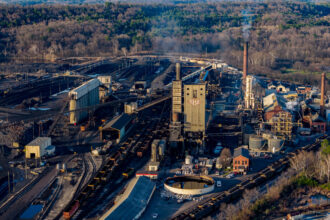
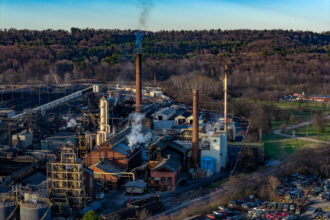
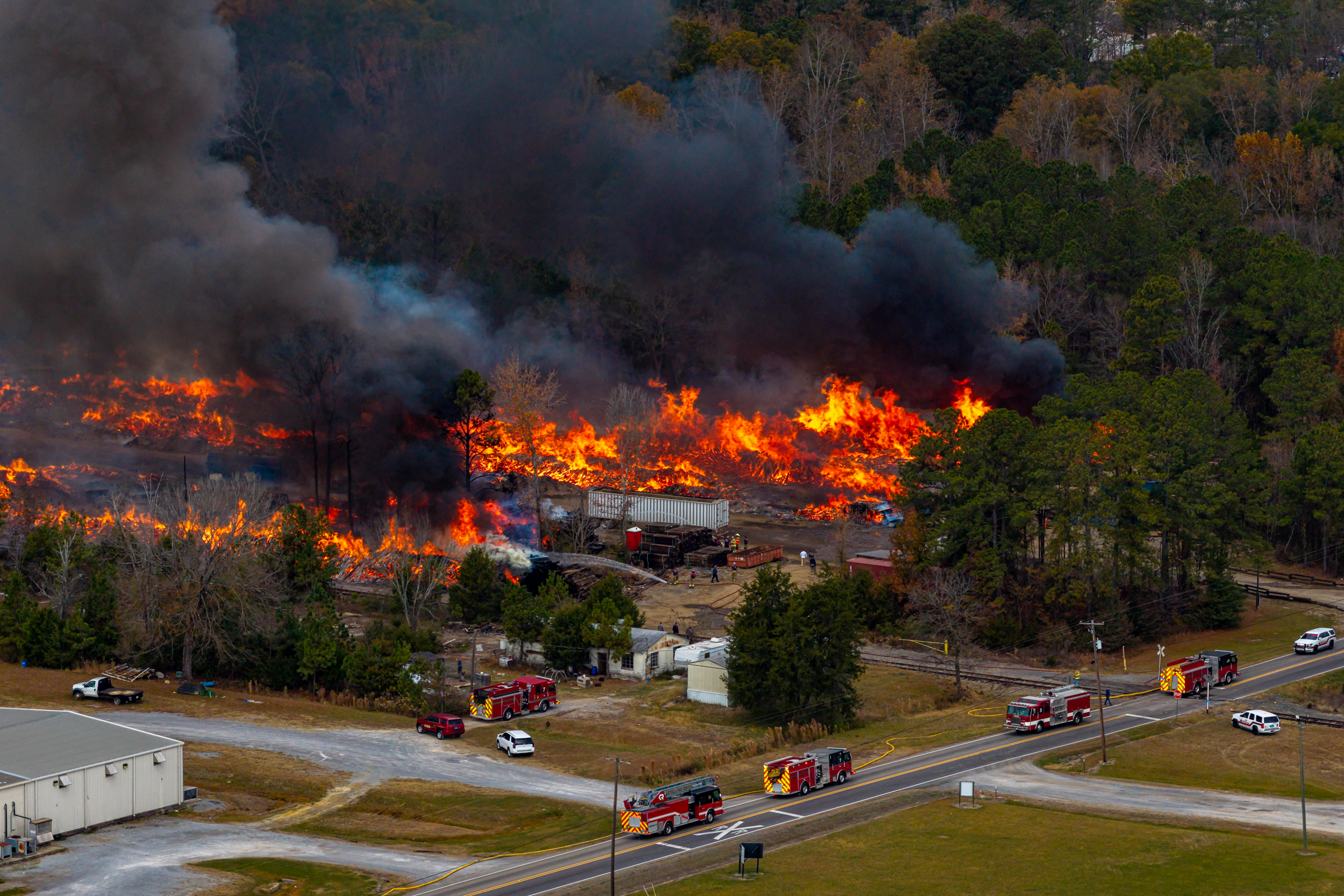
The blaze, she would soon find out, was less than a mile from her home, at a wood processing facility owned by a company called Omaha Track. Just outside, thick, dark smoke rose above the towering pines of Attalla, a town of less than 6,000 people.
Phillips’ worry kicked into overdrive. No public officials had directly informed her family about the plume of smoke billowing through her community. She checked social media. Local officials were saying that an evacuation of residents within a mile had been ordered. Phillips was confused.
“They ain’t told none of us nothing,” Phillips said. “And here we are sitting here and breathing it.”
Jim Slick, director of the Etowah County Emergency Management Agency, said the fire started in a yard where used railroad ties were being stored before being ground into chips of biomass.
Omaha Track and similar companies take wood products, often treated with chemicals, and process and sell them to be burned as industrial fuel. While the industry has billed its products as a renewable energy source because trees and other organic matter can be regrown, environmentalists have critiqued the carbon-intensive practice as “burning trees to save the planet.”
According to its website, Omaha Track’s Attalla facility receives and processes more than 200,000 tons of railroad ties each year. The company could not immediately be reached for comment.
Lynn Battle, chief spokesperson for the Alabama Department of Environmental Management, said in an e-mail Thursday evening that while the overall size of the blaze had been reduced, the fire is ongoing. Several fire departments are applying water to some areas of the site that can be safely reached, she wrote, but there is no significant runoff from the site.
An evacuation order was lifted Thursday afternoon, local officials said.
Slick, the EMA director, said Thursday he believes there to be “very minimal danger to the surrounding areas, if any danger at all.”
“As it is right now, they are burning, but the surrounding areas, the neighborhoods around the yard, so to speak, are safe,” he said.
Tabitha Brown, a certified nursing assistant who lives near the fire, said she was having difficulty breathing after only a few minutes outside Thursday morning and doesn’t believe the fire poses no health risks.
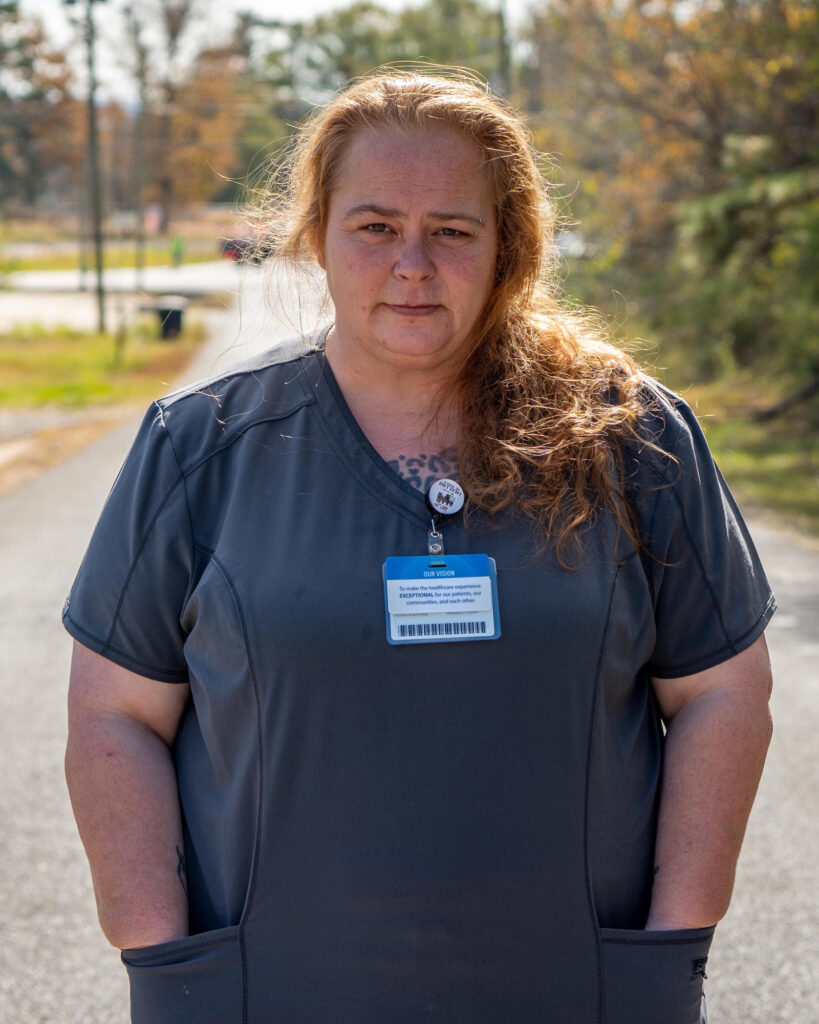
Brown said she suffers from asthma and that those with existing respiratory illnesses often find even limited exposure to air pollution irritating.
“And we haven’t heard anything about what we’re supposed to do,” Brown said.
Fires of all types lead to air pollution that can cause and exacerbate health issues, according to health experts. Exposure to air pollution from a fire where a chemical like creosote or diesel fuel is burned could lead to additional risks.
Creosote is the name given to a wide variety of products commonly used to protect railroad ties and utility poles from pests and rot.
It can be derived from coal tar, the most widely used source, or wood, according to the U.S. Centers for Disease Control and Prevention. Creosote from coal tar contains a number of potentially harmful chemicals and known carcinogens. Many different creosote products in use may contain various chemical formulations.
The CDC says that “long-term exposure of workers to creosote has been shown to increase cancer in several tissues, including the respiratory tract, skin, lung, pancreas, kidney, scrotum, prostate, rectum, bladder, and central nervous system.”
According to a 1984 technical report prepared by the EPA, burning creosote released potentially hazardous chemicals into the air, including benzo(a)pyrene and dibenzo(a,h)anthracene, pyrene and fluoranthene. The authors found the emissions were roughly 40 percent as potent as coke oven emissions.
Residents living near biomass fuel facilities across the country have repeatedly reported health issues, even from normal facility operations.
Still, Slick said he’s not overly concerned about impacts to residential areas near the fire.
“We looked it up in all of the different manuals and books that we have to look up hazards and things like that, and there’s no—other than if you’re right there involved in the smoke and stuff right on the site, now there would be some inhalation hazards, but the firefighters are using their SCBAs, the self-contained breathing apparatuses, so they’re protected,” Slick said.
This story is funded by readers like you.
Our nonprofit newsroom provides award-winning climate coverage free of charge and advertising. We rely on donations from readers like you to keep going. Please donate now to support our work.
Donate NowScot Quaranda, communications director for environmental nonprofit Dogwood Alliance, said it’s simply not believable that a fire of this scale doesn’t put residents’ health at risk.
“I don’t know what ‘manuals and books’ they’re reading, but that’s not a little-to-no impact fire,” Quaranda said of local officials in Etowah County. “There’s no way this won’t have health impacts.”
Quaranda said Thursday’s fire is the latest example of an industry that has serious negative consequences for the communities where their industrial plants are located.
“There are countless examples of these facilities that are backed up to neighborhoods and are just not showing the kind of care and safety that they should,” Quaranda said.
Telling the public there is little to no risk to public health is irresponsible, he said: “It seems like a complete disregard for human health.
Smoke from the fire in Attalla has blown well beyond the immediate area of the incident. Emergency management officials in adjacent St.Clair County warned residents to be wary of outdoor activities as first responders fight the flames.
“There are no evacuations ordered in St. Clair County, but those who suffer from respiratory issues may want to avoid being outside while the smoke is in the area,” the agency told a local television station.
Slick said that it will be difficult to completely extinguish the fire, which has reached railroad ties and two diesel fuel tanks.
“I don’t know that they’ll ever get it completely put out because of the amount of cross ties that’s burning, but they can definitely get it under control and be able to manage it a little bit better,” he said.
Omaha Track has been at the center of controversy before over its rail tie biomass facilities.
In 2023, a Nevada news outlet reported that a facility owned by Omaha Track was under investigation for violating several conditions of its operating permit, including having too many rail ties on site, stacking ties too high and failing to meet all requirements imposed by the local fire marshal. A company representative told the news outlet it believed it had complied with the permit requirements.
In 2024, a Wisconsin Omaha Track facility caught fire, leaving first responders struggling to fight what they said was a nearly inextinguishable blaze.
State records show that a staffer with the Alabama Department of Environmental Management inspected the company’s Alabama facility in September following an anonymous complaint that the company was illegally covering spills of fuels and oils with dirt on the site. The inspector wrote in a report that they could not substantiate the claims.
Like Brown and Phillips, Rebecca Riihimaa said she didn’t hear anything about the incident from public officials or law enforcement. She had already sent her children to the bus stop when she found out about the fire and the school cancellations.
“We didn’t hear a siren, weren’t alerted and haven’t been told to evacuate,” Riihimaa said. “The fact that no one came to our neighborhood to warn us is alarming.”
Phillips said she and other family members began planning for the worst when they heard about the smoke. The news brought back memories of a 2019 warehouse fire in the same small town that left ash falling from the sky onto Phillips’ home. Back then, water pressure in the town was nearly nonexistent as first responders fought the inferno.
Phillips had learned her lesson.
So, on Thursday she bought as much drinking water as she could find. Then, she and her loved ones started brainstorming how they would transport her brother Bubba if it came to that.
“My best friend said we can get him into a pickup if we need to,” Phillips said, her brow furrowed with worry. “We may just have to call an ambulance.”
About This Story
Perhaps you noticed: This story, like all the news we publish, is free to read. That’s because Inside Climate News is a 501c3 nonprofit organization. We do not charge a subscription fee, lock our news behind a paywall, or clutter our website with ads. We make our news on climate and the environment freely available to you and anyone who wants it.
That’s not all. We also share our news for free with scores of other media organizations around the country. Many of them can’t afford to do environmental journalism of their own. We’ve built bureaus from coast to coast to report local stories, collaborate with local newsrooms and co-publish articles so that this vital work is shared as widely as possible.
Two of us launched ICN in 2007. Six years later we earned a Pulitzer Prize for National Reporting, and now we run the oldest and largest dedicated climate newsroom in the nation. We tell the story in all its complexity. We hold polluters accountable. We expose environmental injustice. We debunk misinformation. We scrutinize solutions and inspire action.
Donations from readers like you fund every aspect of what we do. If you don’t already, will you support our ongoing work, our reporting on the biggest crisis facing our planet, and help us reach even more readers in more places?
Please take a moment to make a tax-deductible donation. Every one of them makes a difference.
Thank you,

Lee Hedgepeth
Reporter, Alabama
Lee Hedgepeth is Inside Climate News’ Alabama reporter. Raised in Grand Bay, Alabama, a small town on the Gulf Coast, Lee holds master’s degrees in community journalism and political development from the University of Alabama and Tulane University. Lee is the founder of Tread, a newsletter of Southern journalism, and has also worked for news outlets across Alabama, including CBS 42, Alabama Political Reporter and the Anniston Star. His reporting has focused on issues impacting members of marginalized groups, including homelessness, poverty, and the death penalty. His award-winning journalism has appeared in publications across the country and has been cited by the New York Times, the Wall Street Journal and the Washington Post, among others.

Dennis Pillion
Reporter, Alabama
Dennis Pillion is a reporter for Inside Climate News based in Alabama. He joined ICN in 2024 after 17 years working for Alabama Media Group, including nine as the statewide natural resources reporter. His work for AL.com and The Birmingham News, won numerous Green Eyeshade and Alabama Press Association awards for his coverage of environmental issues in Alabama. He was born and lives in Birmingham, Ala.