

The most critical parts of the East Side Coastal Resiliency Project’s flood protection system may be the ones New Yorkers will never see.
In the new John V. Lindsay East River Park in lower Manhattan, engineers have been working on an ambitious challenge: protecting the park and surrounding neighborhoods from coastal flooding.
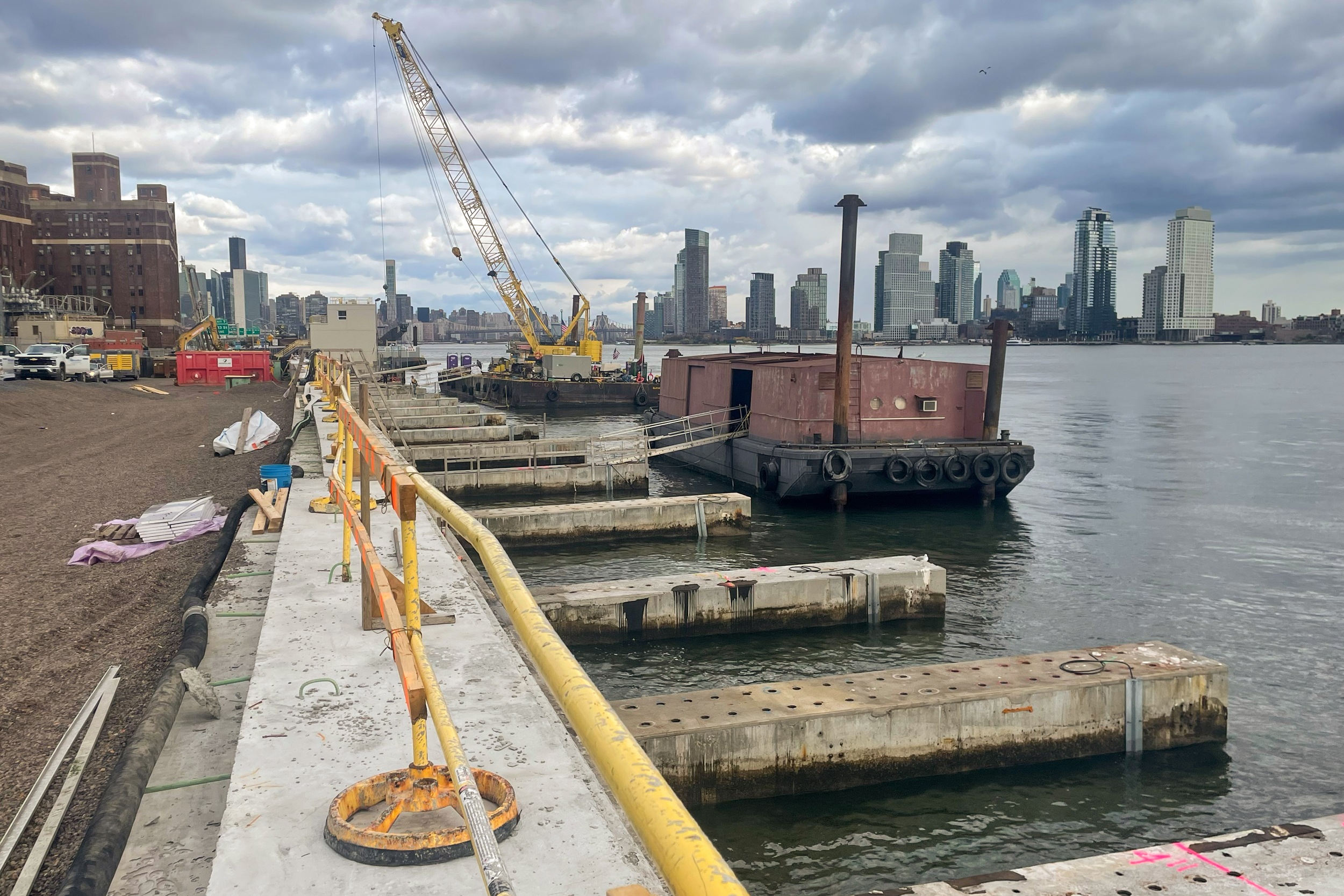
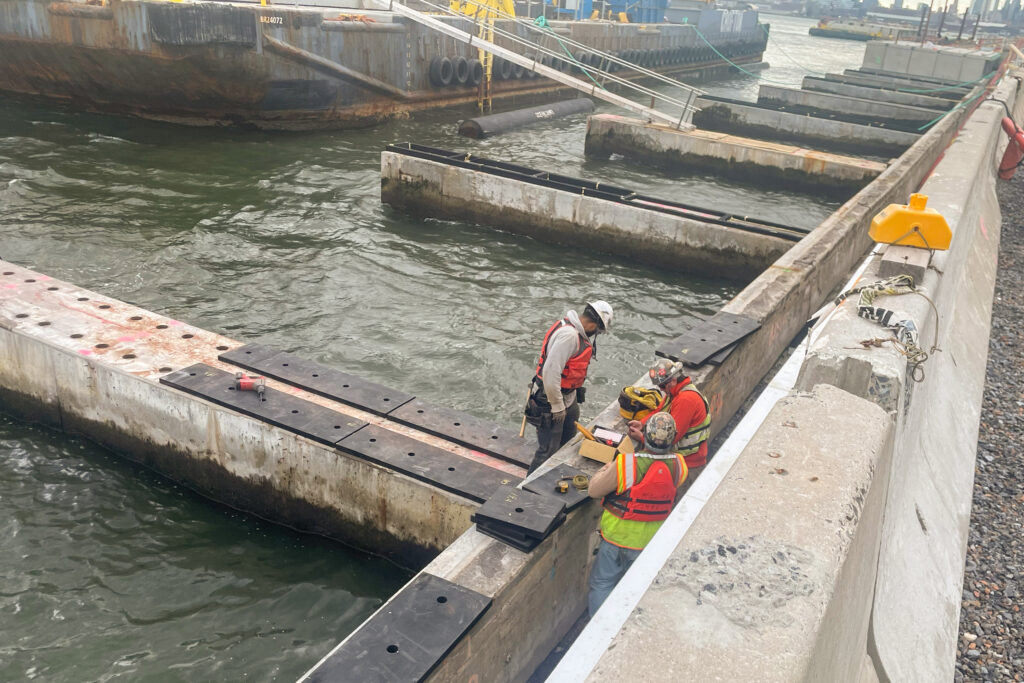
Beneath a 2-foot-thick concrete wall designed to hold back coastal flooding, steel structures extend deep underground, anchoring the barrier and helping prevent water from finding a way underneath it.
Depending on the location, engineers supported the wall with steel sheets driven into the ground or large underground pipes. The latter were used in areas where existing utility lines prevented the installation of a continuous barrier, explained Eric Ilijevich, a director at the city’s Department of Design and Construction.
But keeping floodwater from flowing over the wall is only part of the challenge. Water can also seep through the soil beneath it. To prevent this, engineers installed underground barriers using a technique called jet grouting, which involves injecting cement-based material into the ground to seal gaps.
The greatest danger is not seepage during a single storm, but the cumulative damage caused by repeated flooding. Over time, water moving through the soil could erode the ground supporting the wall, potentially undermining the entire structure.
The system, nearing completion, is designed to protect against flooding up to 16.5 feet above sea level, but engineers built in an additional two feet of protection, bringing it to 18.5 feet in case the team “was wrong in their projection,” said Joseph G. Lione, associate commissioner for coastal resiliency at the Department of Design and Construction of New York City.
The East Side Coastal Resiliency Project, which extends from East 25th Street along the East River to Montgomery Street, between the Williamsburg and Manhattan Bridges, was developed in response to the devastation caused by Hurricane Sandy in 2012, when a storm surge flooded large parts of Lower Manhattan, including the neighborhoods surrounding East River Park. The disaster exposed the vulnerability of the city’s waterfront communities to coastal flooding, a threat expected to grow as sea level rises.
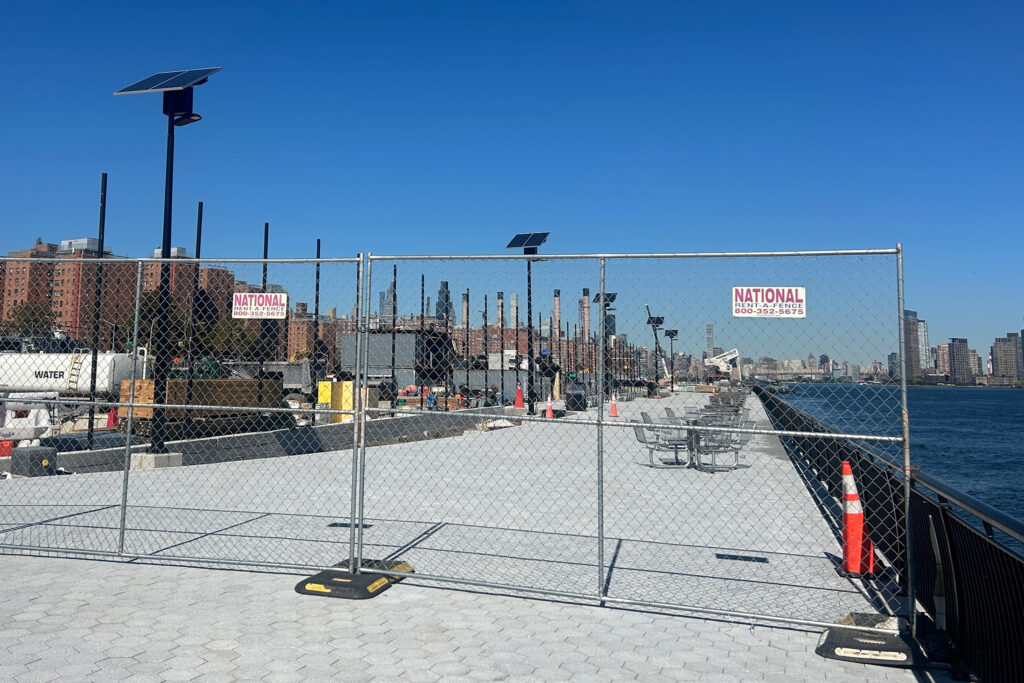
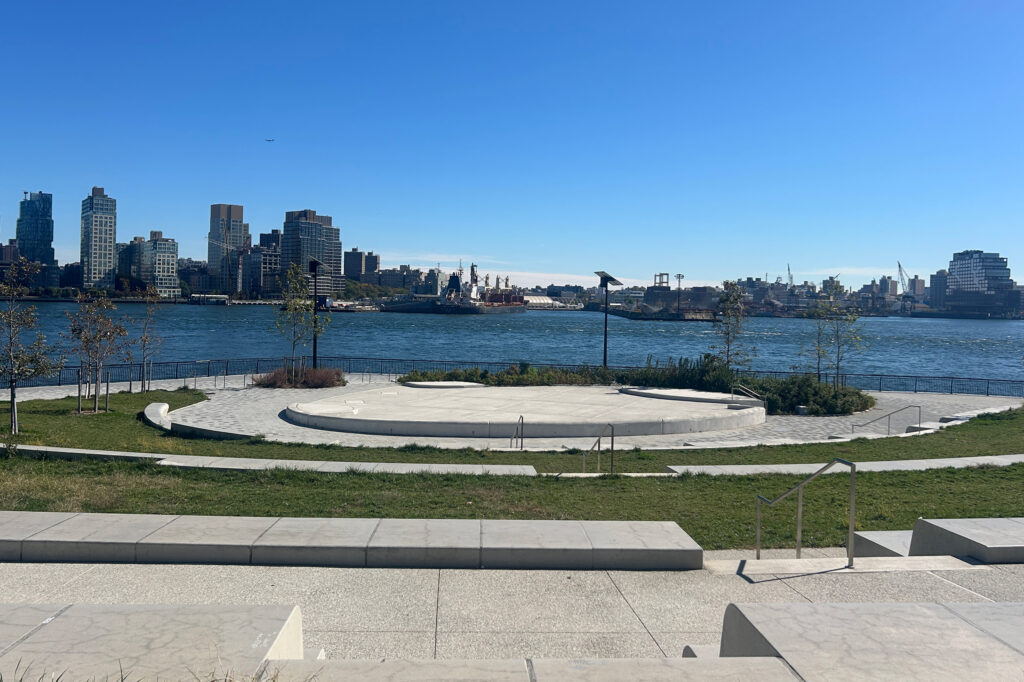
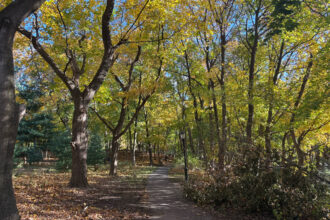
A view of East River Park in Lower Manhattan in October, where newly renovated sections have reopened to the public while construction continues as part of the East Side Coastal Resiliency project. Credit: Alissa de Chassey/Inside Climate News
The $1.45 billion project aims to protect approximately 110,000 New Yorkers on Manhattan’s East Side from coastal flooding. It involves raising sections of East River Park by 8 to 10 feet and installing a system of floodwalls, berms and movable floodgates along the waterfront on either side of the elevated park.
Construction began in 2020 and is expected to be completed in 2027. Right now, only the northern section of the park is still under construction. “We’ve successfully completed over $1 billion” in construction, said Lione.
More than half of the park has now reopened to the public. Lione said the city was required to keep at least 41 percent of the park open throughout construction.
“They did a good job at keeping the park open,” said Wendy Brawer, a member of the Community Advisory Group and director of Green Map System, a sustainability nonprofit.
Raising the park has also improved accessibility by bringing it roughly to street level, as the city built bridges for better pedestrian access from the Lower East Side. “If the water rises, it will go on the steps; the park is now too high to be flooded,” said Lione.
The rebuilt park will also feature a continuous bike lane, “which the community really wants,” said Lione.
This story is funded by readers like you.
Our nonprofit newsroom provides award-winning climate coverage free of charge and advertising. We rely on donations from readers like you to keep going. Please donate now to support our work.
Donate NowThe project also relies on an extensive flood-protection system, much of it hidden beneath the rebuilt park.
The East Side Coastal Resiliency Project first took shape twelve years ago, in 2014.
But in 2018, the city announced a major redesign that would require raising and rebuilding much of East River Park. The decision sparked fierce opposition from residents and environmental activists, who opposed the destruction of mature trees and the prolonged loss of access to one of the neighborhood’s few green spaces during construction. “It was difficult to start with activists a few years ago,” Lione remembers.
Despite protests and legal challenges, construction began near East 25th Street, at the northern end of the project, before reaching East River Park in December 2021. “Now, we have very little pushback,” said Lione. “People understood what it was for.”
But opposition to the project has not disappeared.
“We still exist,” said Pat Arnow, co-founder of the East River Park Action, one of the major community advocacy groups that has opposed the city’s redesign of the park since 2018.
Arnow is no longer calling for a different flood-protection plan, although she maintains that “they could have provided the same amount of flood protection without destroying the entire park.”
For East River Park Action, the main concern is now the lack of shade in the rebuilt park following the removal of mature trees. The newly planted trees are still small, offering little protection from the sun. A few umbrellas provide some shade, but large stretches of the park remain exposed, with concrete surfaces absorbing heat.
“Those little umbrellas don’t do too much,” Arnow said. Brawer estimates that it will take 40 years for the new trees to provide comparable benefits.
New York City plans to plant 2,000 trees, said Lione. So far, the construction team planted about 600.
Lione said many of the removed trees were in poor condition because of exposure to saltwater from the East River. This is something Arnow believes is not true: “We have proof that they were growing,” she said.
Amy Burkoff is a retired biology professor at the City College of New York. But a few years ago, her job was “to document biodiversity in the park,” she said.
After understanding that the city’s redesign would require extensive tree removal, she worked with one of her students to measure what’s called the diameter at breast height, a standard forestry measurement for tracking tree growth. They compared their 2021 measurements with those recorded in 2015.
Burkoff and the student used the city’s own 2015 tree inventory, published as an appendix to the project’s environmental impact statement. Of the 28 trees they were able to compare, most had grown between 2015 and 2021, with an average increase in trunk diameter of slightly more than two inches, Burkoff said. “There is no evidence that these trees are sick and dying,” she said. “In my humble opinion, that was a lie.”
Ilijevich said that even the original design would have required removing 700 trees. He acknowledged that the city had failed to clearly explain the scale of the planned tree removal and why engineers believed alternative approaches would not provide the desired level of flood protection. “We hadn’t communicated the extent to which we were going to do a significant amount of tree removal, even with that original plan,” he said. The city is now planting more than 50 tree species, prioritizing native varieties and those better suited to future environmental conditions. Ilijevich said this diversity will make the park more resilient over time.
Brawer believes the redesign should have given greater consideration to rising temperatures and extreme summer heat. For her, accessibility goes beyond simply being able to enter the park. “If you can’t use the park because it’s too hot, I would call that inaccessible,” she says.
The demolition of a historic fireboat house was another source of concern for advocacy groups. House to the Lower East Side Ecology Center, which had been deemed eligible for historic designation, it had to be destroyed.
“They’ve already been out of their home since December of 2021,” said Arnow.
The foundation below the house was damaged, which forced the team to demolish it. “It was not a decision we made lightly. We did extensive consideration to try to preserve it or relocate it, and it just did not seem cost-reasonable,” said Ilijevich.
The city plans to build a replacement facility for the Lower East Side Ecology Center.
Some Lower East Side residents continue to question the city’s approach. They argue that the original park helped absorb floodwater during storms, including Hurricane Sandy. Ilijevich, however, argued that raising the park was necessary to protect surrounding neighborhoods from coastal flooding. “You have to think about infiltration rates and flow rates,” he says. Addressing the argument that the original park could absorb floodwater, “that’s not a realistic assessment of what happens during a coastal storm event. The park could absorb some of the energy, but it could not absorb the massive flow of flood water that I think people in their minds think.”
Both Ilijevich and Lione expect construction to be completed in 2027.
About This Story
Perhaps you noticed: This story, like all the news we publish, is free to read. That’s because Inside Climate News is a 501c3 nonprofit organization. We do not charge a subscription fee, lock our news behind a paywall, or clutter our website with ads. We make our news on climate and the environment freely available to you and anyone who wants it.
That’s not all. We also share our news for free with scores of other media organizations around the country. Many of them can’t afford to do environmental journalism of their own. We’ve built bureaus from coast to coast to report local stories, collaborate with local newsrooms and co-publish articles so that this vital work is shared as widely as possible.
Two of us launched ICN in 2007. Six years later we earned a Pulitzer Prize for National Reporting, and now we run the oldest and largest dedicated climate newsroom in the nation. We tell the story in all its complexity. We hold polluters accountable. We expose environmental injustice. We debunk misinformation. We scrutinize solutions and inspire action.
Donations from readers like you fund every aspect of what we do. If you don’t already, will you support our ongoing work, our reporting on the biggest crisis facing our planet, and help us reach even more readers in more places?
Please take a moment to make a tax-deductible donation. Every one of them makes a difference.
Thank you,

Alissa de Chassey
Fellow
Alissa de Chassey is a French journalist and a fellow at Inside Climate News. Previously, she covered science and health for Le Figaro in Paris. She is currently pursuing a master’s degree in Science, Health, and Environmental Reporting at New York University. Her work has also appeared in Nature, The Guardian, and The Transmitter.