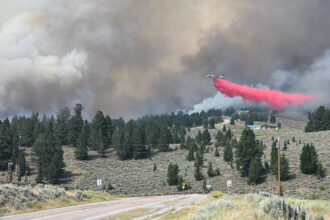


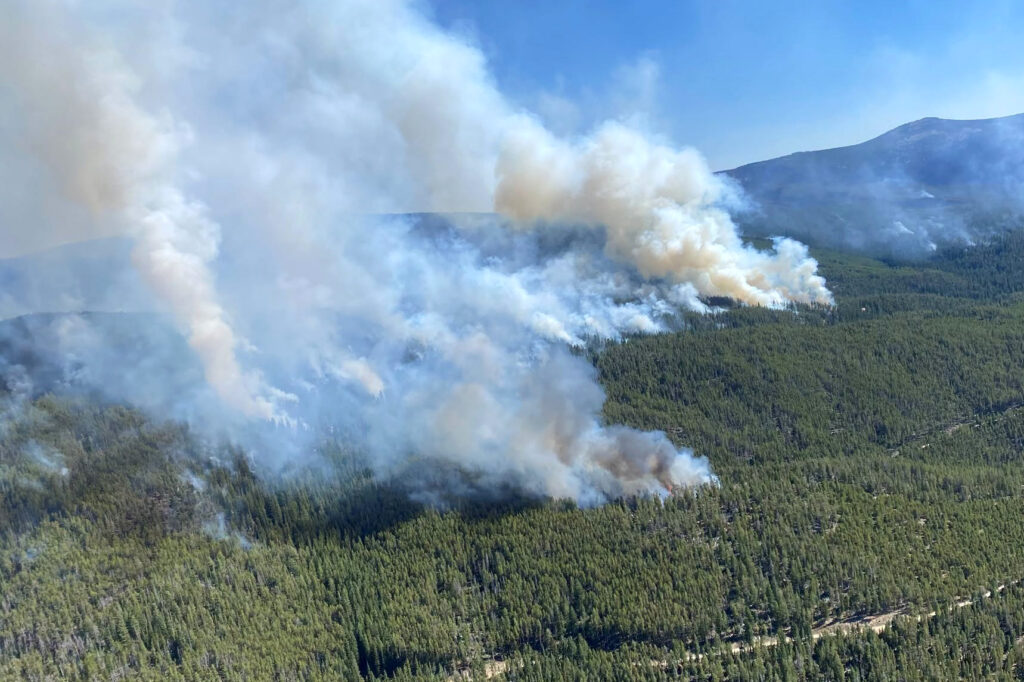
About a month ago, two wildfires ignited a day apart in southwest Montana. The Bobcat Lakes Fire started July 31 near Wise River, followed by the Sand Creek Fire on Aug. 1 near Wisdom.
Now, crews working to contain them are intentionally setting fire to vegetation in areas where steep, densely timbered terrain makes direct attack too dangerous.
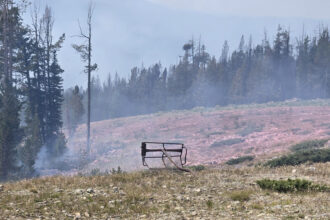
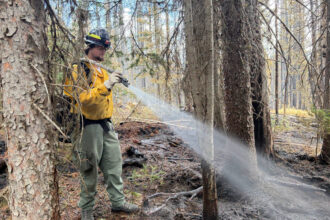
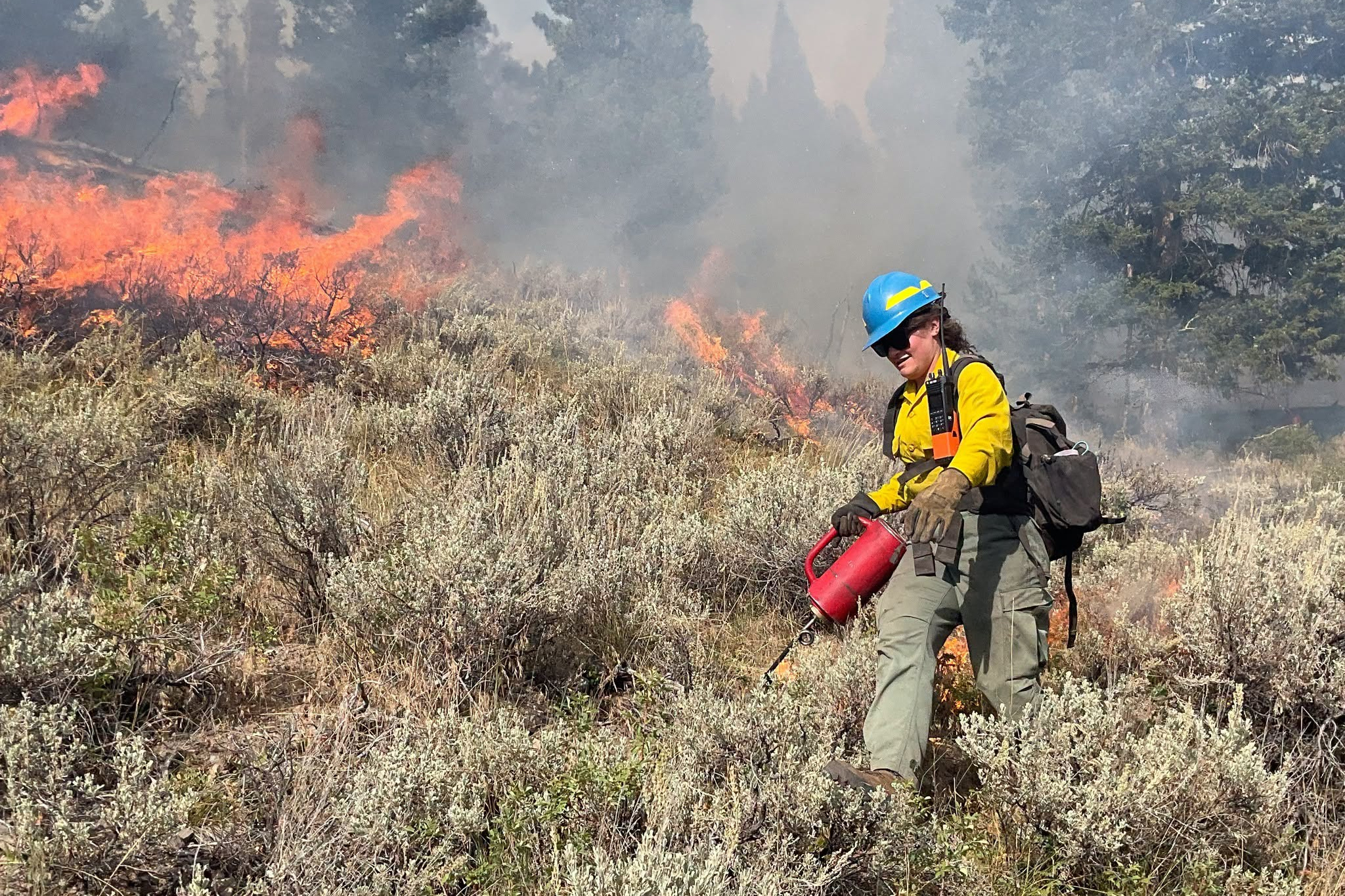
The tactic, known as strategic firing, is being used where crews cannot safely work directly along portions of the active fire edge. Firefighters work from roads, trails or control lines they’ve dug and intentionally burn vegetation between those lines and the main fire. The U.S. Forest Service describes this type of burnout operation as an indirect firefighting tactic used to help contain wildfires.
On Aug. 31, crews conducted firing operations on the northwest side of the Sand Creek Fire. The operations increased smoke production, according to the incident management team. Cold air and southeasterly winds caused smoke to settle into the Big Hole Valley overnight and into the following morning.
Mariah Leuschen-Lonergan, fire communications lead for the U.S. Forest Service’s Northern Rockies Fire & Aviation Management program, said some sections of the Sand Creek and Bobcat Lakes fires are burning in steep, densely timbered terrain that is difficult for firefighters to safely enter and leave.
Intentionally burning vegetation between the fires “removes the fuel before the main fire gets there, so when the fire edge reaches the burned-out area, there’s nothing left to carry it forward,” Leuschen-Lonergan said in an email response to Inside Climate News.
She said the approach gives crews a safer place to work and can help protect private property in the path of the fire.
Firefighters consider safety and threatened property or infrastructure when deciding whether to use a firing operation, Leuschen-Lonergan said.
Terrain, vegetation, current fire behavior and weather also influence where and when the operations are conducted.
“Firing is one tool among several for building and securing control lines,” she said.
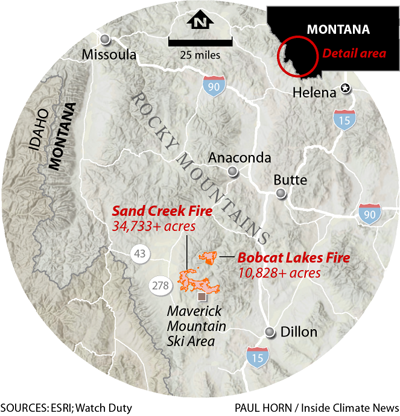
Fire officials have not specified how much of the reported 45,561 acres burned by both fires resulted from strategic firing operations.
Fire officials said they are working on a very rough estimate and will share it as soon as possible.They confirmed that acres burned during firing operations are included in the reported total acreage of each fire.
On the Sand Creek Fire, crews have been using a combination of direct and indirect control lines. Along the western side, firefighters were preparing the Steel-Fox Road as a control line and using hand firing operations to burn pockets of heavy fuels and bring that fire toward established control lines, according to the latest incident update.
Large amounts of dead and downed timber in the southwest portion of the blaze has challenged firefighters. Fire officials said the probability of holding a control line there was very low, prompting crews to scout locations to dig control lines away from the active fire edge, where firefighters could work more safely.
Leuschen-Lonergan said fire managers, in deciding when to intentionally burn downed limbs and vegetation, examine temperature, humidity, wind speed and direction and the moisture level of available fuels, including grass, needles, twigs, branches and brush, as well as heavier logs on the ground.
An incident meteorologist assigned to the fire provides forecasts for the specific location. Fire behavior analysts, operations personnel and the meteorologist evaluate the conditions before a firing operation is approved and carried out.
“No two fires, or even two spots on the same fire, are identical,” Leuschen-Lonergan said.
Crews conduct firing operations when conditions allow vegetation to burn at an intensity they can manage. Wind direction and speed are monitored during the operation to reduce the possibility that the fire will move toward homes or increase in intensity.
If conditions are not suitable, the operation does not proceed.
Rain can also affect the operations. If fuels become too wet to burn effectively, crews may postpone the work until conditions change.
This story is funded by readers like you.
Our nonprofit newsroom provides award-winning climate coverage free of charge and advertising. We rely on donations from readers like you to keep going. Please donate now to support our work.
Donate NowLeuschen-Lonergan said the challenges are not limited to firing operations.
“It’s not firing operations specifically that are getting harder, it’s fire operations in general, and there are many elements involved in those challenges,” she said.
“Fire seasons seem to be running longer. Fuel loads and standing dead trees are heavier in many areas, which makes direct attack, usually our safest option, harder to use.”
She said those conditions can result in greater reliance on suppression methods that keep firefighters farther away from the wildfire.
“We lean on indirect tactics like firing operations more often,” she said.
Development in wooded areas is another factor, Leuschen-Lonergan said, reducing the number of locations where firefighters can safely engage a fire.
Weather conditions could present additional challenges for firefighters in southwest Montana.
The Sept. 1 incident update forecast high temperatures of between 73 and 79 degrees and minimum relative humidity between 19 and 24 percent. Thunderstorms were expected during the afternoon and evening.
Fire activity was expected to increase because of dry air and atmospheric instability, according to the incident management team. Much of the heat on the Sand Creek Fire remained on its western side.
Weather conditions also affect whether strategic firing operations can proceed. Strong or shifting winds can cause crews to postpone or stop an operation, while rain can make fuels too wet to burn as intended.
“The firing operation is intended to be lower intensity than an uncontrolled run of the main fire,” Leuschen-Lonergan said. “That difference in intensity is what makes it a protective tool rather than an added risk.”
About This Story
Perhaps you noticed: This story, like all the news we publish, is free to read. That’s because Inside Climate News is a 501c3 nonprofit organization. We do not charge a subscription fee, lock our news behind a paywall, or clutter our website with ads. We make our news on climate and the environment freely available to you and anyone who wants it.
That’s not all. We also share our news for free with scores of other media organizations around the country. Many of them can’t afford to do environmental journalism of their own. We’ve built bureaus from coast to coast to report local stories, collaborate with local newsrooms and co-publish articles so that this vital work is shared as widely as possible.
Two of us launched ICN in 2007. Six years later we earned a Pulitzer Prize for National Reporting, and now we run the oldest and largest dedicated climate newsroom in the nation. We tell the story in all its complexity. We hold polluters accountable. We expose environmental injustice. We debunk misinformation. We scrutinize solutions and inspire action.
Donations from readers like you fund every aspect of what we do. If you don’t already, will you support our ongoing work, our reporting on the biggest crisis facing our planet, and help us reach even more readers in more places?
Please take a moment to make a tax-deductible donation. Every one of them makes a difference.
Thank you,

Mosabber Hossain
Fellow
Mosabber Hossain is an Inside Climate News Fellow and an award-winning climate and environmental investigative journalist from Bangladesh. His reporting focuses on climate change, biodiversity, environmental justice, adaptation and corruption. His work with Reuters and other international outlets has been republished globally, and some of his reporting contributed to discussions featured on the agenda of the World Economic Forum. Mosabber is a graduate student at the University of Montana studying environmental science and natural resource journalism. Previously, he was a fellow with the Institute for Journalism and Natural Resources and Investigative Reporters and Editors. He is a recipient of the South Asian Investigative Journalism Award from the Thomson Foundation and was featured among eight journalists during the organization’s 60th anniversary for the impact of his investigative reporting. Mosabber is also a wildlife and nature photographer whose work has been published internationally.