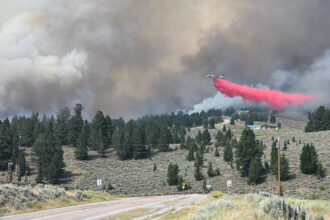
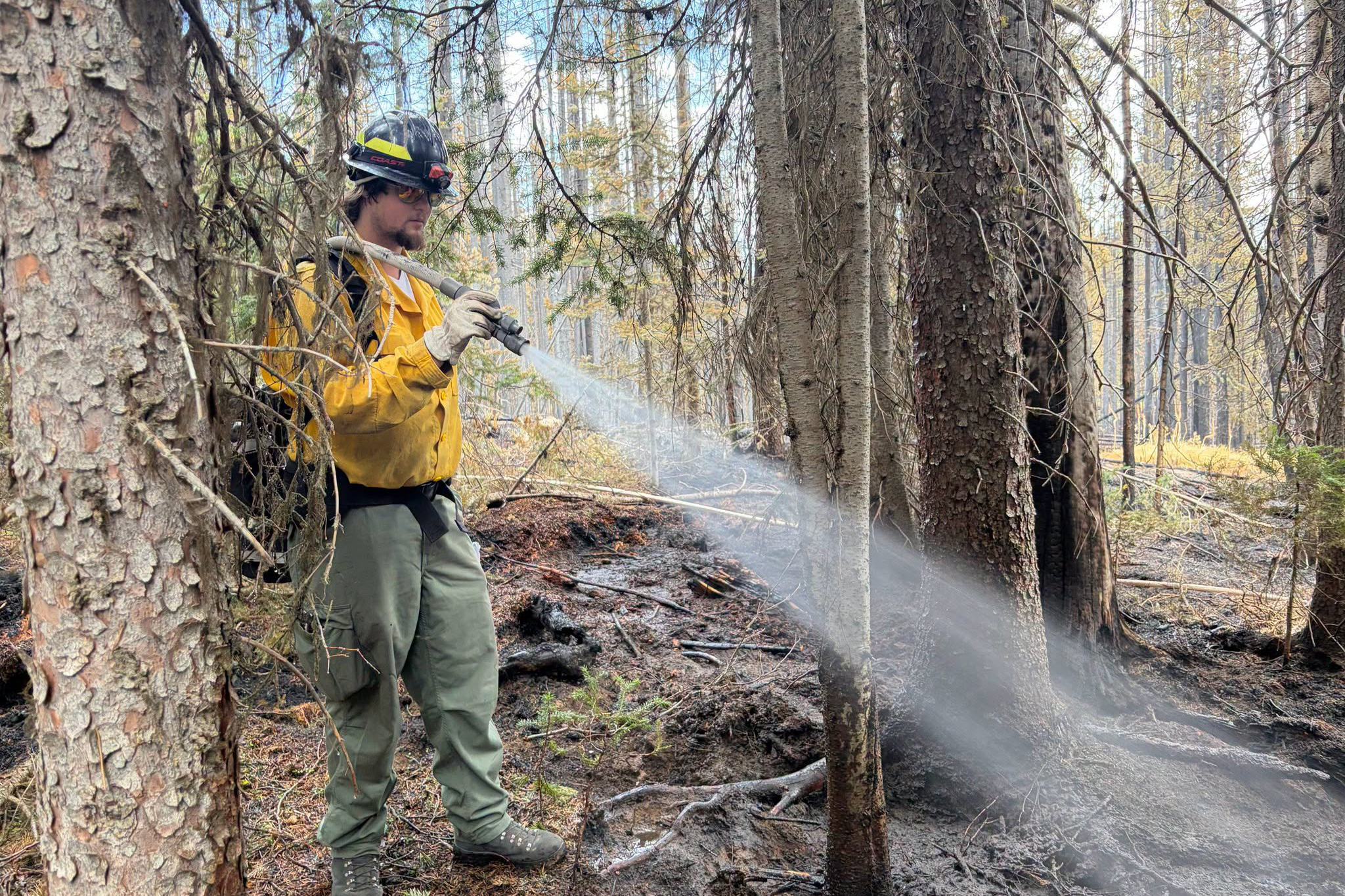


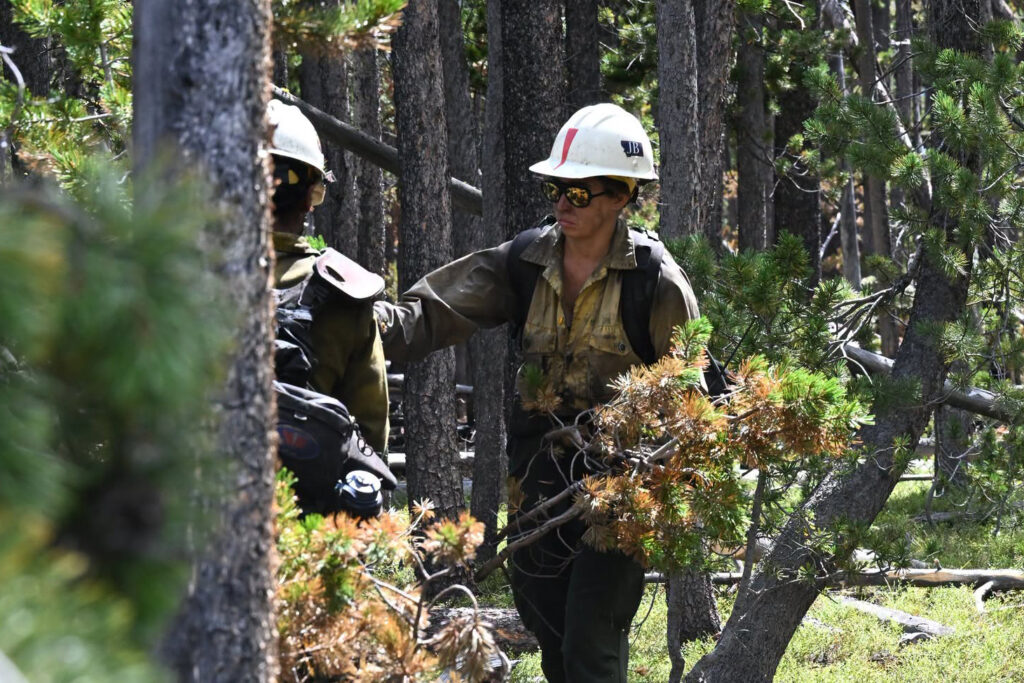
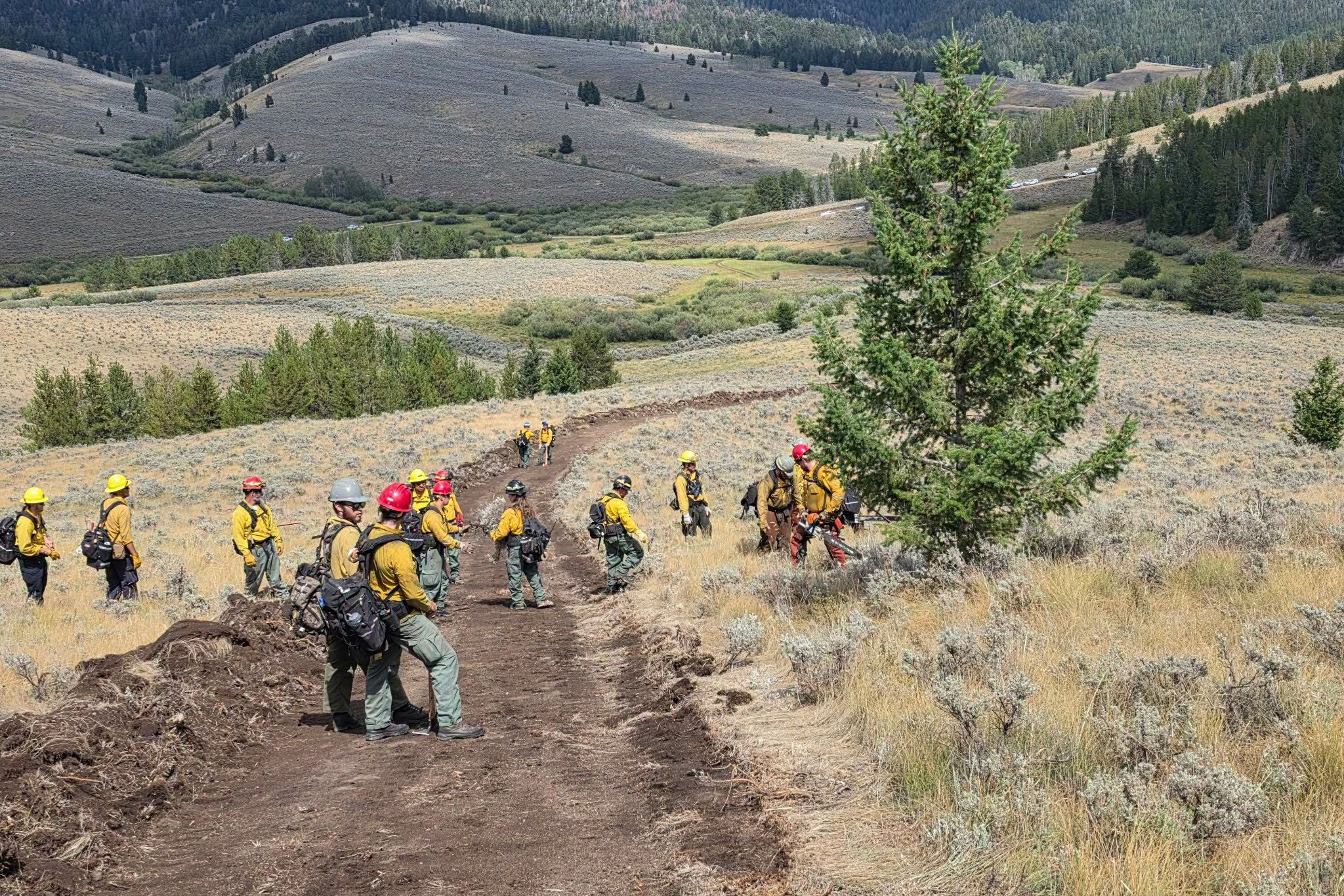
Firefighters are gaining ground on three large wildfires that have burned more than 47,000 acres across southwestern Montana, but unhelpful warmer temperatures, lower humidity and breezy conditions are returning after recent rainfall slowed the fires’ growth.
According to the U.S. Forest Service, containment on the Sand Creek Fire, southeast of Wisdom, increased from 2 percent to 7 percent as of mid-morning Mountain Time on Wednesday. Firefighters increased containment on the nearby Bobcat Lakes Fire from 19 percent to 40 percent.
A total of 843 personnel, 53 engines, 10 crews and 11 dozers were assigned to the two fires. Firefighters were also battling the Moose Fire, about 24 miles southwest of Philipsburg, which was 6 percent contained Wednesday.
Combined, the Sand Creek, Bobcat Lakes and Moose fires have burned the equivalent of about 63 percent of what all 2,424 wildfires across Montana last year tore through, according to the Montana Department of Natural Resources and Conservation.
And the 2026 fire season is still underway.
Philip Knaub, operations section chief for the inter-agency Northern Rockies Complex Incident Management Team 3, said Wednesday that elevated fire weather conditions were returning as temperatures rise, relative humidity falls and breezy conditions develop.
Jenn Kitsmiller, lead meteorologist with the National Weather Service in Missoula, told Inside Climate News that the summer began with relatively normal conditions before heat and dryness developed rapidly in July.
Temperatures that month averaged 3 to 6 degrees above normal, Kitsmiller said, and it “was extremely dry, in a month that’s already usually pretty dry.”
The heat dried vegetation rapidly, she said, while several rounds of thunderstorms brought lightning capable of starting fires.
Those conditions preceded the rapid expansion of the Sand Creek Fire, which grew from 1,684 acres on Aug. 6 to more than 31,000 acres in less than two weeks.
The fire burned across Maverick Mountain Ski Area and threatened nearby Elkhorn Hot Springs before mid-August rainfall helped slow its advance. The rain gave firefighters an opportunity to strengthen lines, and the fire’s reported acreage has since stabilized. But it arrived after the blaze caused potentially lasting damage at Maverick Mountain.
Mariah Leuschen-Lonergan, fire communications lead for the Forest Service in the Northern Rockies, told Inside Climate News on Wednesday that the Sand Creek Fire started under particularly favorable conditions for rapid fire growth: temperatures between 90 and 100 degrees or higher, relative humidity in the single digits and strong winds. Wind can be a major driver of fire growth when it aligns with abundant fuels and favorable topography, she said, which it did in this case.
The ski area’s base structures, “snowcat” vehicles that travel over snow and other equipment survived, but its only chairlift sustained extensive damage and will most likely be inoperable for the coming ski season, owner and operator Erik Borge said in a social media statement.
“At this point, our road forward is undefined,” Borge said. “We are already actively looking at how to rebuild Maverick.”
James Brown, Montana’s commissioner of securities and insurance, said in an interview that state officials are considering additional wildfire mitigation efforts.
“We’re going to be presenting to the Legislature, talking about a potential grant program through the state of Montana that would be aimed at reducing wildfire risk and improving insurance availability,” he said.
Brown also pointed to existing Montana Department of Natural Resources and Conservation grants that can help property owners reduce wildfire risks and encouraged residents to work with groups such as FireSafe Montana to create defensible space around homes and communities.
Despite the dramatic growth of Sand Creek and other large fires in southwestern Montana, broader moisture conditions across the western part of the state have not been uniformly extreme.
Kyle Bocinsky, director of climate extension at the University of Montana’s Montana Climate Office, said the fire activity in Montana this year is “trending close to average.”
“There is a fair bit of time left in our fire season, though,” Bocinsky said.
About This Story
Perhaps you noticed: This story, like all the news we publish, is free to read. That’s because Inside Climate News is a 501c3 nonprofit organization. We do not charge a subscription fee, lock our news behind a paywall, or clutter our website with ads. We make our news on climate and the environment freely available to you and anyone who wants it.
That’s not all. We also share our news for free with scores of other media organizations around the country. Many of them can’t afford to do environmental journalism of their own. We’ve built bureaus from coast to coast to report local stories, collaborate with local newsrooms and co-publish articles so that this vital work is shared as widely as possible.
Two of us launched ICN in 2007. Six years later we earned a Pulitzer Prize for National Reporting, and now we run the oldest and largest dedicated climate newsroom in the nation. We tell the story in all its complexity. We hold polluters accountable. We expose environmental injustice. We debunk misinformation. We scrutinize solutions and inspire action.
Donations from readers like you fund every aspect of what we do. If you don’t already, will you support our ongoing work, our reporting on the biggest crisis facing our planet, and help us reach even more readers in more places?
Please take a moment to make a tax-deductible donation. Every one of them makes a difference.
Thank you,

Mosabber Hossain
Fellow
Mosabber Hossain is an Inside Climate News Fellow and an award-winning climate and environmental investigative journalist from Bangladesh. His reporting focuses on climate change, biodiversity, environmental justice, adaptation and corruption. His work with Reuters and other international outlets has been republished globally, and some of his reporting contributed to discussions featured on the agenda of the World Economic Forum. Mosabber is a graduate student at the University of Montana studying environmental science and natural resource journalism. Previously, he was a fellow with the Institute for Journalism and Natural Resources and Investigative Reporters and Editors. He is a recipient of the South Asian Investigative Journalism Award from the Thomson Foundation and was featured among eight journalists during the organization’s 60th anniversary for the impact of his investigative reporting. Mosabber is also a wildlife and nature photographer whose work has been published internationally.