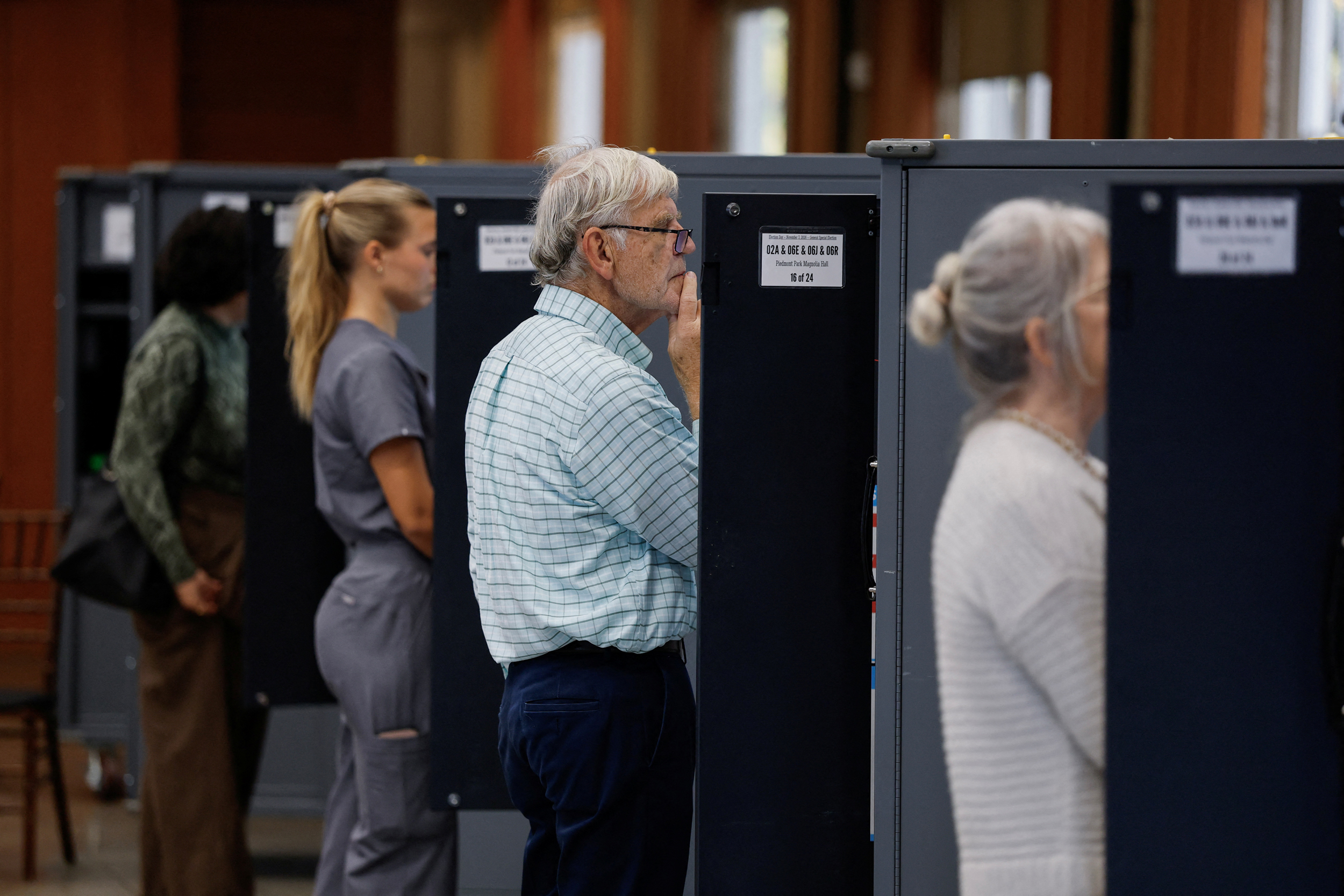


Georgia voters have broken the Republican grip on the state’s energy regulator, giving Democrats control of the Public Service Commission for the first time in 30 years.
Their victories come amid growing frustration over rising electricity bills, a data center buildout and calls for greater accountability from Georgia Power.
On Tuesday, Democrat Peter Hubbard was reelected after winning a seat in a special election last year. Democrat Sheila Edwards, a community activist and business owner, also won a seat.
“Thank you, Georgia!” Hubbard said in a Facebook post early Wednesday. “You have spoken, and Shelia Edwards and I are ready to keep fighting for a future that puts Georgians at the center of our energy policy.”
“Throughout this campaign, I’ve talked about putting People Before Profits, addressing rising utility bills, bringing transparency and accountability to the Public Service Commission, and making sure large data centers pay their fair share,” Edwards said in a Facebook post. “Those commitments don’t end with an election.”
The result is a major shift for the PSC, which regulates public utilities, including the state’s largest energy utility, Georgia Power. Commissioners are tasked with regulating utility rates, overseeing utility service and reliability and approving utility resource plans and major infrastructure investments.
Republicans held a 5-0 majority on the commission from 2006 until 2025, when Hubbard and fellow Democrat Alicia Johnson won seats.
During those nearly two decades, Georgia Power customers saw major rate increases in 2007, 2010, 2013, 2019 and 2022. Since 2023, six more have raised monthly bills by about $44.
Much of the increases were driven by costs tied to the troubled expansion of nuclear Plant Vogtle, in Burke County. Construction began in 2009 after commission approval, with the project expected to finish in 2017 before a series of setbacks. In the end, it took 15 years to complete and went more than $17 billion over budget. While customers continue to pay for the project, the costs of building out gas plants to power data centers have been tacked onto their bills.
“The results show that people are very angry about data centers and climate emissions,” said Patty Durand, founder of Georgians for Affordable Energy. She pointed to a series of protests demanding clean energy in 2024 and 2025. “I won’t pretend it’s not about high bills too, but those are tied to gas and data centers as well.”
The election of Hubbard and Johnson in 2025 was the first signal Georgia voters wanted change in the way utilities, and especially rate increases, are regulated. “It was shocking,” said Charles Bullock, a political science professor at the University of Georgia. “It may have been a straw in the wind of the state’s political realignment.”
Johnson won a five-year term, while Hubbard was elected for just one year, due to a special election schedule. His reelection means he will be in office until 2032, with an early stamp of approval from voters.
Edwards beat first-time candidate Josh Tolbert by 10.6 points and Hubbard beat former Republican Commissioner Fitz Johnson by 12.8 points, the largest margin of any statewide candidate this cycle in Georgia other than U.S. Sen. Jon Ossoff, who beat his Republican opponent, U.S. Rep. Mike Collins, by about 17 points.
The Democrats’ victories came despite being outspent by Republican candidates and outside groups. The Republican campaigns raised more than $1 million combined, largely driven by Fitz Johnson’s fundraising, compared with less than $600,000 for the Democratic candidates. Democratic fundraising relied more heavily on individual donations, while Republican candidates received substantially more money from corporate donors.
This story is funded by readers like you.
Our nonprofit newsroom provides award-winning climate coverage free of charge and advertising. We rely on donations from readers like you to keep going. Please donate now to support our work.
Donate NowAccording to an analysis by the Energy and Policy Institute, the two Republican candidates received a combined $214,100 in contributions of $500 or more from donors associated with entities regulated by the PSC, compared with just $6,500 for the Democratic candidates.
Outside spending in the races topped $5 million, much of it going toward television, digital and other campaign advertising. More than $3 million went toward supporting Tolbert, nearly all of it through a group called Powering Georgia’s Future, which is backed by a separate entity, Competence Matters. Competence Matters is not required to disclose donors. Both Powering Georgia’s Future and Competence Matters websites went dark following the election.
Another $1.5 million was spent through Georgia Conservation Voters in support of Hubbard and Edwards. That money came from the group’s national affiliate, the League of Conservation Voters, as well as from entities including the Jane Fonda Climate PAC and Green Advocacy Project.
Grassroots efforts by volunteers, watchdog groups and activists also helped support the Democratic campaigns. A coalition of more than 30 groups, including Georgians for Affordable Energy, Georgia WAND and Young Democrats of Georgia, organized social media outreach and distributed flyers, yard signs and bumper stickers to compete with the better-funded Republican campaigns.
The results reflect growing political attention to energy costs and utility policy. Nationally, Democrats flipped Senate and House seats in deep red states where Americans have been hit hardest by energy prices and data center buildouts.
The Democratic majority on the PSC will have an opportunity to follow through on campaign promises to increase scrutiny of Georgia Power and strengthen consumer protections. After their election last year, Alicia Johnson and Hubbard opposed a $16 billion grid expansion dominated by natural gas, which ultimately passed 3-2. Hubbard also helped prompt a commission investigation into whether data centers and other large customers are paying their fair share of fuel costs. Last month, he tried to establish an installment plan for customers facing disconnection, but the proposal was tabled.
“Hubbard has made many motions to help Georgia Power customers that his Republican colleagues have tabled or denied,” said Durand. “Those will now pass.”
Edwards campaigned on the same issues that have defined Alicia Johnson and Hubbard’s time on the commission. She has pledged to push for lower energy costs, greater scrutiny of data center expenses and more transparency from Georgia Power, giving the three Democrats a shared agenda as they take control.
Durand said the coalition’s work doesn’t stop now that Democrats control the commission. The commissioners will still need to be held accountable, she said, adding that the coalition of community and grassroots groups plans to issue them a scorecard.
The coalition also hopes to carry that momentum to the state legislature, where it wants to revive legislation that has previously failed to pass. That includes creating a publicly funded consumer utility advocate to represent customers before the PSC and preventing utilities from passing data-center-related costs on to other customers.
About This Story
Perhaps you noticed: This story, like all the news we publish, is free to read. That’s because Inside Climate News is a 501c3 nonprofit organization. We do not charge a subscription fee, lock our news behind a paywall, or clutter our website with ads. We make our news on climate and the environment freely available to you and anyone who wants it.
That’s not all. We also share our news for free with scores of other media organizations around the country. Many of them can’t afford to do environmental journalism of their own. We’ve built bureaus from coast to coast to report local stories, collaborate with local newsrooms and co-publish articles so that this vital work is shared as widely as possible.
Two of us launched ICN in 2007. Six years later we earned a Pulitzer Prize for National Reporting, and now we run the oldest and largest dedicated climate newsroom in the nation. We tell the story in all its complexity. We hold polluters accountable. We expose environmental injustice. We debunk misinformation. We scrutinize solutions and inspire action.
Donations from readers like you fund every aspect of what we do. If you don’t already, will you support our ongoing work, our reporting on the biggest crisis facing our planet, and help us reach even more readers in more places?
Please take a moment to make a tax-deductible donation. Every one of them makes a difference.
Thank you,