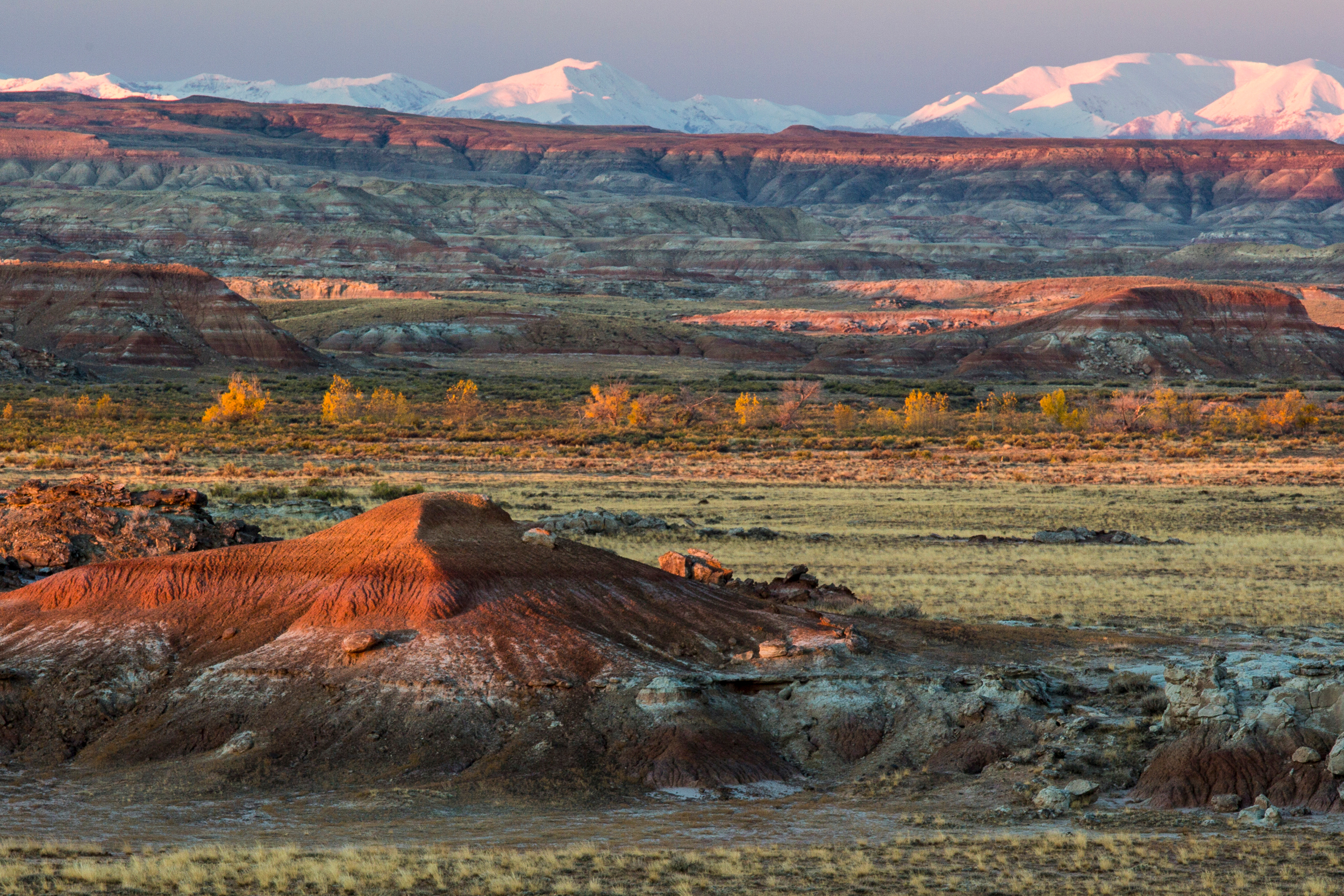


Wyoming’s cherished open spaces appear to be at the forefront of voters’ minds as they head to the polls in an election that could decide whether public lands continue to come under scrutiny from state lawmakers.
Tuesday’s election will be the first in Wyoming since Western congressional Republicans pushed for public lands, areas within a state’s borders held and managed by the federal government, to be transferred to state control in 2025. That same year, over a dozen Wyoming state senators tried to pass a resolution demanding the federal government “extinguish” its landholdings in the Cowboy State in recognition of its “sovereign rights.”
But those strident calls for public land transfers generated enormous backlash across the West, home to the vast majority of public land, with many Westerners expressing support for their protection. Some observers say the blowback has already changed Wyoming’s politics.
“The most interesting thing about what’s going on right now, in Wyoming at least, is the fact that all of the Republican contenders for office have taken a position of not selling the federal estate,” said Gregg Cawley, a professor of environmental politics at the University of Wyoming. “In the past, there would have been a bit more contention.”
Public lands proponents in the Cowboy State hope strong showings by pro-public lands Republicans send a clear message that public land selloffs are a political non-starter, even in a deeply conservative state. A pair of Wyomingites were so appalled by the 2025 resolution that they started the state’s first political action committee dedicated solely to public land issues.
Last year, “I realized this group of legislators is not listening to their constituents,” said Zach Lentsch, co-founder of Protect Wyoming. “They’re beholden to someone else. I don’t know who that someone else is, but it’s not locals and the people that love public lands.”
The issue is personal for Lentsch, whose climbing and outdoor guiding business relies on access to national monuments, national forests and landscapes stewarded by the Bureau of Land Management.
“My entire way of life, and the life of my kiddo, depend on public lands,” he said.
Proponents of public land transfer have argued since the Reagan-era Sage Brush Rebellion of the late 20th century that states should have control over all lands within their borders. They chafe at what they see as far-off bureaucrats in Washington, D.C., preventing Western states from managing public lands as they see fit—often to the benefit of extractive industries—and realizing new sources of revenue.
But transferring public land to states would not renewably generate money for states, opponents argue. Instead, without the federal tax base to foot the bill for their management, states would be forced to sell off public lands, ending the federal practice of balancing development, recreation and conservation for a range of users, opponents say.
The federal government owns about 48 percent of the land base within Wyoming’s borders.
“My entire way of life, and the life of my kiddo, depend on public lands.”
— Zach Lentsch, Protect Wyoming
While the Republicans at the national level pursue disposing of federal land, voters in Wyoming appear to have little appetite for the idea.
On Aug. 6, Keep It Public Wyoming, a public lands advocacy group, published a poll showing public lands were a topline and consensus issue for many voters. Public lands ranked second behind affordability in terms of issue importance, with over 90 percent of respondents saying they did not support the sale of public lands.
More than 80 percent of Republican respondents said they were much less likely to support a candidate who favored selling or transferring public lands in Wyoming.
To capitalize on this support, Protect Wyoming developed a public lands scorecard for candidates from the governor’s race down to House primaries. The group spent on races in the Big Horn basin and Natrona County, places where they felt their resources could make a difference to candidates Protect Wyoming deemed pro-public lands.
The group is not working on federal elections, though members of Wyoming’s delegation have expressed support for state management of public lands.
“If you’re not seen as pro-public lands in Wyoming, you don’t have a political future; that’s our ultimate goal,” Lentsch said.
Tuesday’s election may provide some insights into how public lands affect Wyoming politics, but turning public land management over to Western states remains “a political vampire,” Cawley said. “No one’s been able to figure out how to put a stake through its heart yet.”
Public land supporters hope the primary is the beginning of a different story.
About This Story
Perhaps you noticed: This story, like all the news we publish, is free to read. That’s because Inside Climate News is a 501c3 nonprofit organization. We do not charge a subscription fee, lock our news behind a paywall, or clutter our website with ads. We make our news on climate and the environment freely available to you and anyone who wants it.
That’s not all. We also share our news for free with scores of other media organizations around the country. Many of them can’t afford to do environmental journalism of their own. We’ve built bureaus from coast to coast to report local stories, collaborate with local newsrooms and co-publish articles so that this vital work is shared as widely as possible.
Two of us launched ICN in 2007. Six years later we earned a Pulitzer Prize for National Reporting, and now we run the oldest and largest dedicated climate newsroom in the nation. We tell the story in all its complexity. We hold polluters accountable. We expose environmental injustice. We debunk misinformation. We scrutinize solutions and inspire action.
Donations from readers like you fund every aspect of what we do. If you don’t already, will you support our ongoing work, our reporting on the biggest crisis facing our planet, and help us reach even more readers in more places?
Please take a moment to make a tax-deductible donation. Every one of them makes a difference.
Thank you,

Jake Bolster
Reporter, Wyoming and the West
Jake Bolster reports on Wyoming and the West for Inside Climate News. Previously, he worked as a freelancer, covering climate change, energy, and the environment across the United States. He holds a Masters in Journalism from Columbia University.