

Under a recent legal settlement, Florida will have to adopt new plans for addressing pollution in nine of the hundreds of freshwater springs in the state that constitute one of the largest concentrations of springs in the world.
The agreement between environmental groups and the state Department of Environmental Protection, announced earlier this month, applies to seven springs on the Suwannee River in rural north Florida, as well as the Wekiwa and Rock springs outside of Orlando in central Florida.
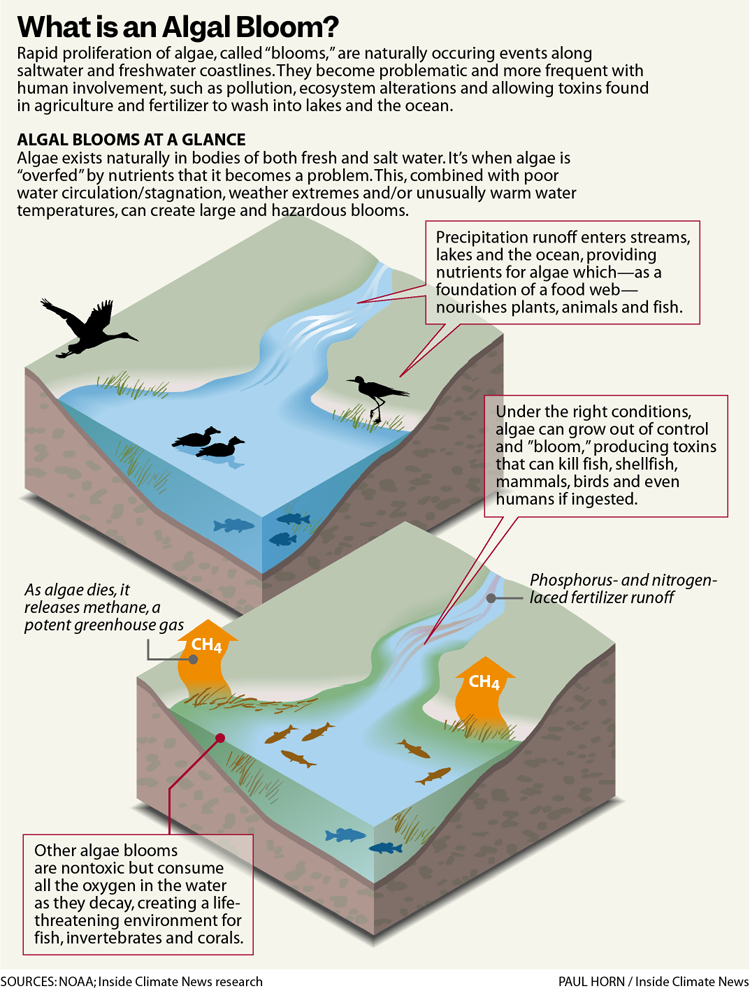
The settlement addresses the two largest sources of nitrogen pollution plaguing Florida’s iconic springs: agricultural lands and septic systems. The pollution contributes to the harmful algae blooms that have fouled waterways across the state and become a major environmental issue in Florida. Under the settlement, the state must develop new Basin Management Action Plans—often referred to as BMAPs—for each springshed aimed at reducing the pollution.
Notably, the Department of Environmental Protection for the first time will be required, particularly in the Suwannee springshed, to verify whether agricultural techniques called best management practices are working, said Ryan Smart, executive director of the Florida Springs Council, one of the groups involved in the litigation. The techniques are designed to stem the flow of pollution.
“BMAPs are the only regulatory strategy we have in Florida to take a polluted body of water and make it clean again. So they are incredibly important,” he said. “The BMAPs have been around for a long time, but they have not been effective. We don’t have significant successes where there have been Basin Management Action Plans for really polluted major bodies of water, and they have been brought back.”
The new BMAPs must include more projects to decrease the flow of the pollution and must increase water monitoring and enforcement. In the Wekiwa and Rock springshed, where septic systems account for 52 percent of the pollution, the plan must expand a prohibition on new conventional septic systems and a requirement to upgrade existing systems.
The agreement comes after the First District Court of Appeal in 2023 invalidated the BMAPs of several springs, prompting the Department of Environmental Protection to adopt new plans. In 2025, the Florida Springs Council filed requests for administrative hearings before the Department of Environmental Protection over the plans for the Suwannee River and Wekiwa and Rock springsheds, arguing the BMAPs failed to comply with legislative requirements. Friends of the Wekiva River joined in the litigation over the plan for the Wekiwa and Rock springshed.
The environmental groups argued for instance that the BMAPs failed to include lists of projects that would sufficiently reduce the pollution, a water quality monitoring component or a mechanism for addressing future pollution associated with population growth.
The environmental groups and Department of Environmental Protection each said the settlement would enable the cleanup to move forward without further delays caused by more litigation.
“The department’s 2025 Basin Management Action Plans for the Suwannee and Wekiwa & Rock Springs can now go into effect, affording protections for these important waters,” the department said in a statement provided to Inside Climate News. “We look forward to implementing these solutions and continuing our efforts to safeguard the long-term health and sustainability of Florida’s natural resources for generations to come.”
Smart characterized the requirement for more enforcement as especially important to the Suwannee springshed and other springs near agricultural lands. The settlement also requires the Department of Environmental Protection to verify that agricultural operators are following through on best management practices. The techniques involve things like adjusting fertilizer and water use to minimize the flow of the pollution.
“You can’t make it easily to a beach in the middle of the state, but they are our beaches,” Smart said of the springs. “If you can go on a nice day to the springs in that area, you’ll just find hundreds of families enjoying them.”
He added: “I do think it’s a big victory for the springs, and I think it’s a great outcome that we were able to settle with DEP. … All we are demanding is plans that are following the law.”
About This Story
Perhaps you noticed: This story, like all the news we publish, is free to read. That’s because Inside Climate News is a 501c3 nonprofit organization. We do not charge a subscription fee, lock our news behind a paywall, or clutter our website with ads. We make our news on climate and the environment freely available to you and anyone who wants it.
That’s not all. We also share our news for free with scores of other media organizations around the country. Many of them can’t afford to do environmental journalism of their own. We’ve built bureaus from coast to coast to report local stories, collaborate with local newsrooms and co-publish articles so that this vital work is shared as widely as possible.
Two of us launched ICN in 2007. Six years later we earned a Pulitzer Prize for National Reporting, and now we run the oldest and largest dedicated climate newsroom in the nation. We tell the story in all its complexity. We hold polluters accountable. We expose environmental injustice. We debunk misinformation. We scrutinize solutions and inspire action.
Donations from readers like you fund every aspect of what we do. If you don’t already, will you support our ongoing work, our reporting on the biggest crisis facing our planet, and help us reach even more readers in more places?
Please take a moment to make a tax-deductible donation. Every one of them makes a difference.
Thank you,

Amy Green
Reporter, Florida
Amy Green covers the environment and climate change from Orlando, Florida. She is a mid-career journalist and author whose extensive reporting on the Everglades is featured in the book MOVING WATER, published by Johns Hopkins University Press, and podcast DRAINED, available wherever you get your podcasts. Amy’s work has been recognized with many awards, including a prestigious Edward R. Murrow Award and Public Media Journalists Association award.