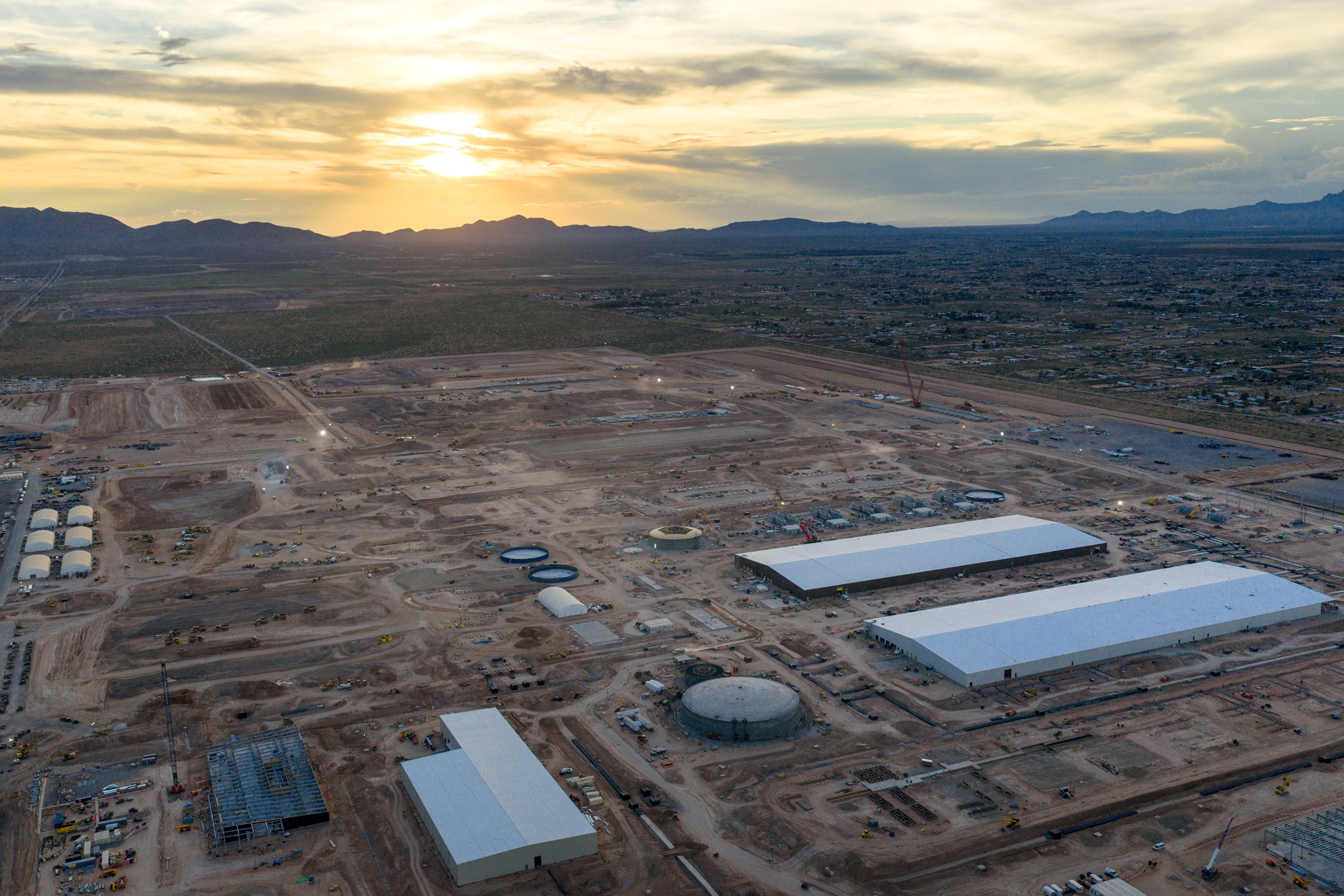


EL PASO—While Texas officials have hit pause on data center permitting, one project that is still moving ahead is Meta’s $10 billion, 1-gigawatt data center in northeast El Paso.
Meta had already signed tax abatement agreements with El Paso, jumped through regulatory hoops and started construction before Texas officials tapped the brakes on data center development this year.
But one hurdle the project must still clear is securing approval for El Paso Electric’s application to the Public Utilities Commission of Texas to build a 366-megawatt natural gas facility, using modular generators, to power the data center. Once operational, Meta’s data center would be the utility’s largest electric customer. The City of El Paso intervened in the application, and a hearing was held in July.
Administrative law judges for the commission released their proposed decision Wednesday. They found that El Paso Electric failed to adequately consider alternatives to the gas plant, called the McCloud facility and failed to issue a request for proposals to contractors. The judges recommended that the Public Utilities Commission only approve the application on the condition that El Paso Electric does not pass capital and operating costs on to its ratepayers. Without this condition, the judges recommend the application be denied.
The ultimate decision lies with the five PUCT commissioners. The application has not yet been scheduled for a vote.
“We’re disappointed,” said Verónica Carbajal, an organizer with the Sembrando Esperanza Coalition in El Paso, which submitted comments of over 1,000 people protesting the application. “If the state was really serious about this, the commission would be denying everything related to data centers.”
El Paso Electric did not respond to a request for comment.
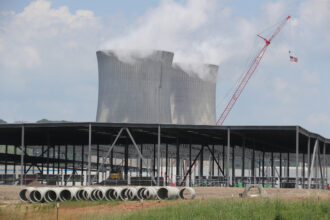
El Paso Electric officials initially claimed that solar power would supply the Meta data center. However, in December the utility applied to build a power plant made up of 813 modular natural gas generators, supplied by the contractor Enchanted Rock. Each modular generator has a capacity of 450 kilowatts. The total estimated cost of the McCloud facility is $499 million.
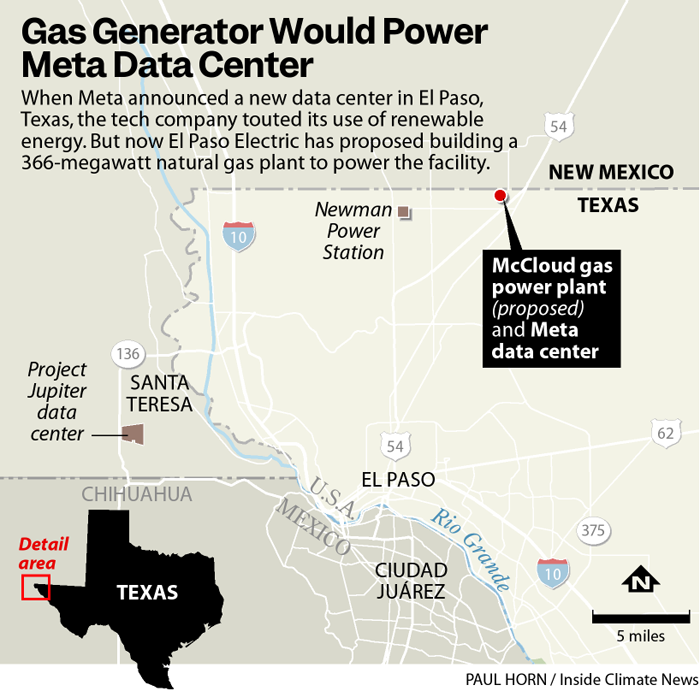
The gas plant would exclusively supply Meta for the first five years and then connect to the broader transmission system. Meta would assume the costs for the first five years, after which ratepayers could be asked to shoulder the cost.
El Paso residents have raised concerns that power generation for the data center will increase air pollution, strain water resources and could increase electric rates. Oracle’s Project Jupiter hyperscale data center is also under construction in neighboring Doña Ana County, New Mexico.
El Paso Electric proposed contracting with Enchanted Rock after Meta recommended the company. The utility did not consider other contractors, according to administrative law judges. El Paso Electric did not conduct a cost-benefit analysis to determine whether the proposed gas plant is a cost-effective option for ratepayers. The utility did not consider alternatives like purchasing capacity or investing in existing generation.
The administrative law judges wrote that Wurldwide, a Meta subsidiary named in the application, drove the process.
This story is funded by readers like you.
Our nonprofit newsroom provides award-winning climate coverage free of charge and advertising. We rely on donations from readers like you to keep going. Please donate now to support our work.
Donate Now“The selection of the Project was driven by Wurldwide’s prescribed timeline and preferences—and its agreement to pay the capital and operating costs,” they wrote.
“The overall lack of analysis regarding options is also concerning,” the judges wrote, because the utility left open the possibility that ratepayers will someday have to pay for the power plant. For those reasons, the judges recommended approval of the application only on the condition that ratepayers not be held responsible for the cost.
Far West Texas, including El Paso, is one of the few regions of the state that isn’t part of the Electricity Reliability Council of Texas grid. Utilities are barred from owning power plants in ERCOT, but the rules are different outside of the grid’s territory, which is why El Paso Electric could make its proposal.
Krysti Shallenberger, a research and communications manager at the Energy & Policy Institute, said that the application is notable because El Paso Electric is a privately-held, monopoly utility seeking to build a power plant solely for a data center.
“What we’re seeing with El Paso Electric, we haven’t necessarily seen in the competitive market,” Shallenberger said. “Which is the utility proposing to build an expensive gas plant [for a data center] that it will rate base. It can make a profit off this.”
Rate base is the value of assets a utility holds to provide service. It forms the basis for calculating how much utilities can charge their customers.
After previously championing the industry, Gov. Greg Abbott has taken steps to slow or limit data center development in Texas. But these measures have largely not affected the Meta data center in El Paso.
The audit of data centers in the ERCOT interconnection process, announced in August, does not impact Meta because El Paso is on the Western Interconnection grid.
Earlier this week, Abbott ordered the Texas Commission on Environmental Quality to pause issuing permits for data center projects. However, El Paso Electric has already obtained a TCEQ air permit for the McCloud facility
It is unclear whether other permits for the data center are still in process and could be impacted by the pause. In response to questions from Inside Climate News, TCEQ director of external relations Ryan Vise said the agency “will provide a full update on compliance to the Governor’s Office by October 19, 2026.”
Carbajal said the current regulatory landscape leaves El Pasoans in limbo.
“There are some communities that are benefiting from the pauses. There are others where data centers are already operating,” she said. “But we’re in the middle because Meta is under construction but not operational.”
About This Story
Perhaps you noticed: This story, like all the news we publish, is free to read. That’s because Inside Climate News is a 501c3 nonprofit organization. We do not charge a subscription fee, lock our news behind a paywall, or clutter our website with ads. We make our news on climate and the environment freely available to you and anyone who wants it.
That’s not all. We also share our news for free with scores of other media organizations around the country. Many of them can’t afford to do environmental journalism of their own. We’ve built bureaus from coast to coast to report local stories, collaborate with local newsrooms and co-publish articles so that this vital work is shared as widely as possible.
Two of us launched ICN in 2007. Six years later we earned a Pulitzer Prize for National Reporting, and now we run the oldest and largest dedicated climate newsroom in the nation. We tell the story in all its complexity. We hold polluters accountable. We expose environmental injustice. We debunk misinformation. We scrutinize solutions and inspire action.
Donations from readers like you fund every aspect of what we do. If you don’t already, will you support our ongoing work, our reporting on the biggest crisis facing our planet, and help us reach even more readers in more places?
Please take a moment to make a tax-deductible donation. Every one of them makes a difference.
Thank you,

Martha Pskowski
Reporter, El Paso, Texas
Martha Pskowski covers climate change and the environment in Texas from her base in El Paso. She was previously an environmental reporter at the El Paso Times. She began her career as a freelance journalist in Mexico, reporting for outlets including The Guardian and Yale E360. Martha has a B.A. in Environmental Studies from Hampshire College and a master’s degree in Journalism and Latin American Studies from New York University. She is a former Fulbright research fellow in Mexico. Martha can be reached on Signal at psskow.33.