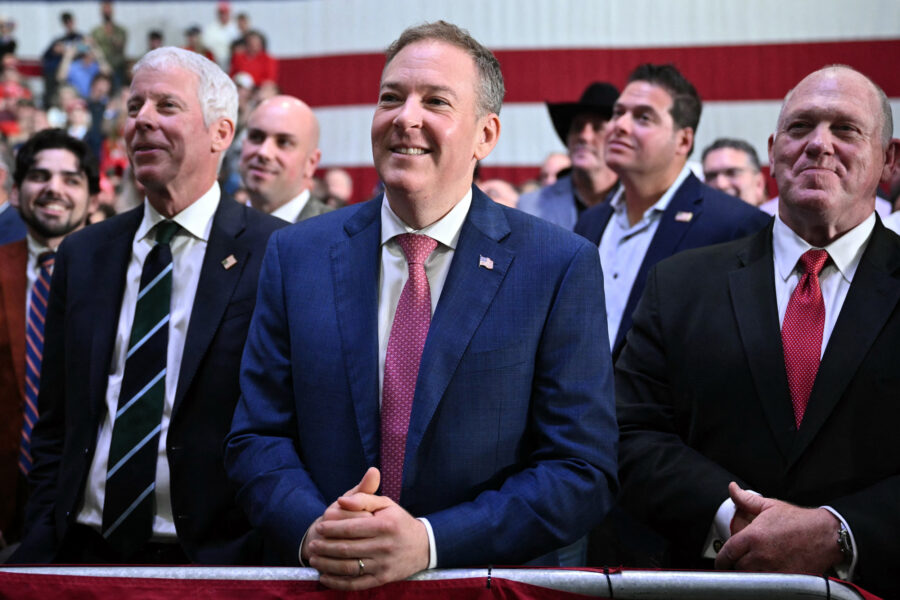


Earlier this week, President Donald Trump responded to rising public concerns about artificial intelligence with a post on Truth Social.
“The same people that said, ‘We’ll all be dead in twelve years because of Global Warming,’ a name since ‘reborn’ to Climate Change, because the Planet was cooling, not warming, and nobody was dead, are the people that are now saying that AI is going to kill us, that robots are going to attack us, and everything is a DISASTER,” he wrote on Truth Social.
He then declared fear of AI “a hoax.”
I found it notable that he injected climate denial into the discussion of AI, as if that would help his argument, and that he did so on the first day of Climate Week NYC.
The annual event has included corporations touting how AI could help the climate. For example, the chip maker Nvidia highlighted how its AI products are being used to advance clean energy, such as operational improvements at a nuclear power plant and energy-storage projects that utilize used batteries. Josh Parker, Nvidia’s head of sustainability, expanded on this in an interview Wednesday with The New York Times at Climate Week. He said AI could help reduce emissions reductions for transportation, manufacturing and buildings, with benefits that would outweigh AI’s climate footprint.
Looking at Trump’s comments alongside some of the hopeful messages coming from Climate Week, I see an evolving AI discourse that mixes climate denial and techno-optimism, neither of which is helpful.
Trump was touching on—and dismissing—concerns that AI would lead to superintelligent computers that would kill people. Yes, that’s a reason to worry, but the more immediate concern is AI’s vast need for water, electricity and investor dollars.
So what’s the reality? The most useful encapsulation of the peril and opportunity of this moment, in my view, was the paper published in a Nature journal in August that finds the increase in carbon emissions from using AI to help optimize fossil fuel production is much more than the savings from using it for end uses related to clean energy. This is in addition to emissions from data centers. (My colleague Arcelia Martin wrote about the paper.)
The co-authors include Will Alpine and Holly Alpine, a couple who worked on AI at Microsoft before starting a nonprofit, the Enabled Emissions Campaign, which calls on technology companies to be accountable for how AI is used to boost oil and gas use.
I asked Holly Alpine what she makes of the talk of AI at Climate Week.
“What we’re seeing at Climate Week is a familiar pattern: companies spotlighting a handful of clean energy pilot projects while the overwhelming majority of AI’s actual applications are aimed at increasing fossil fuel extraction and production,” she said in an email. “Nvidia’s post is a good example—highlighting a renewable energy partnership is easy and photogenic, while conveniently omitting how much AI is being deployed to find, extract, and produce more oil and gas.”
This isn’t complicated. If AI were powered mostly by clean sources and its emissions-cutting uses outweighed its climate-harming uses, then there would be no need to mislead about the effects.
Jonathan Koomey, an independent researcher who has been studying data centers for decades, is wary of companies describing AI as beneficial for the climate while not acknowledging the potential downsides.
I spoke with him recently following a speech he gave in my city, Columbus, Ohio, about the challenges of accurately forecasting the scale of the data center boom— a particularly relevant topic in Columbus, one of the country’s leading data center markets.
“Projecting short-term trends for even 10 or 12 years is a recipe for disaster, in my experience,” he told me.
Koomey’s larger point is that the scale of the data center boom remains uncertain. One of the most harmful scenarios is that utility companies build new power plants to serve anticipated data centers, only for many, if not most, of those projects to never materialize. If that happens, households and businesses would be left to cover the costs through their utility bills. Regulators and lawmakers need to take steps to protect consumers, he said.
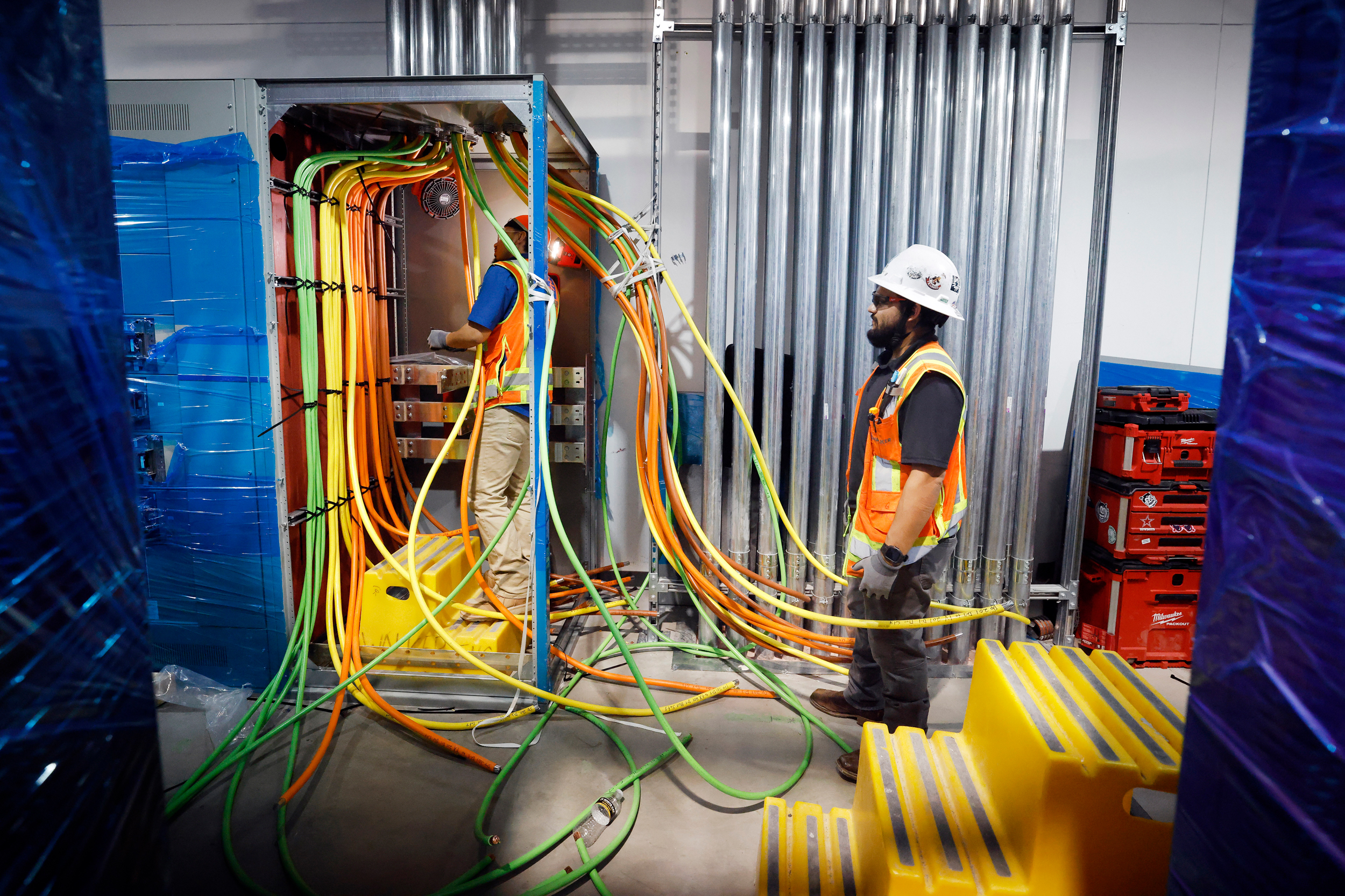
For now, one of the most troubling aspects of the AI data center boom is how the rush to build as fast as possible has led developers to rely on some of the least efficient and most expensive power technologies, such as natural gas combustion turbines.
“It’s madness,” Koomey said, noting that many of the turbines are essentially jet engines, built for short-term use. “No sane [utility] would buy electricity from combustion turbines running 24-7. It just wouldn’t happen.”
At some point, economic gravity will assert itself, he said. Data centers will need to recoup their development costs and determine how much customers are willing to pay.
This story is funded by readers like you.
Our nonprofit newsroom provides award-winning climate coverage free of charge and advertising. We rely on donations from readers like you to keep going. Please donate now to support our work.
Donate NowThis reality doesn’t mesh with Trump’s all-caps defense of AI, and feels far removed from talk of how AI will help the climate. It portends an industry downturn that may be coming soon.
One more thing: I didn’t want to get waylaid by fact-checking Trump’s statement, but one part demands some context.
When he refers to people warning “we’ll all be dead in twelve years,” he’s likely referring to the media coverage of a 2018 report by the United Nations’ Intergovernmental Panel on Climate Change that said the world had 12 years to reduce emissions enough to avoid a temperature threshold that would lead to severe heat and drought.
My colleague Bob Berwyn covered the report at the time and wrote a followup story putting the timeline in context.
No credible climate scientist has said we’ll all be dead by 2030 because of climate change. To say otherwise is—sorry—a hoax.
Other stories about the energy transition to take note of this week:
Leaders at the United Nations and Climate Week Balance Hope For Clean Energy and Worry About Climate Change and AI: Concerns about mounting AI risks helped to drive conversations this week at the United Nations General Assembly and Climate Week, as Seth Borenstein and Jennifer McDermott report for the Associated Press. Rising energy prices were another concern as wars in Ukraine and Iran contributed to high costs.
Federal Judge Says the Trump Administration Erred in Canceling Solar for All Program: A federal judge ruled that the Trump administration exceeded its authority when it canceled the Solar for All program in 2025, as my colleague Amy Green reports. Solar for All was a Biden administration initiative that aimed to increase customer-owned solar power and make solar benefits available across a broad range of incomes. The ruling means the U.S. Environmental Protection Agency must release the program’s funding, but the Trump administration could take action to delay or appeal.
Revolution Wind Installs Final Turbine: Revolution Wind, the 704-megawatt offshore wind farm off of Rhode Island, has installed its final turbine and will soon be fully operational, as Sarah Bawden reports for WPRI television. The Trump administration had sought to stop this and four other offshore wind projects, but a court allowed construction to move forward. Completing these projects is good for the clean energy economy, but as my colleague Ajani Stella wrote last month, the administration has done lasting damage to the prospects of future development.
Moss Landing Battery Plant Catches Fire Again: The nightmare for Moss Landing got a new chapter as the battery plant—already made inoperable by last year’s fire—had a new fire that sent smoke and pollutants into the air, as Rachel Becker and Alejandra Reyes-Velarde report for CalMatters. Fire officials explained that some inaccessible battery modules spontaneously ignited. The Moss Landing battery plant was one of the first large battery energy storage systems to come online and researchers say its design left it poorly equipped to avoid fires. More recent systems use different designs that reduce the chance of a fire spreading.
Correction: This story has been modified to clarify the findings in the Nature journal paper.
Inside Clean Energy is ICN’s weekly bulletin of news and analysis about the energy transition. Send news tips and questions to [email protected].
About This Story
Perhaps you noticed: This story, like all the news we publish, is free to read. That’s because Inside Climate News is a 501c3 nonprofit organization. We do not charge a subscription fee, lock our news behind a paywall, or clutter our website with ads. We make our news on climate and the environment freely available to you and anyone who wants it.
That’s not all. We also share our news for free with scores of other media organizations around the country. Many of them can’t afford to do environmental journalism of their own. We’ve built bureaus from coast to coast to report local stories, collaborate with local newsrooms and co-publish articles so that this vital work is shared as widely as possible.
Two of us launched ICN in 2007. Six years later we earned a Pulitzer Prize for National Reporting, and now we run the oldest and largest dedicated climate newsroom in the nation. We tell the story in all its complexity. We hold polluters accountable. We expose environmental injustice. We debunk misinformation. We scrutinize solutions and inspire action.
Donations from readers like you fund every aspect of what we do. If you don’t already, will you support our ongoing work, our reporting on the biggest crisis facing our planet, and help us reach even more readers in more places?
Please take a moment to make a tax-deductible donation. Every one of them makes a difference.
Thank you,

Dan Gearino
Reporter, Clean Energy
Dan Gearino covers the business and policy of renewable energy and utilities, often with an emphasis on the midwestern United States. He is the main author of ICN’s Inside Clean Energy newsletter. He came to ICN in 2018 after a nine-year tenure at The Columbus Dispatch, where he covered the business of energy. Before that, he covered politics and business in Iowa and in New Hampshire. He grew up in Warren County, Iowa, just south of Des Moines, and lives in Columbus, Ohio.