

At least six small cities and towns in the Coastal Bend region of Texas issued disaster declarations in the last two weeks, begging not to be forgotten amid a spiraling water crisis.
All attention lies on the city of Corpus Christi as it grapples with the growing likelihood of an unprecedented disaster. But Corpus Christi, the eighth-largest city in Texas, doesn’t just provide water to its own industries and residents. It supplies the entire seven-county region, including 20 other municipalities.
“Everyone is like, ‘What the heck is going on and what do we do?” said Elida Castillo, mayor of the small town of Taft, which issued a disaster declaration on April 21. “I’m just trying to figure out what we could do.”
Castillo recently organized a town hall meeting on the water crisis for the 3,000 residents of Taft, but officials from Corpus Christi didn’t show up. She hasn’t heard much from county or state officials either. She is getting a sense that nobody knows what to do, and she isn’t alone.
Amy Hardberger, director of the Center for Water Law and Policy at the Texas Tech School of Law in Lubbock, said most Americans can’t wrap their minds around the grave implications of empty reservoirs. Those who can feel deeply unsettled by what is happening in Corpus Christi.
“It’s not my goal for other people to be panicked,” she said. “But many of us are very scared.”
If Corpus Christi becomes the first modern American city to run out of water, it would take most surrounding communities with it. Up the coast of Corpus Christi Bay, the cities of Ingleside and Aransas Pass, with a combined 19,000 residents, issued disaster declarations on April 22.
“There should be some type of legislation that will assist us now, rather than in the future,” said Ingleside City Manager Brenton Lewis. “All these small cities that have declared disasters are looking at alternate water supplies.”
The towns of Three Rivers, Orange Grove and Alice also issued disaster declarations in the week prior.
“Regional water demand is exceeding available supply,” said an April 14 declaration from the City of Alice, population 17,000. “Continued drought conditions threaten public health, safety and welfare, as well as essential public services.”
Alice, however, expects to fare better than other communities. Last July it cut ribbons on a groundwater desalination plant, a decade in the making, owned and operated by an investor-backed water treatment company called Seven Seas.
“They have a profit margin,” said Alice City Manager Michael Esparza. “We are paying a private company to do something for us. It’s no different than we do with a lot of things. Although, this one is pretty big because it’s our water.”

Furthermore, he said, little Alice lacks the technical expertise to maintain and operate such an advanced facility.
Fifty miles away, the city of Beeville declared a disaster in October and issued $35 million in municipal debt, totalling about $2,600 per resident, to fund its own emergency groundwater desalination project.
Most local small town governments remain either reluctant or unable to consider the high cost required for reverse osmosis treatment, said Kasy Stinson, a project developer for Seven Seas based in Austin, especially if they’re accustomed to water that has been historically undervalued in Texas.
“I don’t know that the reality of the dire straits have really landed with everybody,” said Stinson, who spent a decade in the drinking water division of the Texas Commission on Environmental Quality.
This story is funded by readers like you.
Our nonprofit newsroom provides award-winning climate coverage free of charge and advertising. We rely on donations from readers like you to keep going. Please donate now to support our work.
Donate NowIn the town of Taft, Mayor Castillo wonders the same. She’s watched this crisis creep up for years. Everyone has. Last year Castillo traveled repeatedly to Austin to meet with state lawmakers as they crafted ambitious legislation meant to head off water deficits projected across Texas.
But the historic $20 billion put forth by lawmakers for the much-heralded Texas Water Fund looks meager compared to the $174 billion price tag Texas put on its long-term water needs this month.
To Add Supply or Limit Demand?
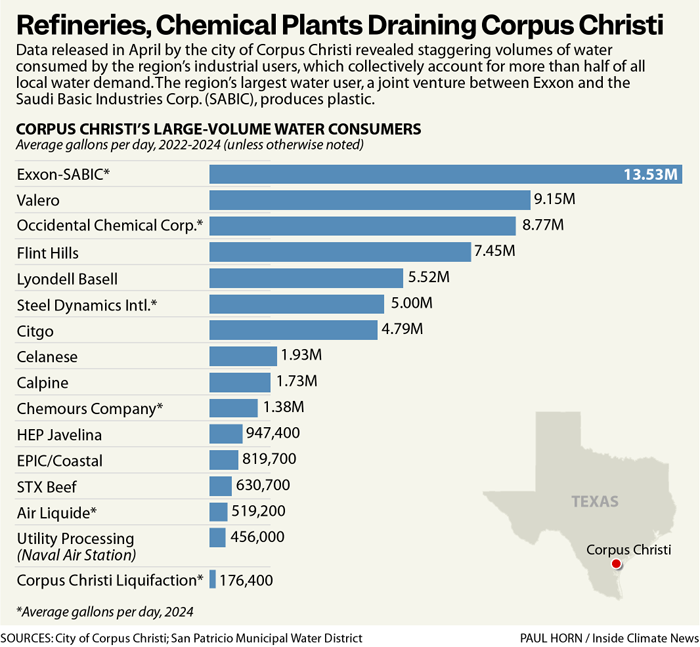
Castillo thought lawmakers focused too much on developing new water sources and not enough on conserving what they already have. For example, she pointed just five miles from Taft, where an enormous Exxon-SABIC plastics plant, booted up in 2022, uses more water than all 300,000 residents of the City of Corpus Christi combined.
Last week Corpus Christi leaders announced plans to require a 25 percent cut in water use in September for facilities like Exxon-SABIC and the other 14 large industrial users, including companies like Occidental Chemical, Valero, Flint Hills and Lyondell Bassel.
Castillo, whose family goes back generations in Taft, thinks emergency cuts should be required immediately. She said Corpus Christi leaders are prioritizing the profits of global corporations over the lives of residents here.
“They’re not taking this as seriously as they should be,” she said. “There needs to be more pressure put on Greg Abbott.”
Abbott, a champion of business-friendly policy in Texas, waived regulations in March to expedite Corpus Christi’s emergency groundwater projects and has pledged state investment to develop new water supplies. In 2024 the state committed $750 million in low-interest loans to help Corpus Christi develop a seawater desalination project, which the city then canceled in 2025 but hopes to revive in June.
Abbott has not made public calls for companies to reduce water use or acknowledged the potential for mandatory cuts in September.
“The Coastal Bend is an important economic driver not only for Texas but also the nation,” said Abbott’s press secretary, Andrew Mahaleris, in a statement to Inside Climate News. “Governor Abbott will utilize all necessary tools to ensure the Corpus Christi area has a safe, reliable water supply.”
Corpus Christi is scrambling to develop a portfolio of emergency groundwater projects, but city leaders still expect to require emergency cuts to water consumption in September. Now schools, hospitals, chemical plants, cities and towns are all drilling their own emergency water wells.
When Corpus Christi City Manager Peter Zanoni appeared on the April 24 broadcast of NBC News, a reporter asked why the city doesn’t require its large industrial customers to reduce water use immediately.
“We don’t want to wreck our economy,” Zanoni said. “It is a race against time.”
Neena Satija of the Texas Newsroom and Emily Salazar of KEDT contributed to this report.
About This Story
Perhaps you noticed: This story, like all the news we publish, is free to read. That’s because Inside Climate News is a 501c3 nonprofit organization. We do not charge a subscription fee, lock our news behind a paywall, or clutter our website with ads. We make our news on climate and the environment freely available to you and anyone who wants it.
That’s not all. We also share our news for free with scores of other media organizations around the country. Many of them can’t afford to do environmental journalism of their own. We’ve built bureaus from coast to coast to report local stories, collaborate with local newsrooms and co-publish articles so that this vital work is shared as widely as possible.
Two of us launched ICN in 2007. Six years later we earned a Pulitzer Prize for National Reporting, and now we run the oldest and largest dedicated climate newsroom in the nation. We tell the story in all its complexity. We hold polluters accountable. We expose environmental injustice. We debunk misinformation. We scrutinize solutions and inspire action.
Donations from readers like you fund every aspect of what we do. If you don’t already, will you support our ongoing work, our reporting on the biggest crisis facing our planet, and help us reach even more readers in more places?
Please take a moment to make a tax-deductible donation. Every one of them makes a difference.
Thank you,