

RICHMOND, Va.—Virginia lawmakers under Democratic control failed to produce a budget on schedule Thursday because of heightened debates over a tax exemption for data centers.
Lawmakers from both chambers adjourned without passing a budget draft needed to make their spending plan public for the required 48 hours prior to a final vote on Saturday, the last day of the legislative session. Democrats control the House 64-36 and the Senate 21-19, with newly elected Democratic Gov. Abigail Spanberger completing the party trifecta.
Senate Democrats favor an end to billions of dollars in tax exemptions for data centers on Jan. 1, while House Democrats approved legislation last month that would have continued those exemptions as long as data centers move away from fossil fuels and transition to renewable energy.
The tax exemptions for the massive server farms are an enormous issue in Virginia, the data center capital of the world, with 575 facilities in operation, according to Data Center Map, more than any other state, or any nation besides the U.S. The state is home to much of the country’s national security establishment and birthplace of the internet, with competitor states closely watching its tax and regulatory policies in the highly competitive and fast-growing data center arena.
The state’s current tax policy exempts data centers that invest $150 million and create 50 jobs from its retail sales and use tax on their computer equipment, which ranges from 5.3 percent to 7 percent, depending upon the locality. The exemption ends in 2035, but more investments and jobs extend the credit to 2050. In 2025, those tax exemptions were worth $1.9 billion to data centers, the equivalent of 2 percent of the state’s $74 billion budget.
Del. Luke Torian, D-Prince William, chairman of the House Appropriations Committee, noted the enormous economic development benefit the state reaps from data centers and said the budget impasse stemmed directly from the Senate’s desire to end their tax exemptions, making the state less competitive for business.
“Eliminating the sales and use tax exemption would cost Virginia far more than lost tax revenue,” Torian said in a floor speech before adjournment. “Virginia’s reputation as a reliable place to do business would be called into question.”
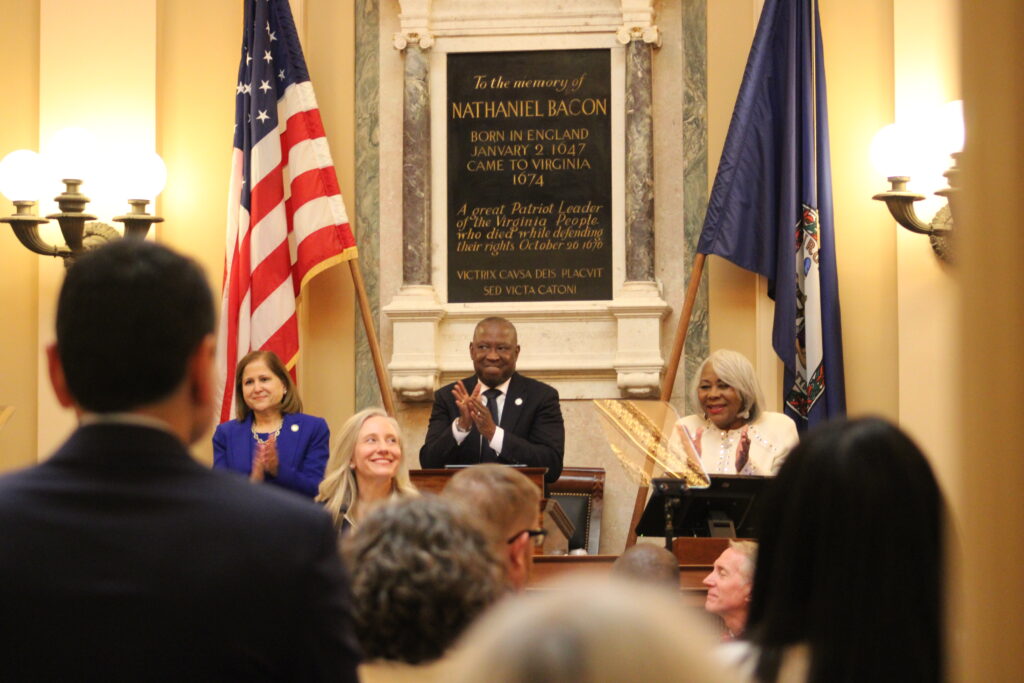
Senate President Pro Tempore Louise Lucas, D-Portsmouth, the chamber’s leading proponent for ending the tax exemptions, declined to share any specifics on budget negotiations with Inside Climate News when asked after adjournment as she left the chamber. But she took to X to share a statement.
“As you know I’ve been saying for weeks now that we will not pass a budget that puts data centers tax breaks ahead of hard working Virginia families and I am not backing down now,” she posted.
The Different Tracks
Lucas’ proposal to end the exemptions Jan. 1 could raise about $1 billion in revenue over the next two years for transportation and other needs and potentially $93.8 million to localities.
On the House side, continuing the exemptions would have required data centers to stop using their own polluting fossil fuel electricity sources as primary power. Natural gas power plants dedicated to data centers are a growing trend around the country.
“Texas and others, they want to have what we have, so we need to be very thoughtful on how we move forward,” said House Speaker Don Scott, D-Portsmouth, in remarks to reporters last week.
“Of course, make the data centers take care of their own power, pay for their own water and make sure they have no detrimental impact on noise in communities,” Scott continued. “We can’t throw the baby out with the bath water.”
The budget will ultimately have to go to the governor, who’s offered some insight on an alternative: use an existing energy consumption tax. It’s a rate that all customers pay that increases with electricity use.
Spanberger has said she’s concerned about disrupting existing contracts that data centers have for the exemption, even though those contracts have clauses allowing them to be changed by the General Assembly.
“Virginians know that rising energy costs is a challenge,” said Spanberger. “If the issue is how much energy our data centers are using, well, should there be a consumption tax to make sure that they are quite literally paying their fair share when it comes to the energy consumption. … It comes down to a basic issue of fairness.”
What’s Next
Lawmakers have two more days before leaving Richmond and returning April 22 to act on other legislative recommendations from Spanberger. It’s unclear if any procedural moves could be made to present the budget and pass it before Saturday. They could call a special session between now and late April for further budget deliberations.
A new budget needs to be adopted by July 1, or localities and services could go un-funded.
The budget delay means negotiations can continue. Energy experts, legislative analysts and environmentalists all say it’s unclear which way those will go. On Wednesday, Virginia Attorney General Jay Jones, Lucas and other budget negotiators and data center representatives from Amazon, Microsoft, Meta and the Data Center Coalition met in a closed-door meeting at the Capitol. But all of them declined to share what happened as they walked out. Data center representatives met behind closed doors again on Thursday.
Sen. Glen Sturtevant, a Republican who represents a district south of Richmond, said he is concerned about opposition from House Democrats to ending the tax exemptions. The money generated from ending those could go toward middle-class tax breaks, he said.
“Instead, we’re giving a huge corporate tax break to the biggest companies in the world,” he said. “If it was the governor who really stuck to her guns that wanted data centers to pay their fair share, then you’d have the governor aligned with where the Senate is.”
About This Story
Perhaps you noticed: This story, like all the news we publish, is free to read. That’s because Inside Climate News is a 501c3 nonprofit organization. We do not charge a subscription fee, lock our news behind a paywall, or clutter our website with ads. We make our news on climate and the environment freely available to you and anyone who wants it.
That’s not all. We also share our news for free with scores of other media organizations around the country. Many of them can’t afford to do environmental journalism of their own. We’ve built bureaus from coast to coast to report local stories, collaborate with local newsrooms and co-publish articles so that this vital work is shared as widely as possible.
Two of us launched ICN in 2007. Six years later we earned a Pulitzer Prize for National Reporting, and now we run the oldest and largest dedicated climate newsroom in the nation. We tell the story in all its complexity. We hold polluters accountable. We expose environmental injustice. We debunk misinformation. We scrutinize solutions and inspire action.
Donations from readers like you fund every aspect of what we do. If you don’t already, will you support our ongoing work, our reporting on the biggest crisis facing our planet, and help us reach even more readers in more places?
Please take a moment to make a tax-deductible donation. Every one of them makes a difference.
Thank you,

Charles Paullin
Charles Paullin is a Richmond, Virginia-based reporter focusing on energy and environment issues. He’s won several awards for his previous work covering state policy with the Virginia Mercury and local news with the Northern Virginia Daily in the Northern Shenandoah Valley. His first reporting gig was with the New Britain Herald in Connecticut, a couple years after attending the University of Hartford, where he first studied sports journalism.