

Salty water is gurgling up from underground in the middle of the small Permian Basin town of Grandfalls, Texas.
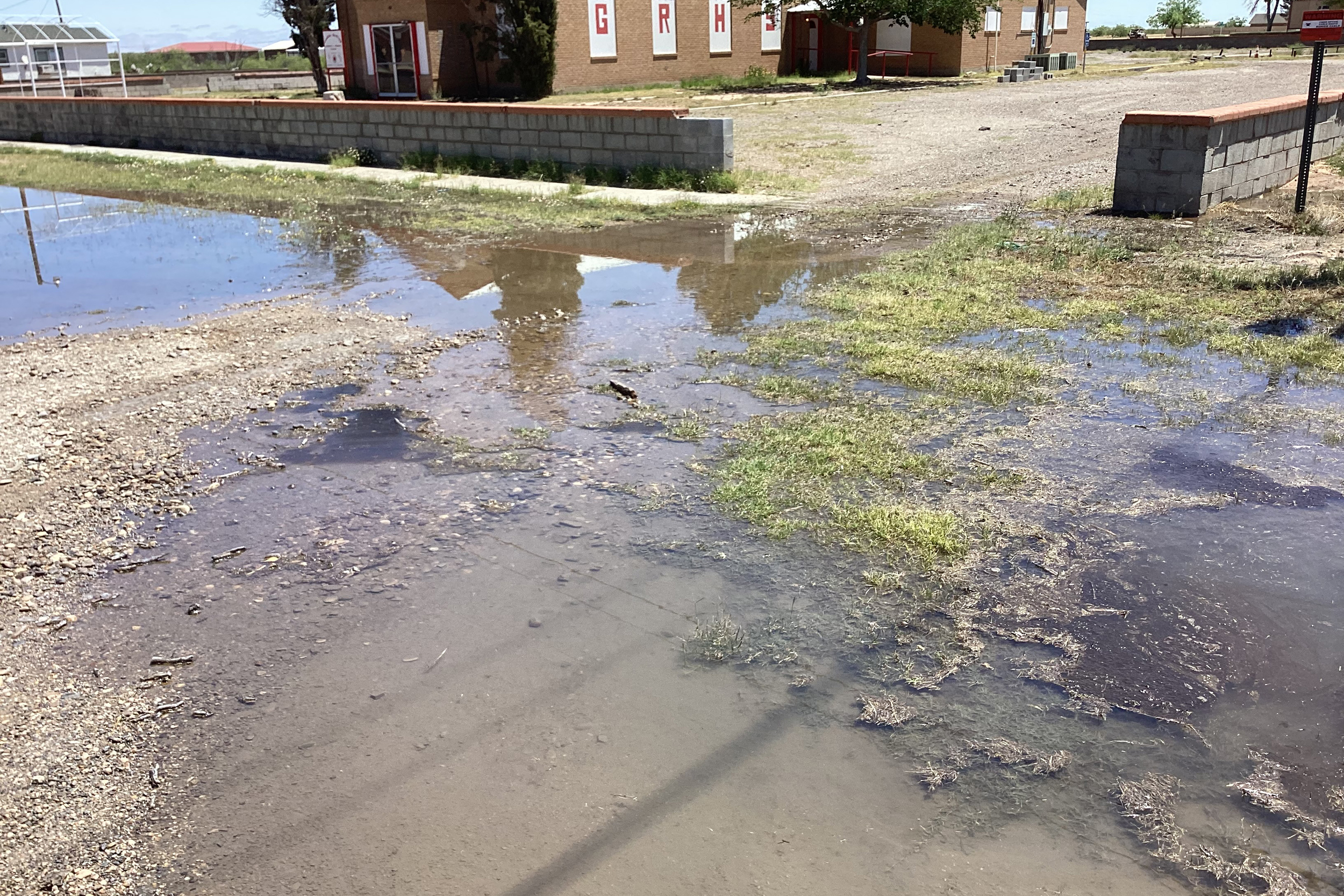
The liquid began pooling in the parking lot of the First Baptist Church on Tuesday. State inspectors from the Railroad Commission arrived soon after and remained on-site on Wednesday. Nearby landowners suspect oilfield wastewater is pushing up through the wellbore of an old plugged oil well.
It is the latest instance of water bursting to the surface in the Permian Basin, which has been wracked by blow-outs, geysers and surface leaks in the last five years. Oilfield wastewater, known as produced water, is injected underground, increasing pressure below the surface.
State regulators acknowledge that excess pressure underground has contributed to other surface leaks in the Permian Basin. The wastewater has extremely high salt content and can contain other contaminants.
Unlike recent blowouts and geysers that occurred on ranches, the latest incident is in the middle of a town that is home to over 300 people. The latest leak is one block from the Grandfalls-Royalty K-12 school and across the street from the historic Union Church, built in 1910. Vacuum trucks were siphoning the liquid off the Baptist Church parking lot on Wednesday. Residents have been warned to keep their distance.
“The Railroad Commission of Texas is responding to an unidentified flow located in Grandfalls in Ward County,” said spokesperson Bryce Dubee. “State Managed Plugging crews are currently on site and have begun removing fluid while continuing to assess the area to determine if the source of the flow is from an oil and gas well.”
The Grandfalls city administrator said Wednesday morning that residents should refer any questions to the Railroad Commission. She said she had called the commission’s district office in Midland, but “it rang and rang and nobody ever answered.” A school district employee said that classes were proceeding as usual while the cleanup operation was underway.
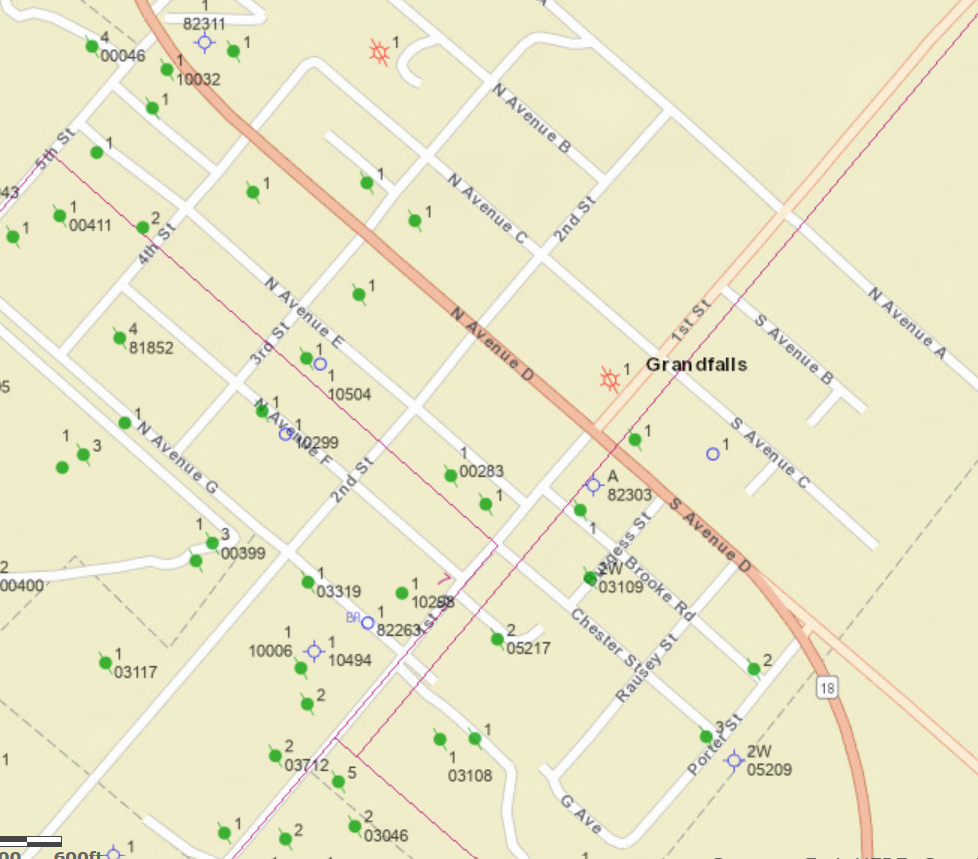
The Railroad Commission’s online Geographic Information System map shows a plugged oil well underneath the foundation of the Baptist church. The date the well was drilled or plugged and other identifying information was not immediately available. There are at least two dozen plugged wells within Grandfalls’ city limits, according to the online map. Many plugged wells in Texas predate modern record-keeping and state officials have limited information about the plugging methods or materials used.
Laura Briggs, a nearby landowner in Pecos County, said she drove through Grandfalls early Tuesday morning and could already see water accumulating on the street. She said the water appeared to be leaking from under the church sanctuary. Briggs said the building’s cornerstone indicates the church dates to 1955. Any plugged oil well underneath would predate the church.
By the time Sarah Stogner, the district attorney for the 143rd Judicial District of Texas which includes Ward County and a longtime oilfield watchdog, arrived on Wednesday afternoon, vacuum trucks had sucked up most of the water. The crew appeared to have drilled a hole in the parking lot and placed hoses into it to collect water. Liquid continued to gurgle to the surface while Stogner took drone footage.
“This is why we need to stop building on top of old plugged wells,” Stogner wrote on X. “They don’t always stay plugged.”
Since the advent of fracking in the Permian Basin, oil companies have generated vast quantities of produced water, the wastewater that comes to the surface during drilling. Most of the water is injected back underground into deep disposal wells. After these wells were linked to a spate of earthquakes in the Permian Basin, the Railroad Commission restricted deep injection in certain areas.
Operators shifted to inject into shallow formations instead. But the shallow injection began to fill underground reservoirs and increase pressure. Aging wellbores or wells that were plugged decades ago have become conduits for the pressurized water to erupt to the surface. Last year, the Railroad Commission introduced new permit restrictions to limit injection pressure and prevent blowouts and leaks.
Many of these incidents have been concentrated around aging oilfields in Ward, Crane and Pecos Counties, where wells were drilled in the 1930s or earlier. Grandfall’s population boomed after oil was discovered nearby in 1928, but has declined since the 1990s.
Stogner documented a previous surface leak in Grandfalls in 2022. Grandfalls is on Farm to Market Road 18 between Fort Stockton and Monahans, about 70 miles southwest of Midland and over 350 miles west of Austin. The town was named for the falls that once cascaded down the Pecos River near town. There is no longer enough water to feed the falls.
About This Story
Perhaps you noticed: This story, like all the news we publish, is free to read. That’s because Inside Climate News is a 501c3 nonprofit organization. We do not charge a subscription fee, lock our news behind a paywall, or clutter our website with ads. We make our news on climate and the environment freely available to you and anyone who wants it.
That’s not all. We also share our news for free with scores of other media organizations around the country. Many of them can’t afford to do environmental journalism of their own. We’ve built bureaus from coast to coast to report local stories, collaborate with local newsrooms and co-publish articles so that this vital work is shared as widely as possible.
Two of us launched ICN in 2007. Six years later we earned a Pulitzer Prize for National Reporting, and now we run the oldest and largest dedicated climate newsroom in the nation. We tell the story in all its complexity. We hold polluters accountable. We expose environmental injustice. We debunk misinformation. We scrutinize solutions and inspire action.
Donations from readers like you fund every aspect of what we do. If you don’t already, will you support our ongoing work, our reporting on the biggest crisis facing our planet, and help us reach even more readers in more places?
Please take a moment to make a tax-deductible donation. Every one of them makes a difference.
Thank you,

Martha Pskowski
Reporter, El Paso, Texas
Martha Pskowski covers climate change and the environment in Texas from her base in El Paso. She was previously an environmental reporter at the El Paso Times. She began her career as a freelance journalist in Mexico, reporting for outlets including The Guardian and Yale E360. Martha has a B.A. in Environmental Studies from Hampshire College and a master’s degree in Journalism and Latin American Studies from New York University. She is a former Fulbright research fellow in Mexico. Martha can be reached on Signal at psskow.33.