

SANFORD, Maine—Twelve candidates. One public poll and one debate. And finally, this past weekend, 16 county meetings to elect 500 delegates who will help choose a nominee at a statewide convention on Saturday.
This has been the condensed, chaotic mini primary touched off after Graham Platner, who originally got the Democrats’ nod to run against incumbent Republican Sen. Susan Collins this fall, withdrew his candidacy, following the July 6 publication by Politico of a rape allegation by an ex-partner of Platner’s.
Under state law, the Democrats have until July 27 to select a replacement. The party chose to do so with a nominating convention made up of elected delegates and state party committee members.
In the middle of two weeks of intense and unusual campaigning by those jockeying for the nod, an Immigrations and Customs Enforcement (ICE) officer shot and killed a man in Biddeford, Maine, causing outpourings of grief and anger across the state and among the candidates.
Longtime state senator Troy Jackson, who came in third in the recent Democratic primary for governor before turning his ambitions to the Senate following the Platner allegations, has emerged from the county meetings with an apparently insurmountable lead in supportive delegates—at least, according to the campaign’s list of claimed supporters. “It’s not clear that the candidates’ released lists of loyal delegates were totally accurate,” wrote the Portland Press Herald on Saturday.
The four candidates closest behind Jackson in the July 10 poll have since withdrawn their candidacies, however, and largely coalesced behind him.
Climate and environmental issues have not gotten much attention in the frenzy; debate moderators did not ask about them and the few existing comparisons of the candidates’ policies have left them out entirely.
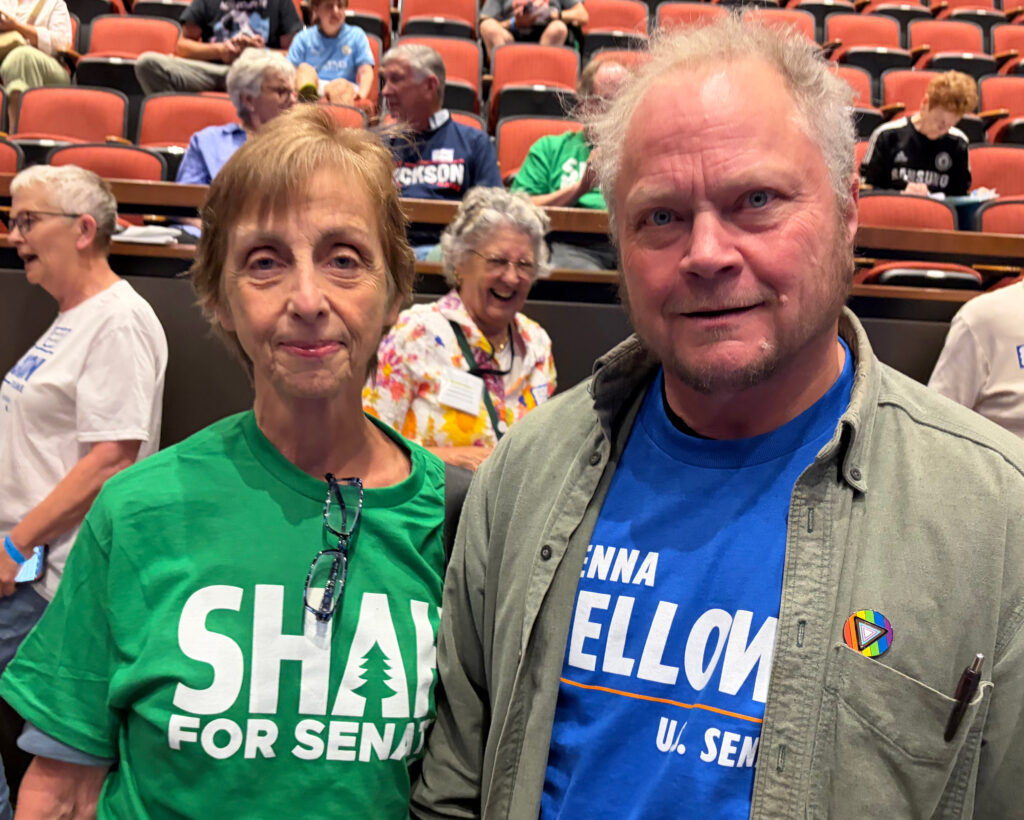
This has left some voters hungry for information. “Climate change is huge for me,” said Trish English, of South Berwick, who was attending York County’s convention to elect delegates on Saturday (and supporting former Maine Centers for Disease Control and Prevention Director Nirav Shah). “And it just blew my mind when you mentioned [climate policies], because I thought, ‘I don’t know where any of them stand on climate change.’”
Meet Troy Jackson
A revealing insight into how the low-key Jackson might work to address climate issues came in a June question and answer session he recorded with members of Our Power, a group that has advocated for greater public ownership of Maine’s energy systems, while he was running for governor.
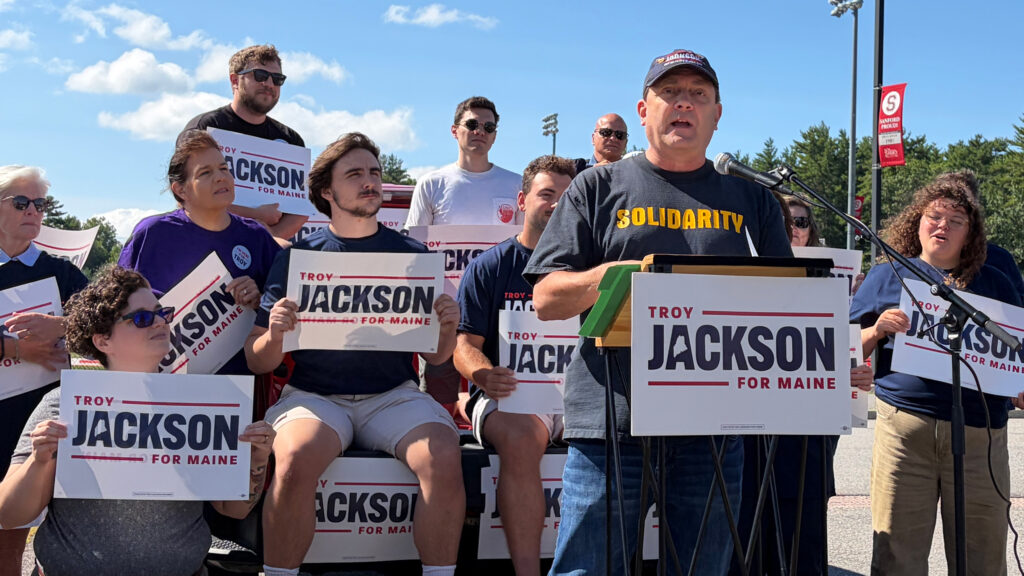
“What we have to do from now on is bring everybody to the table so that we can get real solutions that doesn’t [sic] pit working class people against renewable energy,” said Jackson, who won multiple elections as a Democrat in a deep-red, rural county. “It’s something that the Republicans have latched onto, making it seem like this is the reason why rates are so high, and the only way you combat that is bring everybody to the table so everyone’s hearing the same information and no one feels like they’re being left out of the discussion.”
Jackson’s start in politics is as dramatic as they come: As a 30-year-old, fifth-generation logger from Allagash, he participated in a border blockade by loggers frustrated with what they claimed was their employers’ illegal over-employment of Canadian workers (who received lower wages) in 1998. The loggers blocked a major border crossing with their trucks for nearly a week before standing down.
Frustrated with the resolution, Jackson ran for state representative as a Republican two years later and lost, before successfully running as an independent in 2002. (He joined the Democrats in 2004 and has remained with the party ever since.)
As a state senator, including six years as Senate President from 2018 to 2024, Jackson’s experience as a logger was apparent on multiple occasions. In 2021, he was the lead sponsor of a bill to ban aerial spraying of glyphosate (a practice used by logging companies and some large landowners) that passed the legislature but was vetoed by Democratic governor Janet Mills.
He also sponsored multiple unsuccessful bond measures and other bills that supported research into and the use of woody biomass—a broad category that ranges from whole small trees to sawdust—as a form of energy.
Jackson told Inside Climate News he could envision using the Senate perch to try to secure federal funding “to actually build a scale facility here in Maine, where we’ll be burning biofuel and not relying on oil from overseas.”
Environmentalists like journalist Bill McKibben, founder of 350.org, have criticized biomass energy for, they say, not actually reducing greenhouse gas emissions relative to fossil fuel use. But in heavily forested Maine, leading environmental groups like the Natural Resources Council of Maine have historically tried to find a middle ground, supporting burning of some types of woody biomass products in some circumstances.
Jackson has received a lifetime score of 81 percent for his legislative tenure from the environmental advocacy group Maine Conservation Voters, with scores reflecting increasing alignment later in his tenure. His last vote to earn a points deduction from MCV came in 2023, when he voted in favor of a bill that environmental groups said would have the effect of preventing local governments from banning fossil-fuel based forms of heating (although, on its face, the bill applied equally to bans on all forms of heat). The law did not pass.
“Maine Power for the Benefit of Mainers”
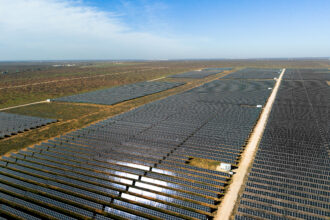
Jackson also initially spearheaded, via legislation in 2021, the ongoing effort to build a massive new amount of onshore wind power in Aroostook County, his home county, plus a transmission line to carry all that power south to Maine and New England’s population centers.
Intriguingly, the large northern region Mainers refer to simply as “the County” is not plugged into the rest of the New England grid, and, as ICN previously reported, Jackson chose not to require that the development include offramps to deliver some of the wind energy to the county (the unsuccessful biomass bond measure he sponsored in 2021 did have grid integration for Northern Maine as one of its aims).
After an initial attempt at a procurement fell apart in 2023, the state Public Utilities Commission (PUC) recently closed its bidding in a second attempt to select developers to build the wind and transmission projects.
This story is funded by readers like you.
Our nonprofit newsroom provides award-winning climate coverage free of charge and advertising. We rely on donations from readers like you to keep going. Please donate now to support our work.
Donate NowJackson now finds himself at odds with the approach the PUC is taking, which is to share both the costs of building the transmission line and the power that will be generated in Northern Maine with other New England states. Jackson told Inside Climate News in January that Maine should keep the rights to all this power—projected to be among the cheapest new sources of electricity in New England, if it gets built. He reiterated that position to Our Power.
“This is Maine power, and it should be for the benefit of Mainers,” Jackson said. “We can give our wind away, we can give our power away to [New England states], or we can charge them.”
The issue is not so much the physical power itself, which will inescapably be shared among New England states thanks to a regional grid, but the rights to claim it and its renewable energy attributes at a low price via long-term contracts.
Jackson noted that as a U.S. senator, he would be well positioned to help the project across the finish line, potentially through new federal funding. “I mean, I might still be able to make that [project] happen, right?” he said with a laugh.
Taking “Rate of Return” National
Household energy costs, in addition to electricity, include heating and transportation fuels. They are a hot-button issue in Maine, where retail prices paid for electricity have seen the third-largest increases in the country in recent years.
During his gubernatorial campaign, Jackson seized on public anger about a proposed further rate increase by Maine’s largest electric utility: At an October 2025 press conference, he simultaneously opposed the proposal and launched his energy plan for the governor’s race.
That rate proposal was rejected by the PUC. The utility, Central Maine Power (CMP), is now defending a smaller proposed rate increase in an ongoing proceeding.
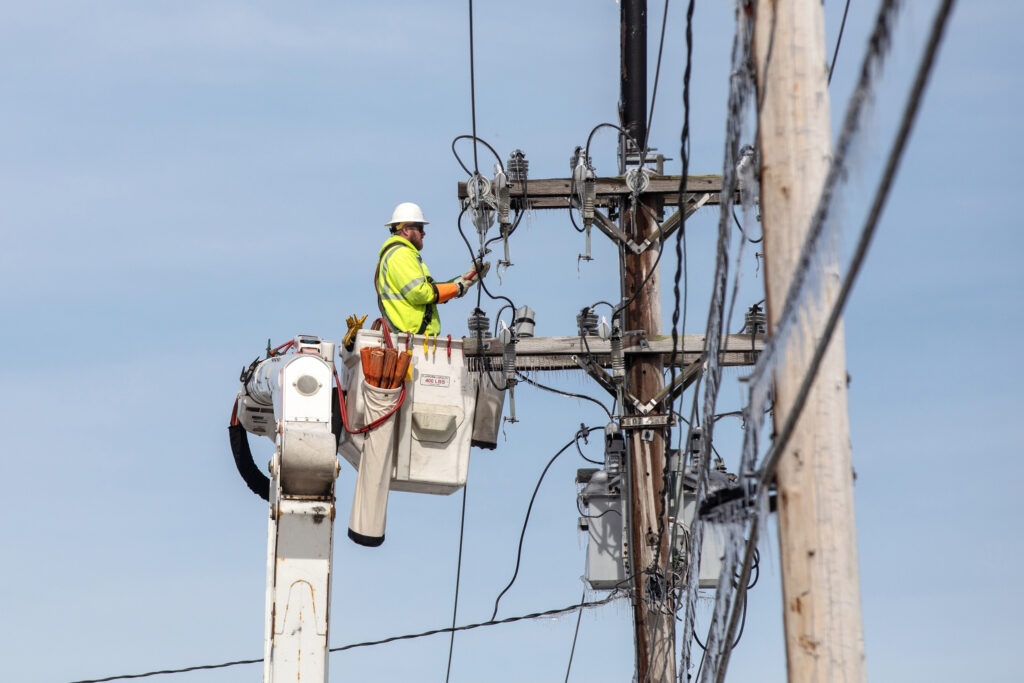
Jackson’s gubernatorial platform included calling for a cap on the amount that the PUC allows for-profit utilities and their shareholders to profit from physical investments to deliver power to customers—often referred to as the “guaranteed rate of return” or “allowed rate of return.”
In recent years, the PUC has allowed rates of return of between 9 and 10 percent on these investments. Jackson called for a cap below this, though he did not propose a specific rate like some other candidates.
CMP has defended the proposed rate increase as necessary to secure funding to replace and upgrade aging infrastructure and harden it against storms made worse and more frequent by climate change. In a statement to ICN, CMP also noted that delivery charges, which are the subject of the PUC rate proceeding, make up only 48 percent of a typical bill, with the remainder being electricity supply and public policy charges outside its control. And it claimed in a filing to the PUC that despite the allowed return on equity of about 9.3 percent on these distribution charges, over the last two years, its actual returns were closer to 5 percent.
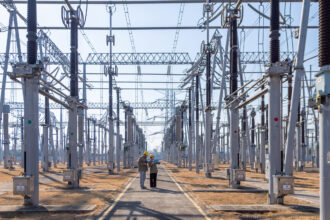
Unlike a governor, U.S. senators have very little influence over rate decisions by state regulators—but they can have an outsized impact on energy generation costs, whether through federal investment tax credits or proposed rules around data center costs. They also might be able to help rein in the amounts ratepayers pay for transmission of electricity.
That’s because, unlike with local power delivery, the Federal Energy Regulatory Commission (FERC) sets the rates, including the allowed rate of return, for most utilities engaged in transmission of electricity, which is considered interstate commerce. And in recent years, FERC has allowed rates of return from 9.5 percent to 10.5 percent for New England transmission owners, including Avangrid, the parent company of CMP.
Congress created FERC as an independent agency and oversees it. Recent proposals from the American Economic Liberties Project and Rocky Mountain Institute, among others, have called for Congress to revisit its mandates to FERC around the rate of return.
Both From “the County”
Should Jackson falter, a couple of other remaining candidates have emphasized the importance of climate change to their campaigns.
Lizzie Dickerson, a former member of the Rockland City Council and Maine House of Representatives, said during Thursday’s debate that climate issues drove her to enter the race. “We had these big plans,” she told ICN about her time in office, which included efforts to develop light rail and convert spare manufacturing space to making solar panels. “And yet here we are. It’s 2026, and the planet is burning up, and we still haven’t gotten anywhere substantive with this. And in fact, our president is doing things that are making it far worse.”
David Costello, meanwhile, a former acting Secretary of the Maryland Department of the Environment, told ICN, “It’s one of my stronger points, to make the case for a much more aggressive national plan that includes pricing carbon as well as [carbon] drawdown projects.”
If Jackson does win the nomination on Saturday, the general election will pit two people who grew up in sparsely populated Aroostook County (population roughly 66,000) against one another in the general election: Collins is originally from Caribou.
Jackson said he’s “thought about that [fact] a lot. I mean, we’re both from the County, but we’re totally different. You know, I’m not management. I’m working class. … I never grew up in wealth or anything like that.”
And in an election focused on economic issues, Jackson told ICN he believes climate change and energy will be important topics of discussion. “Climate and energy, I believe, are economic things that can, you know, help transform the state, and I do—I want to talk about them.”
About This Story
Perhaps you noticed: This story, like all the news we publish, is free to read. That’s because Inside Climate News is a 501c3 nonprofit organization. We do not charge a subscription fee, lock our news behind a paywall, or clutter our website with ads. We make our news on climate and the environment freely available to you and anyone who wants it.
That’s not all. We also share our news for free with scores of other media organizations around the country. Many of them can’t afford to do environmental journalism of their own. We’ve built bureaus from coast to coast to report local stories, collaborate with local newsrooms and co-publish articles so that this vital work is shared as widely as possible.
Two of us launched ICN in 2007. Six years later we earned a Pulitzer Prize for National Reporting, and now we run the oldest and largest dedicated climate newsroom in the nation. We tell the story in all its complexity. We hold polluters accountable. We expose environmental injustice. We debunk misinformation. We scrutinize solutions and inspire action.
Donations from readers like you fund every aspect of what we do. If you don’t already, will you support our ongoing work, our reporting on the biggest crisis facing our planet, and help us reach even more readers in more places?
Please take a moment to make a tax-deductible donation. Every one of them makes a difference.
Thank you,