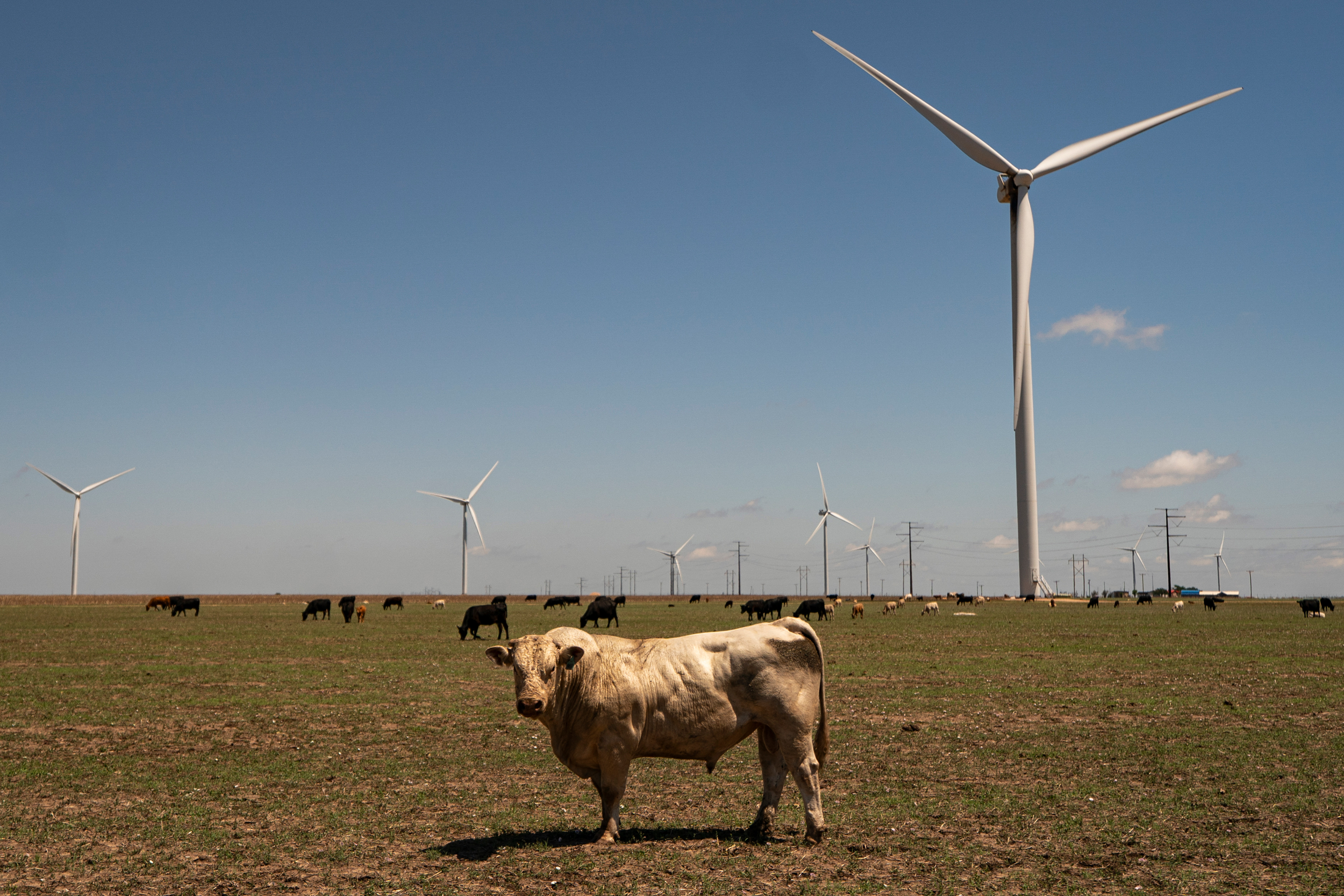


Environmentalists in Texas want the state to adopt new laws and regulations governing where renewable energy projects should be built, how they should run and what they can do to minimize their environmental impact. These policy proposals would be in stark contrast to what’s been introduced in prior legislative sessions—bills designed to artificially slow renewables’ progress.
Without clear rules, ideological opponents of renewable energy have weaponized conservation concerns to justify sweeping legislative proposals that would effectively ban new solar, battery storage and wind projects, according to a new report by the Environment Texas Research & Policy Center and the Frontier Group, both progressive research organizations.
Luke Metzger, the executive director of the research and policy center, said while wind and solar can have negative impacts on Texas land and wildlife, it’s less than those of fossil fuels.
There are renewable energy developers already using best practices, Metzger said, like utilizing acoustic surveys before construction to identify high-traffic bird corridors and implementing reasonable setbacks and light and noise standards.
These approaches help minimize environmental harm on private property, where ranch and farm families have stewarded the land for generations, Metzger said. The income these families earn from leasing their land for renewable energy development often helps them keep their land intact, rather than selling it off to be subdivided.
Metzger said state policy makers should ensure that any new rules support that approach, rather than blocking clean energy altogether.
“Banning renewables doesn’t protect our environment,” Metzger said. “It means more pollution, more water strain and it undermines those landowners that depend on that income to keep their land intact.”
The nonprofit group suggests that any siting policies for renewable projects should establish clear rules and include timely decisions and should avoid draconian or non-science based regulations.
The last time Texas lawmakers convened in 2025, numerous bills were introduced seeking to restrict the growth of renewable energy sources across the state.
One proposal, sponsored by Sen. Lois Kolkhorst, a Republican from Brenham, sought to force renewable energy projects to apply for permits required of no other energy generators and added new guidelines to increase setbacks from property lines for wind power projects.
During the last session, Kolkhorst told reporters that her proposed bill was about protecting the environment and landowners. She said it was the right thing to do for Texas.
The solar, wind and battery storage industries fought off proposed legislation aimed at requiring every watt of new solar generation to be accompanied by a watt of new gas generation.
Two bills sought to force existing wind and solar companies to buy fossil fuel-based power or connect to a battery storage resource to cover the hours the energy plants are not operating. Both renewables and oil company lobbyists saw the legislation as adding unnecessary costs and opposed it.

They were sponsored by Rep. Jared Patterson, a Republican from Denton County, and Sen. Kevin Sparks, a Republican from Midland. Patterson previously chaired the House Committee on Protecting Texas LNG. Sparks is the president of a family oil and gas company in Midland.
Patterson said at the time that the aim of the legislation was to ensure producers, not consumers, bear increased costs. He also worried about relying on the “whims of nature.”
After these bills did not advance through the Legislature, the Republican Party of Texas urged lawmakers to eliminate and counterbalance all subsidies, rebates and mandates for renewable energy sources and related infrastructure. The state GOP chapter also said that the Legislature should establish a uniform reliability standard.
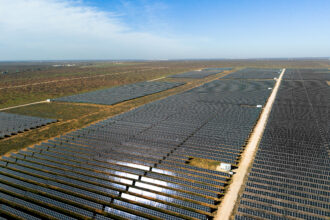
Texas leads the U.S. in its production of wind and utility-scale solar. On most days, solar, storage and wind are providing nearly half of the state’s electricity, said Cyrus Reed, the conservation director of the Sierra Club Lone Star Chapter. On March 14, renewables met a record 79 percent of the state’s electricity demand, according to a Solar Energy Industries Association report.
As renewable energy is meeting a larger share of the state’s daily electricity demand, it has significantly reduced air and water pollution, said Quentin Good, a policy analyst at Frontier Group and an author of the report.
As electricity consumption across the state grew between 2018 and 2023, sulfur dioxide emissions from Texas power plants went down by 50 percent and greenhouse gas emissions went down by 11 percent due, at least in part, to the growth of renewables, Good said.
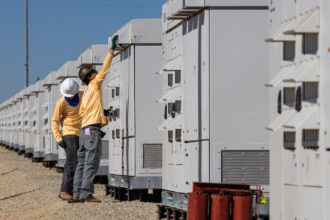
The addition of battery storage as part of Texas’ independent grid has helped store electricity when conditions have become tight, adding resilience and preventing system-wide outages Texans have grown to fear during serious weather events. On March 13, batteries supplied a record 20 percent of evening electricity demand.
“The massive amount of renewable energy and battery storage in Texas is really helping deliver cleaner air and water,” Good said. “It’s helping Texas move away from some of the harmful impacts of fossil fuel production and use.”
The report also said that any statewide regulations on renewables should prioritize stewardship of Texas land and wildlife, while also allowing landowners to responsibly develop energy projects on private land.
This story is funded by readers like you.
Our nonprofit newsroom provides award-winning climate coverage free of charge and advertising. We rely on donations from readers like you to keep going. Please donate now to support our work.
Donate NowA theme throughout legislative discussions in 2025 among conservative lawmakers was whether the proposed bills to curb the growth of renewables infringed on private property rights. By the end of deliberations, there was a divide among state Republicans.
Some lawmakers saw the effort to govern how Texans utilized their private land as a transgression against small government conservatism and strong private property freedoms. Other Republicans see the expansion of renewable energy in Texas as antithetical to the future of the party, one which has deep ties to the oil and gas industry and is aligned with President Donald Trump, a staunch opponent of renewable energy, especially wind.
Another recommendation the environmentalists made in the report is to set statewide baselines or ceilings for local siting requirements, like setbacks from a property line, so that localities cannot effectively ban renewables. This would increase certainty for developers, while providing a baseline for environmental projections, the report outlined.
Lastly, the report argues that lawmakers should adopt a tiered process which addresses risks specific to the technology and sensitivity of a specific site.
More environmentally sensitive areas should require stricter scrutiny, the report authors suggested, while renewable energy projects which chose their location with conservation in mind should have an accelerated review.
This could include projects that utilize existing developed land—like putting solar on rooftops and carports instead of utilizing the state’s best agricultural areas, said Garrett Bader, a smart solar specialist for the American Farmland Trust in Texas.
Lisa Gonzalez, the vice president and executive director of Audubon Texas, a chapter of the national bird conservancy group, said it’s important that developers work with agencies like Texas Parks and Wildlife and the U.S. Fish and Wildlife Service before a shovel ever hits the ground.
Responsible developers use advanced mapping to steer projects away from sensitive habitats and towards “low conflict areas,” Gonzalez said. There are also emerging artificial intelligence technologies being developed to curtail or slow wind blades when birds or bats are in the area.
In Texas, the effects of climate change—extreme weather, drought, rising temperatures, sea level rise and shifting seasons—are already reshaping the ecosystems that birds and other animals rely on, Gonzalez said.
As climate change is one of the single greatest long-term threats to Texas birds, from waterbirds to grassland species, Gonzalez said, shifting toward clean power is a high priority.
Texas lawmakers can start submitting their proposals for new state legislation after the fall elections. Environmentalists are preparing to argue against bills that restrict renewable energy and further incentivize fossil fuels.
About This Story
Perhaps you noticed: This story, like all the news we publish, is free to read. That’s because Inside Climate News is a 501c3 nonprofit organization. We do not charge a subscription fee, lock our news behind a paywall, or clutter our website with ads. We make our news on climate and the environment freely available to you and anyone who wants it.
That’s not all. We also share our news for free with scores of other media organizations around the country. Many of them can’t afford to do environmental journalism of their own. We’ve built bureaus from coast to coast to report local stories, collaborate with local newsrooms and co-publish articles so that this vital work is shared as widely as possible.
Two of us launched ICN in 2007. Six years later we earned a Pulitzer Prize for National Reporting, and now we run the oldest and largest dedicated climate newsroom in the nation. We tell the story in all its complexity. We hold polluters accountable. We expose environmental injustice. We debunk misinformation. We scrutinize solutions and inspire action.
Donations from readers like you fund every aspect of what we do. If you don’t already, will you support our ongoing work, our reporting on the biggest crisis facing our planet, and help us reach even more readers in more places?
Please take a moment to make a tax-deductible donation. Every one of them makes a difference.
Thank you,

Arcelia Martin
Reporter, Texas Renewables
Arcelia Martin is an award-winning journalist at Inside Climate News. She covers renewable energy in Texas from her base in Dallas. Before joining ICN in 2025, Arcelia was a staff writer at The Dallas Morning News and at The Tennessean. Originally from San Diego, California, she’s a graduate of Gonzaga University and Columbia University Graduate School of Journalism.