

Researchers analyzing modern and fossil corals from the Galápagos Islands concluded that global warming has intensified El Niño cycles over the last 40 years, making them more extreme than natural variations seen during the previous millenium.
Their study, published Thursday in Science, revealed sharper swings in sea surface temperatures in the eastern tropical Pacific Ocean beginning in the late 19th century, as the burning of fossil fuels accelerated and began disrupting the global climate.
The findings suggest that rising greenhouse gas concentrations are amplifying one of the world’s most important drivers of extreme weather. The scientists said they ruled out natural causes for the changes and found that their results align with modeling studies and coral records from other parts of the Pacific.
The study shows that El Niños are growing stronger “in parallel with the warming of global temperature,” said lead author Julia Cole, professor and chair of the University of Michigan Department of Earth and Environmental Sciences.
Cole said the results are concerning because strong El Niños in recent decades have been deadly and costly, and they are especially timely because the current El Niño ranks among the strongest on record by some measures and is already causing widespread disruption. A 2023 study estimated economic losses of trillions of dollars from the strong El Niños in 1982-83, 1997-98 and 2015-16.
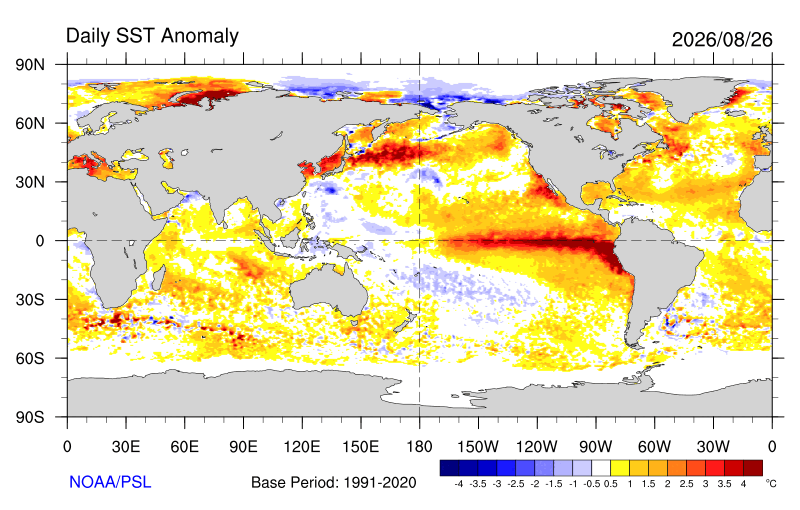
El Niño events are part of a vast, cyclical shift in the distribution of heat and moisture across the tropical Pacific and the atmosphere above it. They pump warm water eastward to raise sea level along the California coast by 12 inches, and fuel ocean heatwaves that decimate corals and coastal fisheries. The strongest events alter atmospheric circulation and rainfall patterns worldwide. Scientists measure El Niño strength in several ways, including temperature anomalies in the eastern tropical Pacific, where the greatest El Niño warming occurs. For July, the ocean in the region was 2.03 degrees Celsius (4.14 degrees Fahrenheit) above average. By mid-August, it climbed to 2.7 Celsius (4.86 degrees Fahrenheit), well into super El Niño territory.
Cole said the combination of the event and ongoing global warming will “likely to supercharge the temperature increase” this year and into 2027. Some projections forecast that global temperatures could reach 1.7 or 1.8 degrees Celsius above pre-industrial temperatures, well above the current record.
The Coral Trail
On global climate maps, El Niño is depicted as a deep red spear of unusually warm water extending westward from a hot blob along the coast of South America, and the Galápagos Islands are often near the center of the heat. The first documented super El Niño in 1982-83 killed about 95 percent of the shallow-water corals around the Galápagos Islands, right around the time Cole began her research career. While most of her peers were studying Earth changes on geological scales spanning millions of years, she wanted to zoom in to capture climate variability on a human timescale, she said.
When Cole visited the islands in 1989, many of the large mapped corals that could have served as sample material were gone, wiped out by the El Niño early in the decade and then decomposed quickly by organisms in the biologically active waters. But in 2006, her team discovered fossil coral remnants, often perched as boulders near remote east-facing coastlines, tossed inland by large waves or tsunamis.
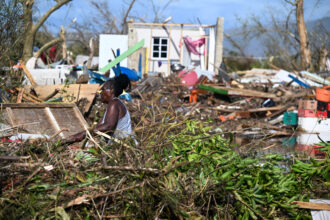
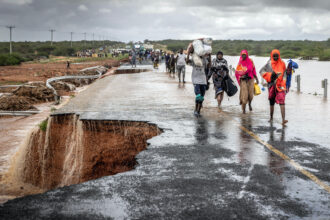
Cole said the signal of El Niños intensified by human-caused warming would have been even stronger if the study had included the most recent occurrences. All the events categorized as super El Niños have occurred since the 1980s and have triggered flooding in East Africa, led to disease outbreaks and intensified tropical storms. This year’s El Niño is intensifying drought in Indonesia, fueling widespread fires that are sending smoke and hazardous air pollution across Southeast Asia, Cole said. Her team is currently analyzing corals to show the changes from the El Niños in 2015-16 and 2023-24, she added.
Ocean scientist Mark Eakin, former head of the coral reef watch program at the National Oceanic and Atmospheric Administration, said the study documents the increasing frequency of intense El Niños “that have been directly responsible for severe marine heatwaves that drove coral bleaching and deaths of coral reefs around the world.”
This story is funded by readers like you.
Our nonprofit newsroom provides award-winning climate coverage free of charge and advertising. We rely on donations from readers like you to keep going. Please donate now to support our work.
Donate NowHe said the new long-term record of El Niño patterns “provides a critical understanding of the impact humans have had on both the climate and coral reefs.”
Corals grow one to two centimeters per year by depositing layers of calcium carbonate. The chemistry of these layers records the temperature of the seawater in which the corals grew. The researchers reconstructed the record by comparing elements and isotopes in the fossil core samples, which they extracted millimeter by millimeter using special drills. They show that El Niño cycles were relatively stable during the pre-industrial period from 1000 to 1850. Sea surface temperatures became more variable during a transitional period from 1850 to the 1980s, before the large spikes began with the first super El Niño in 1982-83.
Stronger El Niños, Devastating Impacts
Co-author Jonathan Overpeck, dean of the University of Michigan School for Environment and Sustainability, said each major El Niño in the last 20 years has pushed the global average temperature a step higher.
“El Niño has always increased the global temperature, but it used to come back down,” he said. But that changed after the 2015-16 event, when temperatures remained elevated. The same thing happened after the 2023-24 El Niño, even though it was weaker than the previous one. Overpeck said the step-change in temperature is an ominous sign that global warming is accelerating.
Humans and natural systems are already feeling the acceleration through more extreme weather, he added. “We’re seeing it in the flooding. We’re seeing it in the drying. We’re seeing it in the wildfires. These are all driven by extremes, and El Niño is one way to really supercharge climate extremes.”
Recent reports from the Intergovernmental Panel on Climate Change didn’t find a strong global warming fingerprint on El Niño variability, but the new study “adds to the growing pile of evidence that ENSO (El Niño-Southern Oscillation) has already become stronger as the planet warms,” said Brown University climate scientist Kim Cobb, director of the Institute at Brown for Environment and Society.
Long-term fossil records like those in the new study help measure the increase of El Niño strength in the last couple of decades compared to smaller natural variations during the pre-industrial era, said Cobb, who was not an author of the new paper but has conducted related research on corals from different parts of the Pacific.
The new study corroborates evidence gleaned from climate reconstructions from other corals across the central and western tropical Pacific to paint an ocean-wide picture, she said. “Taken together, these findings carry enormous consequences for societies and ecosystems around the world, as one of the largest sources of global weather and climate extremes seems poised to further amplify extremes in a warming world.”
About This Story
Perhaps you noticed: This story, like all the news we publish, is free to read. That’s because Inside Climate News is a 501c3 nonprofit organization. We do not charge a subscription fee, lock our news behind a paywall, or clutter our website with ads. We make our news on climate and the environment freely available to you and anyone who wants it.
That’s not all. We also share our news for free with scores of other media organizations around the country. Many of them can’t afford to do environmental journalism of their own. We’ve built bureaus from coast to coast to report local stories, collaborate with local newsrooms and co-publish articles so that this vital work is shared as widely as possible.
Two of us launched ICN in 2007. Six years later we earned a Pulitzer Prize for National Reporting, and now we run the oldest and largest dedicated climate newsroom in the nation. We tell the story in all its complexity. We hold polluters accountable. We expose environmental injustice. We debunk misinformation. We scrutinize solutions and inspire action.
Donations from readers like you fund every aspect of what we do. If you don’t already, will you support our ongoing work, our reporting on the biggest crisis facing our planet, and help us reach even more readers in more places?
Please take a moment to make a tax-deductible donation. Every one of them makes a difference.
Thank you,

Bob Berwyn
Reporter, Austria
Bob Berwyn is an Austria-based reporter who has covered climate science and international climate policy for more than a decade. Previously, he reported on the environment, endangered species and public lands for several Colorado newspapers, and also worked as editor and assistant editor at community newspapers in the Colorado Rockies.