

Second time’s the charm?
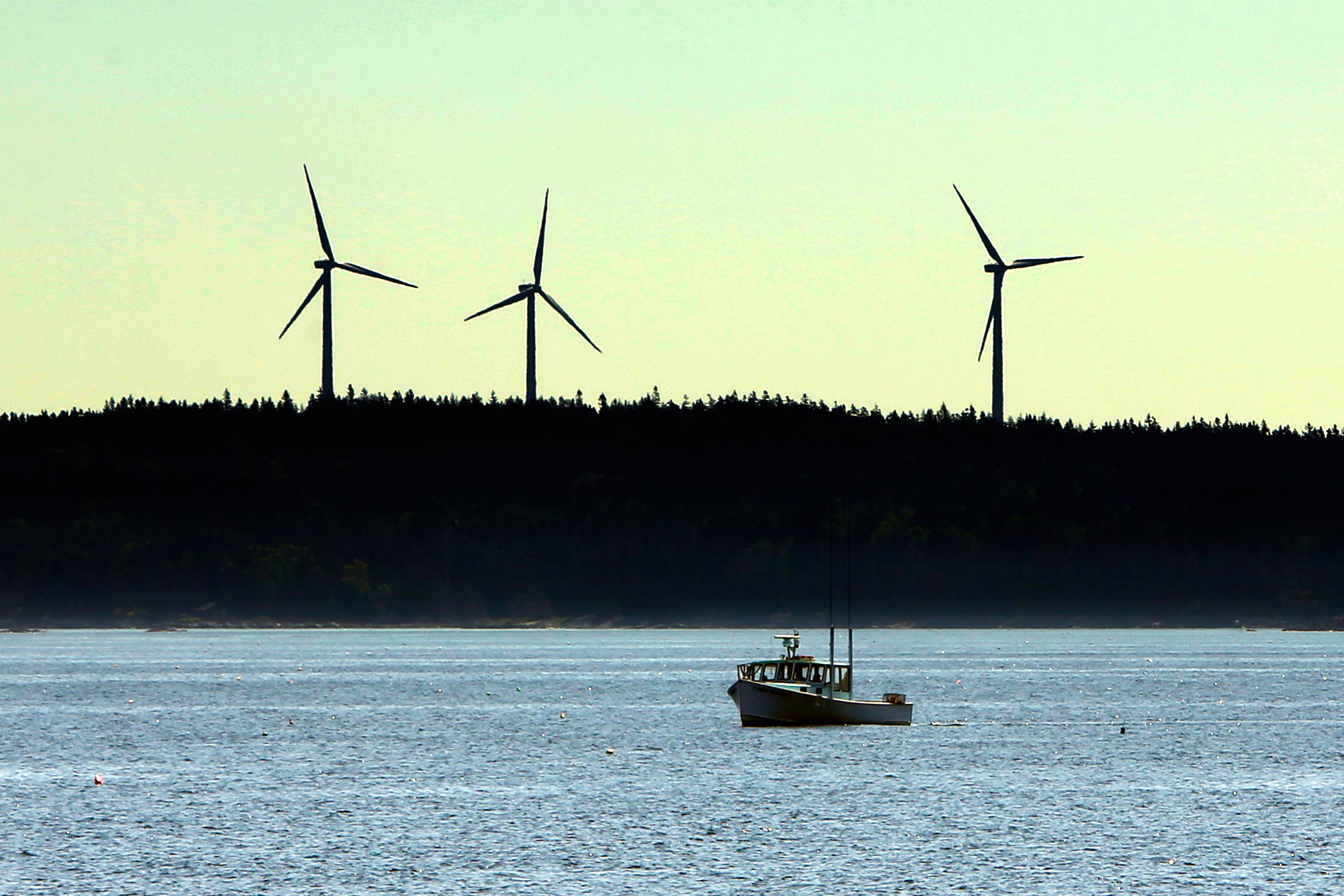
On Aug. 25, Maine’s Public Utilities Commission selected winning proposals in a years-long effort to turn more of northern Maine’s howling winds into energy that can power population centers in the southern part of the state and region.
The PUC selected one developer to build 800 megawatts of new onshore wind energy in Aroostook County—enough to power over 300,000 homes—and another to build a new transmission line capable of carrying up to 1,200 MW of power to Southern Maine and New England. Six hundred MW of the first tranche of power are reserved for Maine.
Advocates of renewable energy cheered the move.
“Maine has just said yes to 600 megawatts of clean energy—clean energy that is [at] a stable price, that is going to increase reliability and that is going to bring a whole host of economic benefits to Maine people,” said Eliza Donoghue, executive director of the Maine Renewable Energy Association.
Unlike the first time it ran this procurement, Maine did so in collaboration with four other New England states—Vermont, Rhode Island, Connecticut and Massachusetts—whose residents will help pay for the transmission line via charges on their utility bills, even as two of those states elected not to sign long-term deals for the new power.
Many steps remain before construction on the projects can commence, including securing all necessary local, state and federal approvals. If all goes to plan, power will flow across the new line in the “early 2030s,” according to PUC Chair Phil Bartlett.
That power is projected to boost grid reliability and cut both planet-warming emissions and costs, especially during the winter months when gas-fired power plants—the single largest source of electricity in New England—are more expensive to run, while wind speeds tend to be at their highest.
The scant public information about the project, however, left some critical of the process. “We don’t actually have enough information on the RFP portion to be able to make any kind of determination whether it’s great or not,” said Tanya Blanchard, co-founder and board president of Preserve Rural Maine, an organization that formed in response and opposition to the transmission line proposed last time this project was bid.
Among the remaining unknown details are the price for the power, the exact route the proposed transmission line will take, and the breakdown of how much each state’s ratepayers will pay for the transmission line.
Bartlett said that many of these details would be made public once contracts are finalized and defended the commission’s practice of secrecy before then. “There’s always the chance that things don’t get finalized and you’re going back out and you wouldn’t want to provide sort of unfair information to other competitors,” Bartlett said.
Federal approvals remain dicey under the presidential administration of Donald Trump, which has used every tool at its disposal to block the development of domestic wind power, even while power costs and demand have soared.
Perils Ahead
The first required federal approval will come not from a department of the Trump administration but from the independent Federal Energy Regulatory Commission (FERC).
FERC will need to approve the contract that the five states are still finalizing with the project developer, Avangrid.
Federal law typically limits FERC’s review of such contracts to about 60 days.
If FERC approves the transmission contract, Avangrid will still need state permits from the Maine PUC and Department of Environmental Protection. It would likely need U.S. Army Corps of Engineers approval as well, if the route crosses waterways or wetlands. At some point in those processes, the proposed transmission route would become public.
Environmental organizations cheered the progress toward new wind power while stopping short of supporting the wind and transmission projects until their environmental impacts are identified.
“With careful siting, thoughtful design, and responsible operation, the clean energy projects identified today will deliver reliable, affordable electricity to Mainers while reducing the pollution that is threatening our health and fueling changes to our climate that are already being felt across the state,” read a joint statement from the Natural Resources Council of Maine, Maine Audubon, Maine Conservation Alliance, Conservation Law Foundation and Acadia Center.
Avangrid is the parent company of Central Maine Power, the utility that delivers electricity to most Maine customers and has been locked in a months-long struggle with the PUC over its petition to further raise rates at a time of widely perceived energy unaffordability.
The PUC has said that this project will offer some relief, claiming it will net ratepayer benefits of $387 million to $425 million over its lifetime, factoring in all transmission costs. That number does not include local economic benefits or the benefits of avoided greenhouse gas emissions, but could not be independently verified.
To provide those cost savings, however, the turbines need to get built. San Francisco-based Clearway Energy Group will be responsible for building the wind farm.
Clearway’s senior director of communications, Zadie Oleksiw, told Inside Climate News that the company would proceed with seeking its own permit approvals “concurrently” with the transmission permitting.
Bartlett said the power purchase agreement that Maine is still finalizing with Clearway will be “contingent on” the transmission line receiving necessary approvals. In other words, construction on the generation project would likely not begin before all transmission approvals are finalized.
The Trump administration has pursued one tactic after another to slow or block wind energy—from issuing stop-work orders to offshore wind projects under construction, to buying back the leases of earlier-stage developments, to requiring personal review by Interior Secretary Doug Burgum of all proposals on federal land, to freezing heretofore routine Department of Defense reviews of any impacts to military aviation.
The Clearway project will reportedly be built on leased private commercial timberland and thus should avoid the Department of Interior bottleneck—but will almost certainly need several other federal approvals.
Lessons Learned?
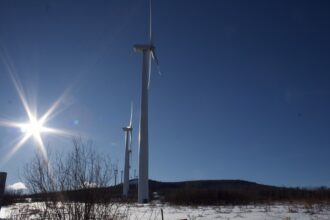
Several wind farms already exist in Northern Maine, including developments in Mars Hill, Oakfield and Columbia. Oakfield, with a capacity of 148 MW, is the largest and would be dwarfed by the proposed Clearway project.
But the transmission line on which the latter two installations send power to southern New England is at capacity. That has thwarted several additional proposed wind generation projects for over a decade.
Prior attempts to independently build new transmission lines to the region—including one by the Maine Electric Power Co., which is jointly owned by CMP and Maine’s other large utility, Versant—have also floundered. Observers described a chicken and egg problem of developers of proposed generation needing guaranteed transmission to secure financing, and vice versa.
This story is funded by readers like you.
Our nonprofit newsroom provides award-winning climate coverage free of charge and advertising. We rely on donations from readers like you to keep going. Please donate now to support our work.
Donate NowMaine responded by initiating a combined state-led procurement for both generation and transmission in Northern Maine, with projects selected at the end of 2022. The winning transmission developer quarreled with the PUC, however, over how to respond to unforeseen rising costs, and local opposition also erupted once the proposed route, which entailed substantial use of eminent domain, became public. The effort fell apart in acrimony.
Backers of the current Northern Maine project say that it is designed to avoid some of the pitfalls that sunk or delayed these earlier efforts.
An Avangrid spokesperson wrote, “A distinguishing feature of Avangrid’s proposal is its use of existing corridors and rights of way. By utilizing areas where the company has ownership and control, we can greatly reduce uncertainty and limit potential disruption to communities and the environment.”
Bartlett said that the contracts will include pre-determined adjustments to contract prices based on changing market conditions, ideally avoiding a similar disagreement to the one that emerged with the prior transmission developer.
And Maine will bear at most 11 percent of the cost of the new line, according to Bartlett, thanks to the involvement of other New England states.
A Picture Emerges
Each of the claimed advantages of these projects are subject to some uncertainty due to the limited public information. However, several key details have emerged.
While none of the four other involved New England states would confirm their share of the transmission costs to ICN, citing ongoing negotiations, Maine’s reported 11 percent share is close to its portion of overall electric load in New England—a metric used to divvy up the costs of transmission lines of regional importance. Chair Bartlett confirmed to ICN that the division was “in part based on Maine’s load share.”
As for siting, both Avangrid and the PUC glossed over a key distinction: between building a new line alongside an existing one and building it in a corridor where a utility has acquired rights of way, but nothing has yet been built.
Blanchard published a map showing how either scenario would make sense for this line: It could parallel existing transmission lines that form a “V” between Chester and Pittsfield, Maine, or it could follow a more direct route across which a CMP subsidiary previously proposed building a (largely) new transmission line between those towns.
ICN was able to verify via the Internet Archive that the map was previously hosted on a website created by the Maine Electric Power Company.
MEPCO had sought approval for the direct line and news reports said the company had acquired at least 60 percent of necessary rights of way as of 2017 before activities ceased.
After emailing an initial statement, Avangrid did not respond to an interview request or a detailed list of questions sent by ICN, including about the proposed transmission route.
Who Gets the Power?
As ICN reported earlier this year, the destination for this power is both complicated and controversial.
Physically, the electricity will mingle indistinguishably with other electrons and be shared across New England and, sources say, help drive down power costs through the wholesale markets.
“The building of renewable power anywhere in New England reduces the cost of wholesale power for all folks within New England,” said Maine’s Public Advocate Heather Sanborn.
On the other hand, utilities in some New England states can realize extra savings by contracting for rights to this power and the associated renewable energy attributes at a guaranteed price for a decade or longer, through power purchase agreements.
Some in Maine—including Democratic Senate candidate Troy Jackson—have called for Maine to hold onto all those rights, selling them if and when the price is right, even if it meant building the transmission line alone.
Additionally, while Northern Maine will host the project, it will not receive power from it in either the physical or contractual sense, being electrically disconnected from the rest of New England. The new proposed transmission line will only export power and so will not change this dynamic.
In announcing the selections, Maine’s PUC reported it would contract for 600 MW, presumably leaving 200 MW from the Clearway project for the other New England states.
Vermont Department of Public Service Commissioner Kerrick Johnson told ICN that the state could take “somewhere in the range of 40 to 50 megawatts,” of power from the project although Vermont utilities were “still actively considering and analyzing this opportunity.”
Rhode Island’s largest utility announced plans to contract for up to 150 MW of the power.
Neither of the two largest power-consuming states in New England, Massachusetts and Connecticut, will contract for a share of the 800 MW, according to officials with each state’s energy offices.
That could set up a race among the New England states to sign contracts with further wind farms and other would-be generators in Northern Maine to use the remaining 400 MW of line capacity.
For now, there are contracts to finalize permits to obtain in a federal environment as hostile as northern Maine in winter.
About This Story
Perhaps you noticed: This story, like all the news we publish, is free to read. That’s because Inside Climate News is a 501c3 nonprofit organization. We do not charge a subscription fee, lock our news behind a paywall, or clutter our website with ads. We make our news on climate and the environment freely available to you and anyone who wants it.
That’s not all. We also share our news for free with scores of other media organizations around the country. Many of them can’t afford to do environmental journalism of their own. We’ve built bureaus from coast to coast to report local stories, collaborate with local newsrooms and co-publish articles so that this vital work is shared as widely as possible.
Two of us launched ICN in 2007. Six years later we earned a Pulitzer Prize for National Reporting, and now we run the oldest and largest dedicated climate newsroom in the nation. We tell the story in all its complexity. We hold polluters accountable. We expose environmental injustice. We debunk misinformation. We scrutinize solutions and inspire action.
Donations from readers like you fund every aspect of what we do. If you don’t already, will you support our ongoing work, our reporting on the biggest crisis facing our planet, and help us reach even more readers in more places?
Please take a moment to make a tax-deductible donation. Every one of them makes a difference.
Thank you,