This story is part of an investigation conducted by an international team of journalists based at The Outlaw Ocean Project. Read the other stories here.
In May, the Hellenic Aquaculture Producers Organization gathered in Athens to promote the industry as the future of sustainable food security. Flanked by industry titans, the European commissioner for fisheries and oceans, Costas Kadis, framed aquaculture as a solution to the pressures of climate change, pollution and overfishing. “In the European Union, aquaculture is at the epicenter of our priorities,” he said.
The industry group’s chairman, Apostolos Touralias, went one step further: “Aquaculture is the most sustainable form of animal protein,” he said. “Aquaculture needs less space, less feed, less freshwater. It produces the lowest carbon footprint regarding all other sectors.”
But not everyone agrees with the industry’s assessment of itself.
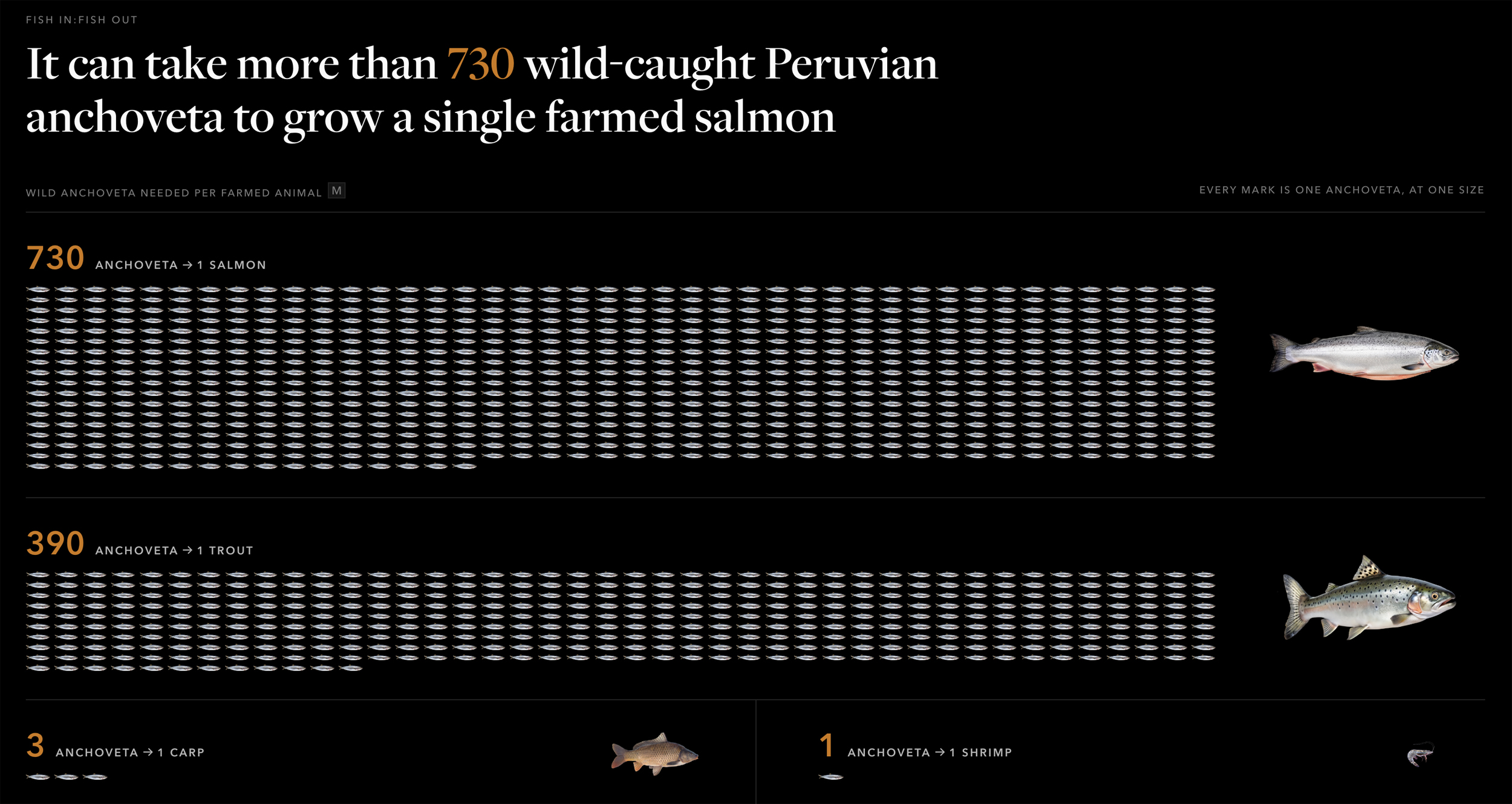
“The aquaculture industry’s sales pitch is flat wrong,” said Daniel Pauly, project director of the Sea Around Us initiative at the University of British Columbia. The most popular farmed seafood are fed wild fish—the exact livestock aquaculture claims to be saving. That’s accelerating ocean depletion, not slowing it, he explained.
After the 2011 debt crisis, Greece bet its coastal future on the blue economy by mapping out 25 “Areas of Organized Development.” While many of these zones remain in the final stage of legal approval, the plan earmarked potentially exclusive use of almost 60,000 acres of coast to multinational aquaculture firms. Expanding the industry’s footprint 24-fold came with a simple economic pitch: People want more seafood, the limit of what can be viably pulled from the wild is quickly being reached and fish farming is the way to meet the growing demand while slowing the collapse of the oceans.
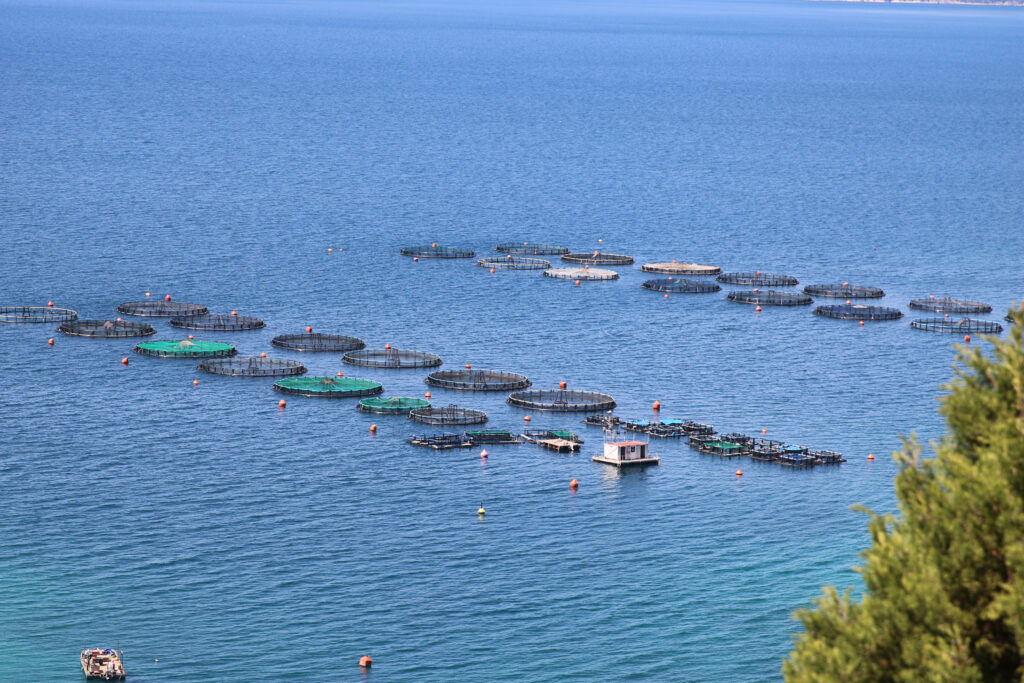
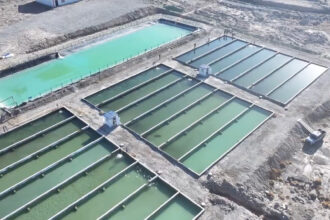
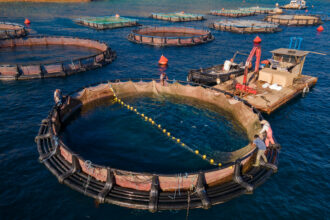
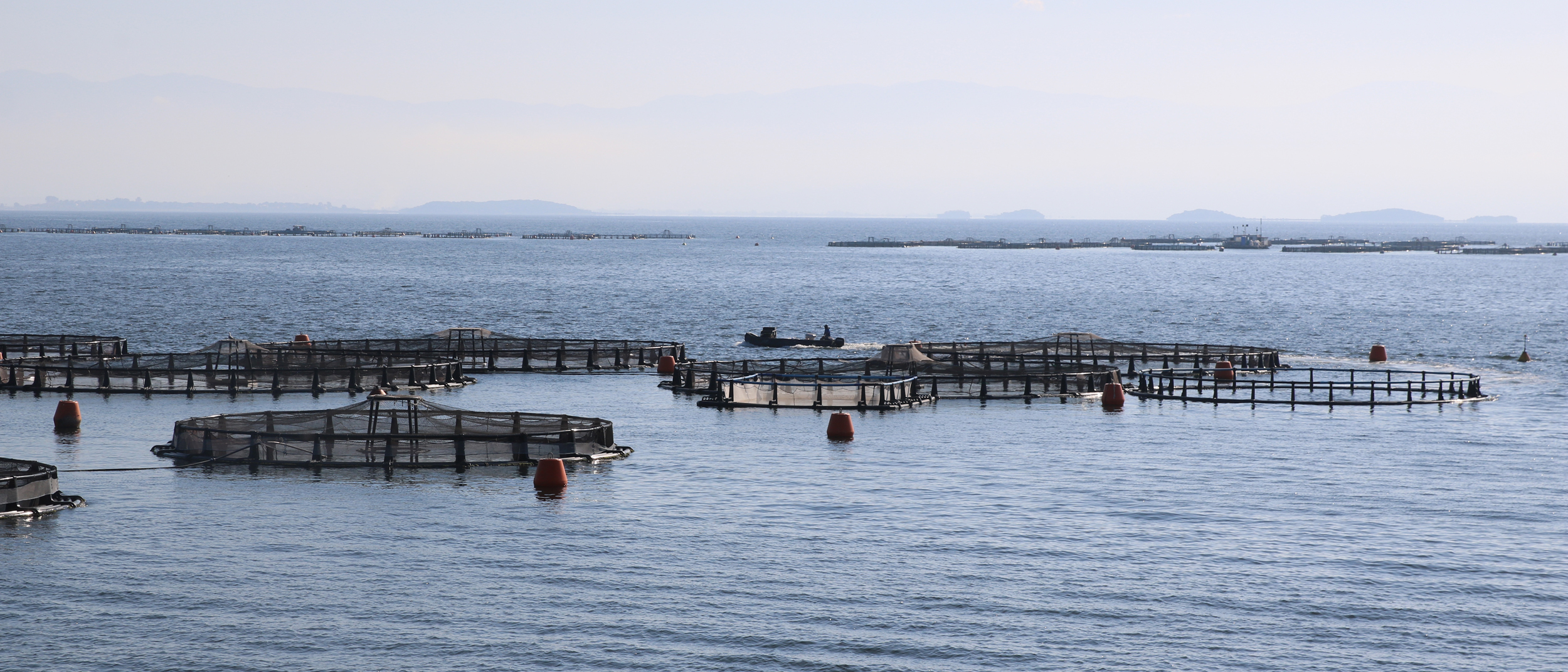
From the Ionian Sea in the west to the Euboean Gulf in the east, the Greek farmed finfish industry is now the most valuable in the European Union. It’s also the bloc’s top producer of sea bream and sea bass, producing over 120,000 tons annually.
Now accounting for over two-thirds of the nation’s total seafood production, the sustainability argument for fish farming—“grow more, so we can catch less”—is one of the reasons that the $313 billion industry is the fastest-growing food sector in the world.
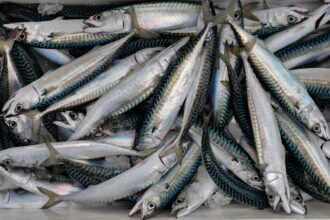
Yet two-thirds of global aquaculture grows species that are fed fishmeal and fish oil—ingredients made by cooking and pulverizing wild-caught fish. Before it reaches market, a seabass or sea bream at some Mediterranean farms, for instance, eats more than two-and-a-half times its weight in wild-caught fish.
The feed that powers most of this industry comes with a huge variety of other hidden costs, many of them borne by communities far away from Greece or other developed fish-farming economies, according to a wide-reaching investigation by The Outlaw Ocean Project, a news organization based in Washington, D.C.
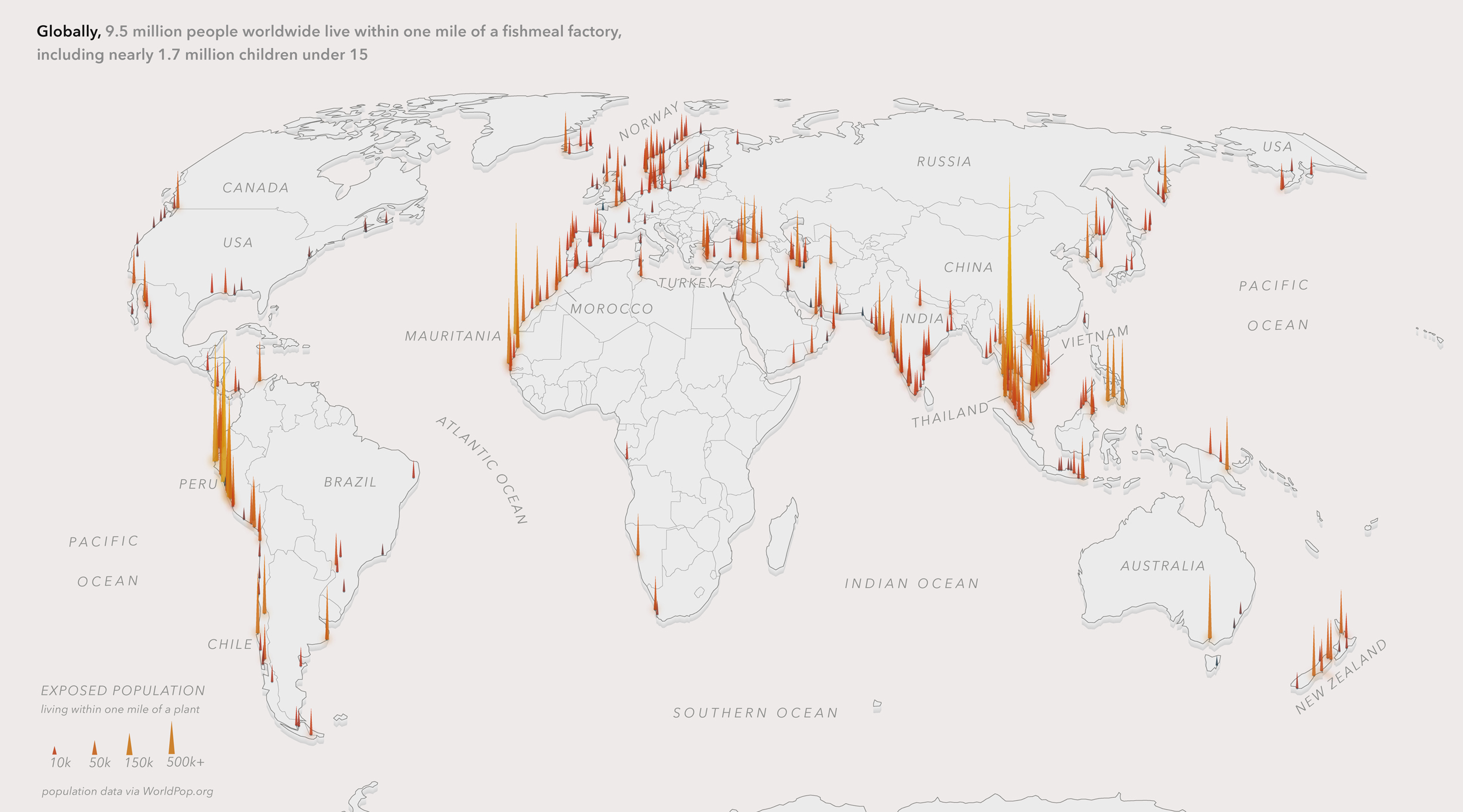
These costs include the loss of artisanal fishing jobs, chronic chemical exposure, avoidable worker deaths and violent protests typically spurred by the horrid stench from fishmeal factories. These social and environmental impacts exact a price primarily paid by the poorer countries where the feed ingredient is harvested and processed.
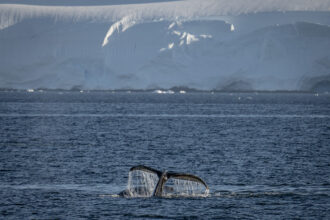
Some sea bass and sea bream farmed in Greece in recent years were fed fishmeal tied to more than a dozen environmental enforcement actions in U.S. waters between 2018 and 2025, and humpback whale deaths in the Southern Ocean in 2024, according to The Outlaw Ocean Project’s investigation.
About This Investigation
Across five years, The Outlaw Ocean Project carried out an extensive investigation of fishmeal and fish oil. The reporting effort mapped a vast segment of the entire global fishmeal industry, including more than 1,400 fishmeal factories across 64 countries.
The Food for Feed investigation found that the oceans bear an especially heavy and largely invisible burden from the fishmeal and fish oil industry. More than a fifth of wild-caught fish around the world is used for non-human consumption, especially fish feed but also for chickens and pigs.
In Gambia and Mauritania, the series documented how the industry drives food insecurity as fish that once sustained local communities are increasingly being diverted into fishmeal factories for export. In remote islands in Russia’s far east and in China’s Xinjiang region, reporting detailed the use of forced labor on ships, on farms and in factories. In other countries, including India and Peru, this industry was tied to at least 80 incidents of civil unrest, some of them violent, usually in the form of labor strikes and community protests sparked by the water pollution or the stench from factories cooking thousands of tons of decomposing fish. The team also developed Bait to Plate, an online tool that tracks the fishing and seafood industries.
Africa’s Last Colonial State
In Greece, two of the largest aquaculture players have also been sourcing fishmeal from Western Sahara.
Since the mid-1970s, Morocco has militarily occupied Western Sahara, a presence that more than 10 EU Court of Justice rulings and various United Nations resolutions have deemed illegal. Still, Moroccan ships routinely fish in Western Saharan waters, turning their illicit catch into fishmeal in Western Saharan plants, before exporting it to farms globally labeled as Moroccan.
The seafood company Avramar—which controls 70 percent of Greek production and exports to 40 countries—imports raw materials and ingredients from more than a dozen Moroccan companies. Additionally, one of its subsidiary companies, Perseus—which has since been enveloped into Avramar’s larger operations—was receiving shipments of fishmeal from Western Sahara as recently as 2022.
Meanwhile, Irida—Greece’s largest feed manufacturer and a supplier to Avramar—also received raw ingredients from two companies primarily based in Western Sahara in 2024 and 2025 respectively, according to trade and audit records: Copelit and Protein and Oil Industry.
When asked about these issues, none of the companies responded to a request for comment.
Fishing without the permission of the Western Saharan people, the Sahrawis, and importing to EU markets under false Moroccan labels has humanitarian consequences. Some 180,000 Sahrawi people live in refugee camps in Algeria while overfishing undermines local food security.
Greece is not alone; France, Spain, Germany and the Netherlands also source fishmeal from Africa’s last colonial state.
This story is funded by readers like you.
Our nonprofit newsroom provides award-winning climate coverage free of charge and advertising. We rely on donations from readers like you to keep going. Please donate now to support our work.
Donate NowExploiting the Oceans
In countries with available data, at least half of the species landed by fishmeal vessels were classified by scientific studies as “overexploited” or worse, The Outlaw Ocean Project’s investigation found.
In fact, most of the vessels in this fleet are purse seiners or trawlers, types of fishing boats that deploy vast nets to capture dense schools of fish and routinely haul in non-target species. At least 165 are also bottom trawlers, a particularly destructive form of fishing that uses weighted nets that scrape the ocean floor, destroying virtually everything in their path and releasing carbon dioxide buried in sediment.
While companies like Avramar claim a “commitment to safeguarding marine biodiversity,” their reliance on overexploited West African sardines, for example, tells a different ecological story.
Avramar—which was recently acquired by the Canadian company Cooke Inc., and rebranded in August to Cooke Hellas—acknowledged a request for comment but did not respond further.
“Any accounting of the true impact of aquaculture has to start not with the farm, but with the feed,” said Pauly, with the Sea Around Us initiative. “And that kind of accounting offers a very different picture than the industry offers.”
Indeed, the global transformation of the food chain has turned farms and oceans into engineered calorie-processing systems. The natural food web, including who eats what, and how energy moves from plants to animals to humans, is no longer mainly determined by ecosystems. It’s now shaped by industrial design.
As Greek aquaculture looks to expand, the disconnect between its sustainability claims and the feed it relies on poses a legal and reputational risk. While the EU is introducing fines for supply chains that fail to independently undertake due diligence, these won’t enter into force until 2028. Until then, the onus will remain on Greece and other European aquaculture giants to untangle the legal and environmental mess in both their own and foreign waters.
Dana Cleaveley, a research consultant formerly with SeaChoice, a Canadian sustainable-seafood group, said many products—such as sweatshop garments, “blood diamonds” and coffee—have already had to begin reckoning with the human rights and environmental abuses buried in their supply chains.
Seafood, she said, has been slower to face that kind of scrutiny. But as the world searches for more protein and leans further into aquaculture, that may change.
About This Story
Perhaps you noticed: This story, like all the news we publish, is free to read. That’s because Inside Climate News is a 501c3 nonprofit organization. We do not charge a subscription fee, lock our news behind a paywall, or clutter our website with ads. We make our news on climate and the environment freely available to you and anyone who wants it.
That’s not all. We also share our news for free with scores of other media organizations around the country. Many of them can’t afford to do environmental journalism of their own. We’ve built bureaus from coast to coast to report local stories, collaborate with local newsrooms and co-publish articles so that this vital work is shared as widely as possible.
Two of us launched ICN in 2007. Six years later we earned a Pulitzer Prize for National Reporting, and now we run the oldest and largest dedicated climate newsroom in the nation. We tell the story in all its complexity. We hold polluters accountable. We expose environmental injustice. We debunk misinformation. We scrutinize solutions and inspire action.
Donations from readers like you fund every aspect of what we do. If you don’t already, will you support our ongoing work, our reporting on the biggest crisis facing our planet, and help us reach even more readers in more places?
Please take a moment to make a tax-deductible donation. Every one of them makes a difference.
Thank you,
Johnny Sturgeon
Fisheries Reporter
Johnny Sturgeon is a London-based reporter covering fisheries and aquaculture. Joining us from the Outlaw Ocean Project, he has experience producing in-depth maritime investigations for nonprofit newsrooms. A former boatbuilder, he holds a B.A. in History & Politics from the University of Oxford, and an M.S. from Columbia Journalism School.