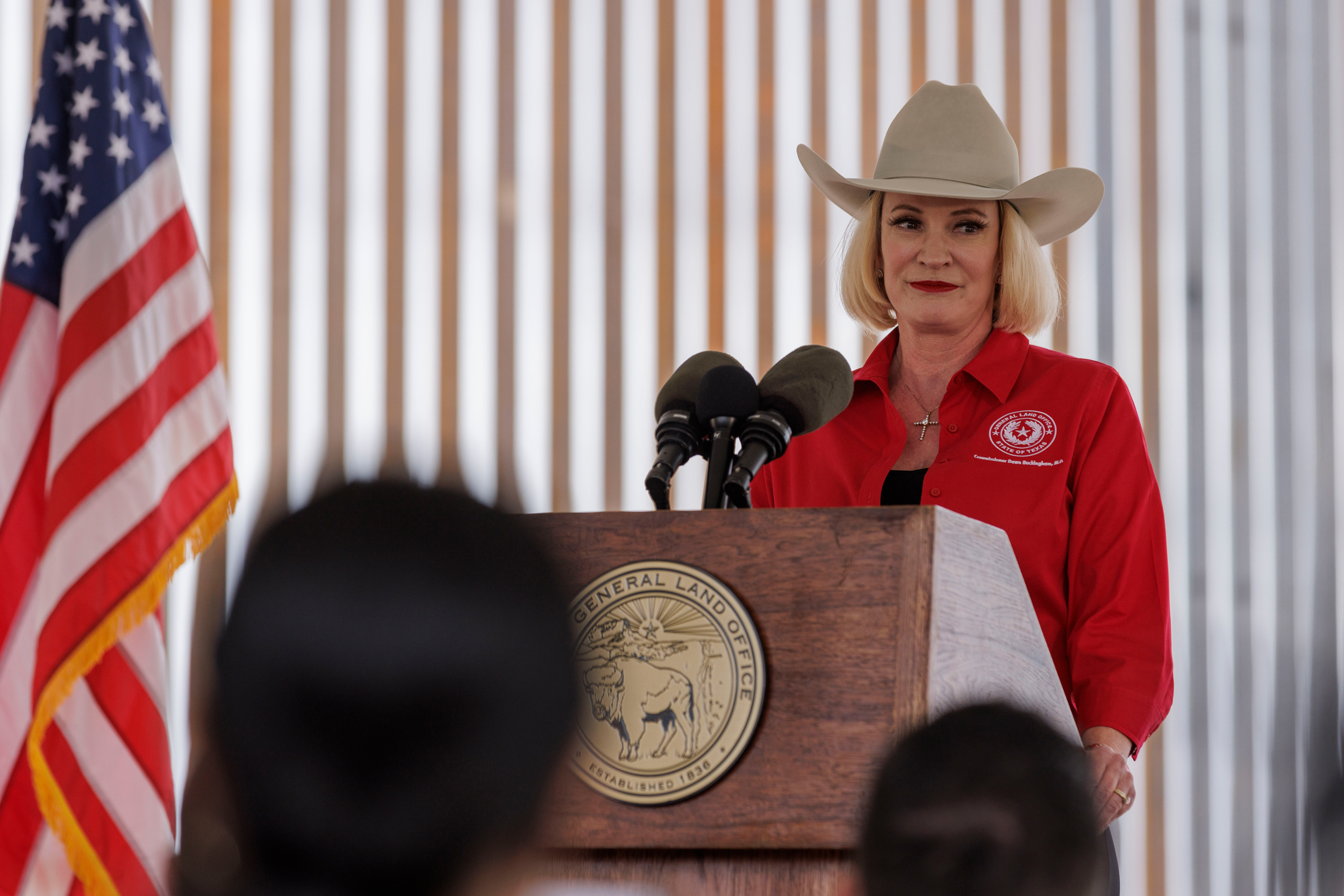


Border wall construction in the Big Bend region puts Republican Texas Land Commissioner Dawn Buckingham in a bind: back President Donald Trump’s immigration agenda or respond to growing bipartisan opposition to the wall.
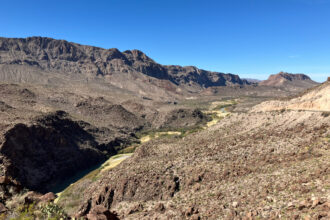
The Texas General Land Office manages 13 million acres across the state, much of it in far West Texas. Among its holdings are parcels along the Rio Grande that form the international boundary. On GLO-managed land in the Big Bend, the Trump administration plans to build a border wall in Presidio and Hudspeth counties and vehicle barriers in Brewster County.
On Oct. 2, U.S. District Judge Kathleen Cardone blocked border wall construction in the Big Bend sector with a temporary injunction. But the federal government isn’t giving up on its plans to wall off much of the Big Bend. U.S. Department of Justice attorneys have asked the judge to suspend the order and plan to take the case to the Supreme Court.
Meanwhile, the federal government can continue work to secure right of way and access for border wall construction. GLO land lies squarely in its path.
Buckingham is up for reelection in November for a second four-year term, facing Democratic nominee Benjamin Flores.
Buckingham has said she supports a “virtual wall” in West Texas and has sent cease-and-desist letters to federal contractors who cleared state-managed land in the Big Bend for construction without authorization. But the GLO has been in communication with U.S. Customs and Border Protection about building border infrastructure on state land, according to a letter the agency sent in response to a public information request from Inside Climate News.
The GLO did not respond to requests for comment.
“We stand by our assessment and remain confident in our legal authorities to secure the border while preserving the unique landscape of the Big Bend region,” CBP spokesperson Jessica Turner said. “We are working with the Department of Justice on next steps.”
Buckingham, who grew up on a ranch near the Texas coast, served in the Texas Senate before running for land commissioner in 2022. Once elected, she quickly established herself as a champion of hardline border security.
In 2023, Buckingham claimed, over the objections of the federal government, that Fronton Island in the Rio Grande was state land. This allowed state law enforcement to clear vegetation and patrol the island for unauthorized border crossings into Texas. After Trump returned to office, in 2025, she offered federal access to two Rio Grande islands to aid border security and deportation efforts. These islands are in the Rio Grande Valley, where there is already extensive border fencing.
“I unapologetically use every tool at my disposal to gain complete operational control of our southern border,” Buckingham said at the time.
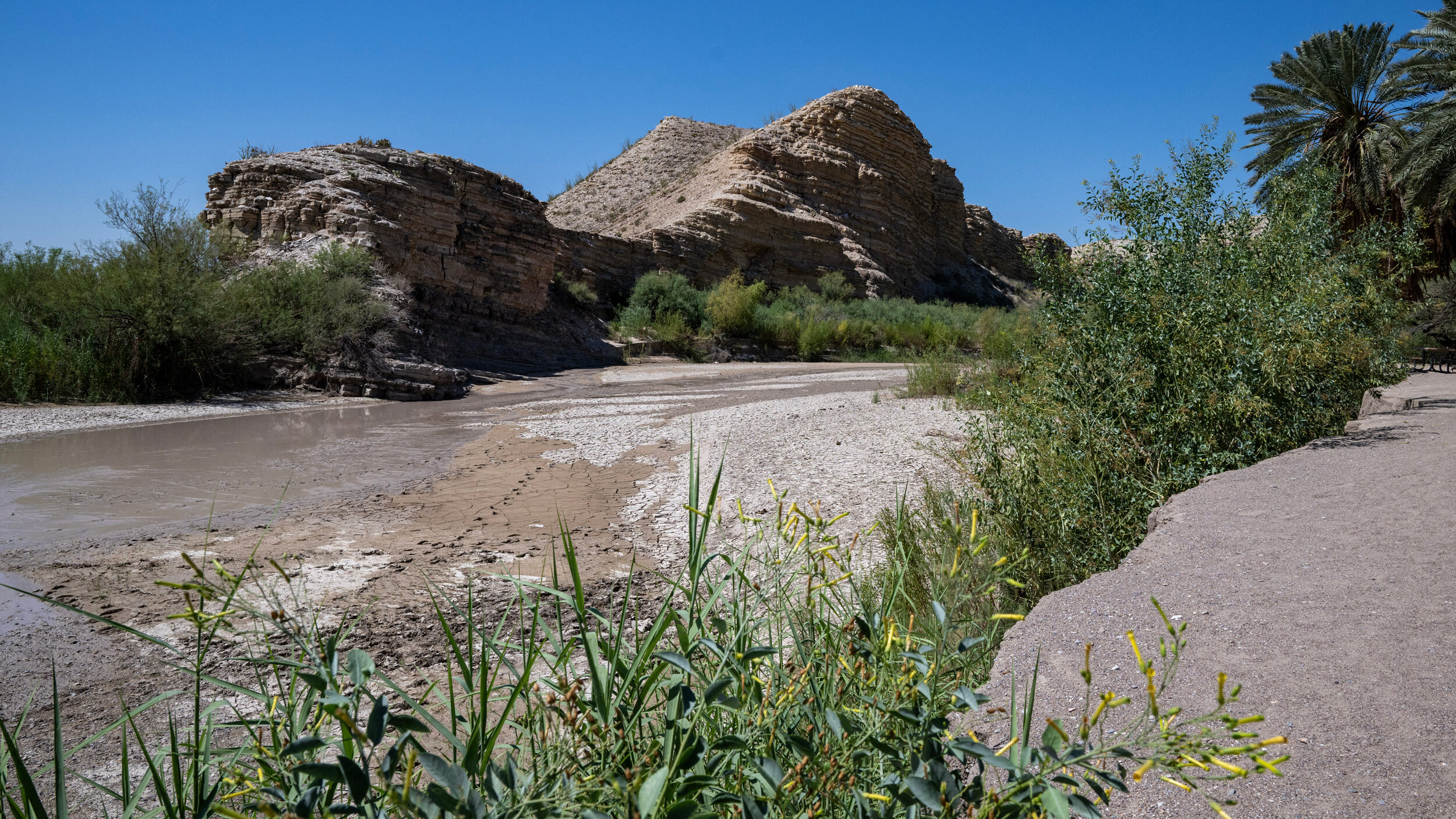
The political winds began to shift in February 2026, when plans for a federal border wall in Big Bend emerged. Maps showing the proposed wall through Big Bend National Park and Big Bend Ranch State Park ignited bipartisan opposition. A wall was also planned for large stretches of rural borderlands managed by the GLO. CBP has since changed its plans and says it will use vehicle barriers and detection technology in the national park instead of a wall.
Texas retained its state lands when it was annexed into the United States in 1845. What is now known as the Permanent School Fund was created soon after. Proceeds from leasing or selling state land have benefited the fund, which supports public schools, ever since. The fund is now valued at over $60 billion.
That land creates a checkerboard across West Texas, including in the border counties. GLO leases this land for oil and gas drilling, cattle ranching and even rare-earth elements mining. Permanent School Fund land along the border is often leased to ranchers, who rely on access to the Rio Grande to water their cattle. A wall would not only cut off the United States from Mexico, but also cut off ranchers from their primary water source.
Former Republican Land Commissioner Jerry Patterson was quickly one of the most vocal opponents of a wall in Big Bend.
On Feb. 27, Patterson posted on Facebook that Buckingham told him she supports a virtual wall, which would use detection technology, and has serious concerns about a physical wall in the Big Bend.
On March 9, the Instagram page of the Gage Hotel in Brewster County, a gateway to the national park, posted photos of Buckingham attending a screening of the documentary “The River and the Wall.” The documentary, made during the first Trump administration, shows the damage a border wall would cause in Texas. One of the filmmakers, Jay Kleberg, had unsuccessfully run against Buckingham in 2022 as a Democrat.
“We thank the Marathon community, Mr. Bryan and Texas Land Commissioner, Dawn Buckingham, for advocating against a physical barrier in the Big Bend region last night,” the hotel’s social media post read.
JP Bryan, an oil magnate and Big Bend landowner, owns the hotel. Bryan, a conservative, put out a statement against the wall days later.
This story is funded by readers like you.
Our nonprofit newsroom provides award-winning climate coverage free of charge and advertising. We rely on donations from readers like you to keep going. Please donate now to support our work.
Donate NowBuckingham spent March 4 through 13 in Brewster County, according to calendars obtained through a public information request, and had dinner with Bryan on March 8.
Around this time, CBP began sending letters to land owners along the border in Big Bend to gain access to their property. Letters were sent to the Texas Parks and Wildlife Department, as previously reported by Inside Climate News, and private landowners.
GLO attorneys obtained exemptions to avoid releasing records related to the border wall to Inside Climate News. However, in an April 28 request to the Texas attorney general, Open Government Director Hadassah Schloss wrote that, consistent with orders from Trump and Gov. Greg Abbott, GLO officials were in “regular contact” with CBP to discuss the location of state-owned property managed by the GLO and the “types of document[s] that CBP may need from the GLO and/or the State of Texas to construct, operate, and maintain critical border security infrastructure on GLO-managed real property.”
GLO did not respond to questions about the extent of these communications and whether the agency has granted CBP access to any state-managed land.
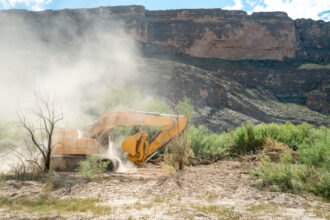
Buckingham avoided the spotlight as the border wall outcry grew across Texas. But she drew a line in the sand on July 31 when she denounced federal border wall contractors who had cleared GLO-managed land in Presidio County without permission.
“Texas sovereignty will not be infringed upon by failure to follow established protocol,” Buckingham said. “I am committed to maintaining a positive relationship with CBP, but we will not allow rogue actors who breached our agreement to undermine the incredible work we do for Texas.”
Buckingham sent cease-and-desist letters to CBP, the contractor, Barnard Construction, and Trans Pecos Ice LLC, which leases the land from the GLO. Buckingham demanded that the land be remediated.
GLO did not respond to follow-up questions about the incident.
Susan Hays, the Democratic nominee for county commissioner in Presidio County, said that Buckingham’s statement is the strongest yet from a statewide official in response to the wall in the Big Bend region. Hays, active in the local opposition to the wall, said numerous landowners in Hudspeth County oppose the wall and have not granted access to CBP.
In September, construction began on the wall in Hudspeth County, in an area where CBP had obtained access from landowners.
Bill Addington, a resident of Sierra Blanca whose family has ranched in Hudspeth County for generations, said Buckingham should take a clear stance against the wall. He said that ranchers who lease land from GLO will be severely impacted if a border wall cuts off their access to the Rio Grande.
“I think the commissioner is gaslighting us,” Addington said. “What are they waiting for to say no against the wall?
“Why can’t they just say the wall is not in the best interest of the state? It’s not in the best interest of the lessees,” he said. “If we can’t get to the river, our farming and ranching operations are done.”
Addington was among the witnesses in an emotional hearing at the El Paso federal courthouse on Oct. 2. A lawsuit brought by the Center for Biological Diversity sought to stop border wall construction in the Big Bend sector. Addington spoke to his family’s generational connection to the land along the Rio Grande. To the relief of the plaintiffs, the judge issued a temporary injunction to halt construction.
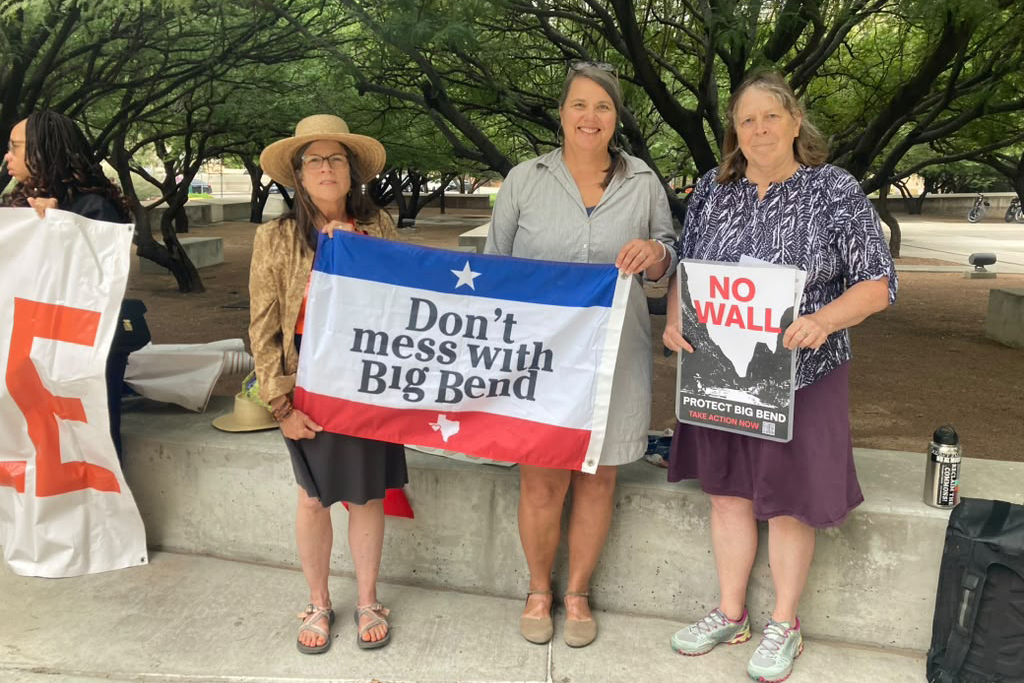
For now, construction cannot proceed on GLO-managed land in the Big Bend sector. But behind the scenes, CBP can continue to court landowners, including the GLO, to gain access to their property if construction is allowed to resume.
Meanwhile, Buckingham’s campaign enters the final stretch before the Nov. 3 election.
The border wall in Big Bend, along with data centers and the rising cost of living, have put Texas Republicans on the defensive in statewide races this year. Buckingham and other statewide elected officials are choosing their words carefully when discussing the wall.
Buckingham’s campaign website still criticizes the Biden administration’s record on the border but does not reference the wall. A Buckingham campaign ad posted online earlier this year shows steel panels being raised for the border wall and inveighs against “Chinese commies,” a border “invasion” and Islam. But a more recent ad strikes a softer tone—narrated by a woman—portraying Buckingham as a wife and mother who knows what it means to pinch pennies.
Her campaign did not respond to requests for comment.
Alex Martinez, chief of staff for Benjamin Flores’ campaign, said that, if elected, Flores would firmly oppose border wall construction on GLO property in Brewster, Presidio and Hudspeth counties.
“Texas public lands, particularly those supporting the Permanent School Fund, belong to the people of Texas and must be defended,” Martinez said. “[Flores] will not voluntarily authorize border wall construction on GLO land, and he is prepared for a prolonged legal battle to protect it.”
About This Story
Perhaps you noticed: This story, like all the news we publish, is free to read. That’s because Inside Climate News is a 501c3 nonprofit organization. We do not charge a subscription fee, lock our news behind a paywall, or clutter our website with ads. We make our news on climate and the environment freely available to you and anyone who wants it.
That’s not all. We also share our news for free with scores of other media organizations around the country. Many of them can’t afford to do environmental journalism of their own. We’ve built bureaus from coast to coast to report local stories, collaborate with local newsrooms and co-publish articles so that this vital work is shared as widely as possible.
Two of us launched ICN in 2007. Six years later we earned a Pulitzer Prize for National Reporting, and now we run the oldest and largest dedicated climate newsroom in the nation. We tell the story in all its complexity. We hold polluters accountable. We expose environmental injustice. We debunk misinformation. We scrutinize solutions and inspire action.
Donations from readers like you fund every aspect of what we do. If you don’t already, will you support our ongoing work, our reporting on the biggest crisis facing our planet, and help us reach even more readers in more places?
Please take a moment to make a tax-deductible donation. Every one of them makes a difference.
Thank you,

Martha Pskowski
Reporter, El Paso, Texas
Martha Pskowski covers climate change and the environment in Texas from her base in El Paso. She was previously an environmental reporter at the El Paso Times. She began her career as a freelance journalist in Mexico, reporting for outlets including The Guardian and Yale E360. Martha has a B.A. in Environmental Studies from Hampshire College and a master’s degree in Journalism and Latin American Studies from New York University. She is a former Fulbright research fellow in Mexico. Martha can be reached on Signal at psskow.33.