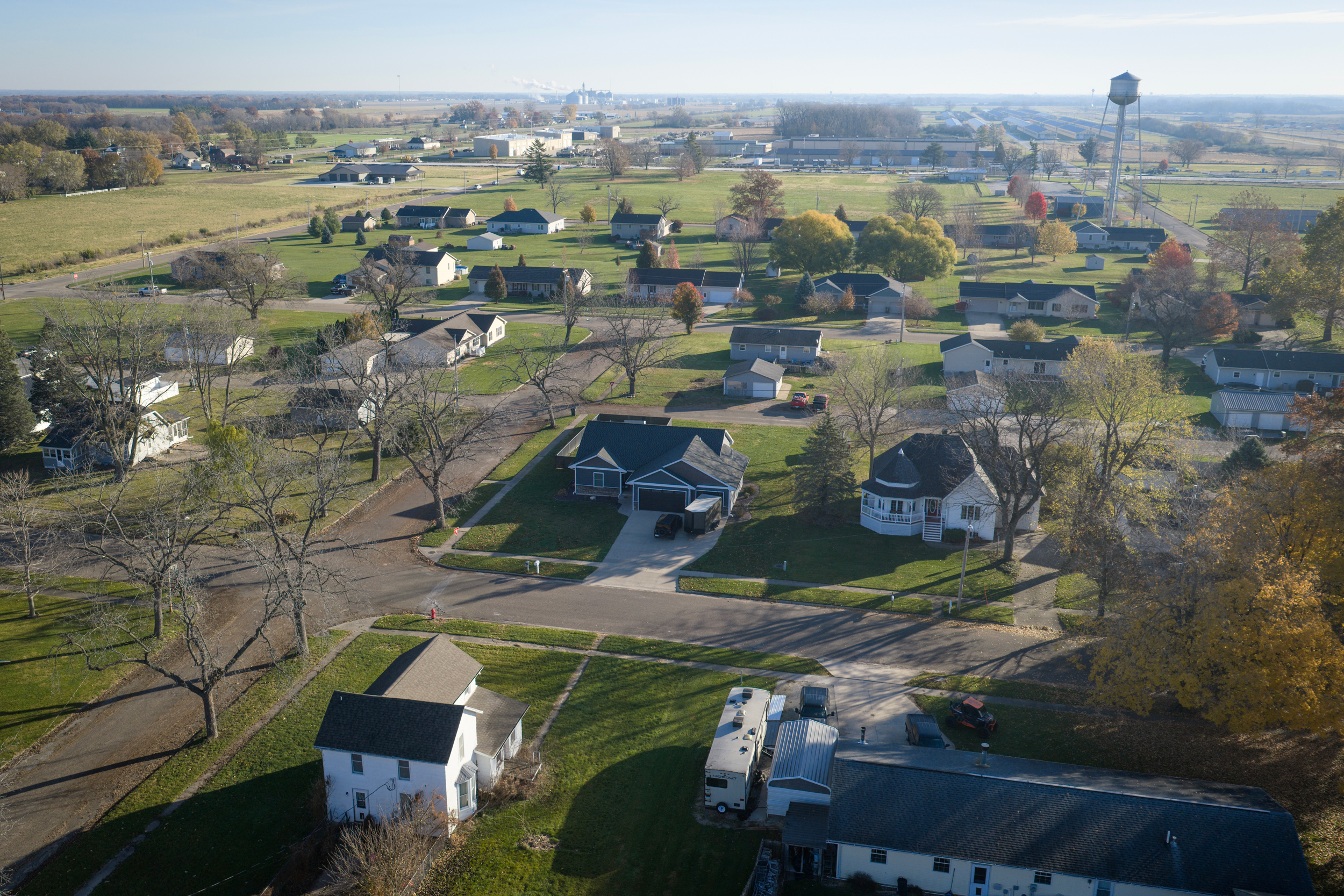


Plans to detonate nearly 10,000 pounds of degraded lead azide at an Eastern Iowa ammunition plant are on hold after the Army postponed the operation and a federal appeals court temporarily halted an emergency permit from the Environmental Protection Agency.
Initially scheduled for Friday, the planned explosion generated immense public outcry and concern from public health experts, environmentalists and elected officials who say residents received inadequate notice and guidance regarding the impacts of lead dust on their health and the environment.
Lead azide is a common primary explosive in bombs. After decades in storage at the Iowa Army Ammunition Plant, 68 barrels of the compound have become dangerously unstable and require emergency disposal.
Acting Army Secretary Adam Telle announced late Thursday that the detonation would be rescheduled to Monday. But hours later, a ruling by the U.S. Court of Appeals for the 8th Circuit placed an administrative stay on the EPA’s detonation permit, indefinitely delaying the operation.
The ruling came less than 24 hours after environmental law organization Earthjustice, representing the Iowa Environmental Council and the Sierra Club Iowa Chapter, sued the EPA over its permit and filed an emergency motion asking the court to suspend it.
In their suit, the petitioners argued that the decision-making process lacked transparency and that the Army failed to adequately explore alternatives to detonation. “Within the permit, we just do not see enough things that will protect human health and the environment,” said Thien Chau, a senior attorney for Earthjustice. He described the planned detonation as “abnormal and extraordinary.”
The court could rule on the emergency motion at any point in the next few days, Chau said.
A Ticking Time Bomb
During a March safety review at the Iowa Army Ammunition Plant in Middletown, Iowa, officials discovered that stored lead azide had dissolved and reformed into irregularly shaped, highly volatile crystals. Friction, heat or shock could easily trigger spontaneous detonation.
Rather than risk an accidental explosion by leaving the barrels in storage, relocating them or chemically neutralizing the contents, all alternatives the Army considered, the department opted to conduct a controlled detonation of nearly five tons of lead azide, according to its environmental assessment. The Environmental Protection Agency granted an emergency permit for the detonation last Friday, citing an “unacceptable” risk of accidental combustion.
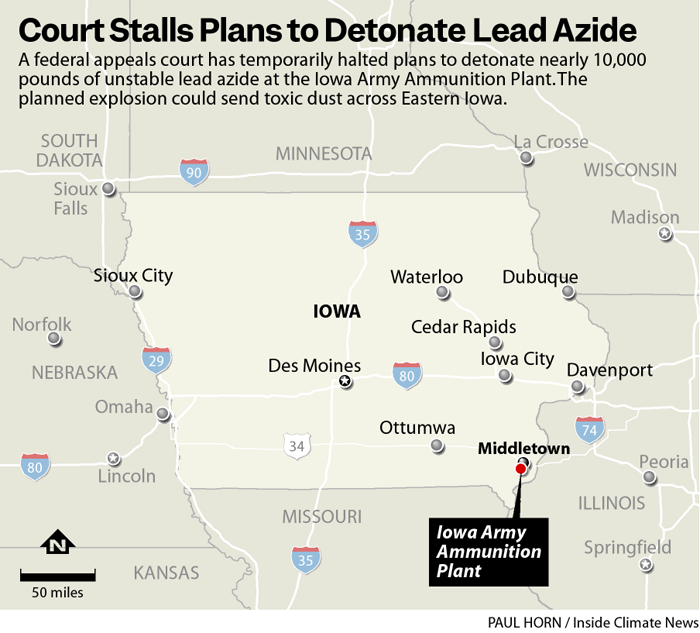
Even with mitigation technology like blast containment barriers and water misters in place, the explosion will generate a lead-containing dust cloud that could deposit the neurotoxin across hundreds of miles in an area where tens of thousands of Iowans live.
Residents of Middletown were informed of the planned detonation at a town hall in October. But state officials and most Iowans learned about the explosion just days before it was scheduled to take place.
Maps released by the Army in a public advisory early this week projected surface deposition of lead 50 miles northwest of Middletown, with airborne exposure as far as 100 miles afield.
A spokesperson for Gov. Kim Reynolds said that the advisory was the first she had heard of the operation.
The projected ranges for the dust cloud shrank significantly in updated maps released Wednesday, which the Army says reflect changing weather forecasts. Their most recent projections showed toxic lead dust settling on surfaces over a smaller region that extends at least 30 miles north of the plant and up to 10 miles wide.
Planning for Toxic Debris
The Army’s projections suggest outdoor lead dust levels in the plume’s path could exceed federal benchmarks for indoor lead levels in homes and childcare facilities, said Patrick O’Shaughnessy, a professor of occupational and environmental health at the University of Iowa.
Still, the precise amount and location of lead that would be released by the blast is unknown and depends on weather conditions and the effectiveness of the Army’s engineered controls, O’Shaughnessy said.
According to the emergency permit issued by the Environmental Protection Agency, the Army is required to use high-end estimates to avoid underestimating the potential impact of the detonation. The Army did not respond to questions about more specific ranges of lead concentrations.
Leading up to the planned Friday detonation, the Army advised residents to stay indoors, close windows and doors, and set heating and cooling systems to “recirculate” for a few hours after the planned blast. The Army also advised residents to clean their cars and hose down play surfaces and windowsills once the cloud settled.
Any surfaces typically touched by children would be especially important to clean, said O’Shaughnessy. As a neurotoxin, lead is most harmful to small children and infants with developing brains and nervous systems.
The EPA emergency permit requires the Army to conduct monitoring before, during and after detonation. In addition, researchers at the University of Iowa scrambled to set up independent air and soil monitoring following the Army’s announcement early this week, said David Cwiertny, director of the university’s Center for Health Effects of Environmental Contamination.
This story is funded by readers like you.
Our nonprofit newsroom provides award-winning climate coverage free of charge and advertising. We rely on donations from readers like you to keep going. Please donate now to support our work.
Donate NowMany residents of the heavily agricultural state have expressed concern about the lingering effects of lead dust for soil, crops and livestock, Cwiertny said. Scientists will rely on field samples taken after the explosion to gauge the impact on agriculture and animals.
“We know that unlike a porch or patio table, you cannot simply wipe down farm fields, gardens or topsoil, because those surfaces are hard to clean,” he said.
The Army has not issued specific guidance for livestock producers in the exposure zone. The Iowa Department of Agriculture and Land Stewardship recommended livestock be kept at an alternate location or indoors until the air plume could pass.
The department also suggested that producers ask the U.S. Army to collect soil and forage samples at their farms after the detonation, power wash the exteriors of buildings and equipment and work with a veterinarian to monitor livestock for signs of lead poisoning.
Leaders Call For Clarity
On Thursday night, Gov. Reynolds issued a statement saying she had spoken to Acting Secretary of the Army Adam Telle and asked that he delay the detonation. Governor-elect Rob Sand and U.S. Senator-elect Josh Turek also called on military leadership to postpone the operation until Iowans could be given more information about the decision-making process.
In light of growing public interest in the detonation, the Department of the Army, Department of Health and Human Services and Environmental Protection Agency issued a joint statement Friday morning.
“Officials have been meticulously planning for this event since March, and all agencies involved are prepared to take the most extreme mitigation measures available to ensure there is no risk to the public and any disruptions are minimized,” the statement read.
About This Story
Perhaps you noticed: This story, like all the news we publish, is free to read. That’s because Inside Climate News is a 501c3 nonprofit organization. We do not charge a subscription fee, lock our news behind a paywall, or clutter our website with ads. We make our news on climate and the environment freely available to you and anyone who wants it.
That’s not all. We also share our news for free with scores of other media organizations around the country. Many of them can’t afford to do environmental journalism of their own. We’ve built bureaus from coast to coast to report local stories, collaborate with local newsrooms and co-publish articles so that this vital work is shared as widely as possible.
Two of us launched ICN in 2007. Six years later we earned a Pulitzer Prize for National Reporting, and now we run the oldest and largest dedicated climate newsroom in the nation. We tell the story in all its complexity. We hold polluters accountable. We expose environmental injustice. We debunk misinformation. We scrutinize solutions and inspire action.
Donations from readers like you fund every aspect of what we do. If you don’t already, will you support our ongoing work, our reporting on the biggest crisis facing our planet, and help us reach even more readers in more places?
Please take a moment to make a tax-deductible donation. Every one of them makes a difference.
Thank you,

Anika Jane Beamer
Reporter, Iowa
Anika Jane Beamer covers the environment and climate change in Iowa, with a particular focus on water, soil and CAFOs. A lifelong Midwesterner, she writes about changing ecosystems from one of the most transformed landscapes on the continent. She holds a master’s degree in science writing from the Massachusetts Institute of Technology as well as a bachelor’s degree in biology and Spanish from Grinnell College. She is a former Outrider Fellow at Inside Climate News and was named a Taylor-Blakeslee Graduate Fellow by the Council for the Advancement of Science Writing.