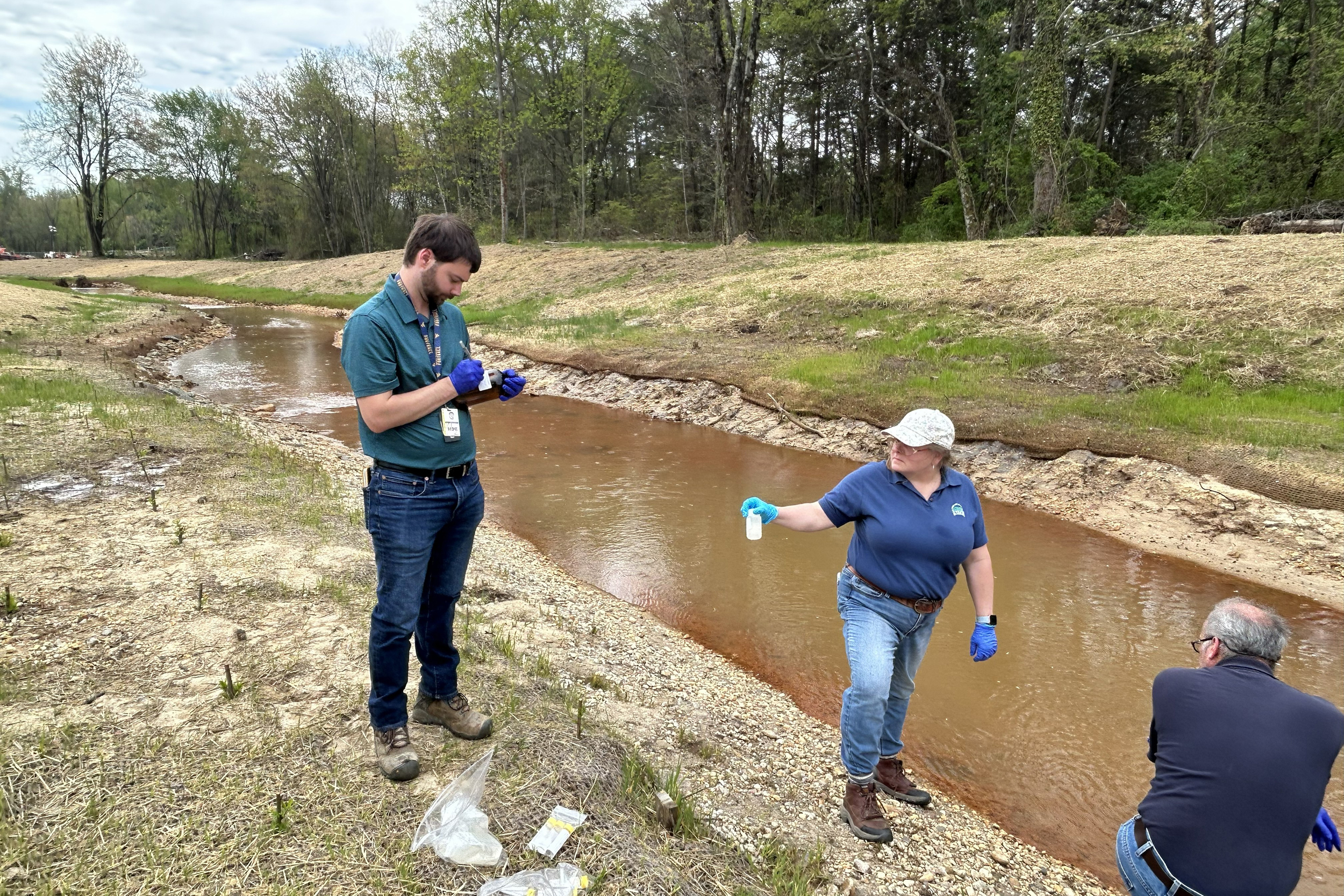


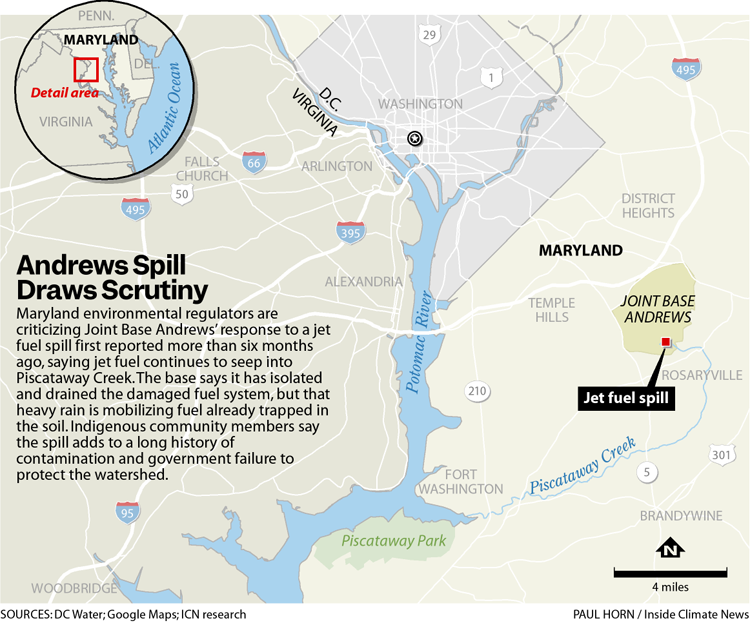
Maryland environmental regulators say jet fuel continues to seep into Piscataway Creek from Joint Base Andrews more than six months after the spill was reported, despite the base’s assurances that it has isolated the damaged fuel system and stopped the leak.
“MDE remains deeply concerned about the ongoing environmental impacts and continues to observe signs of jet fuel coming from the site,” the Maryland Department of the Environment said in a written response. “Jet fuel continues to flush into the creek, particularly after heavy rain.”
In its response to Inside Climate News, the installation acknowledged that they continue to “actively contain and recover” spilled fuel trapped in soil that flushes into the creek during storms.
Piscataway Creek connects Joint Base Andrews, located in Prince George’s County, to the Potomac River near Fort Washington Park. The adjacent Piscataway Park provides public access points to the creek and the river for fishing and boating.
The initial incident drew criticism from lawmakers and environmental advocates over the base’s delay in reporting the spill. The fuel system failed a tightness test on Dec. 11, according to the MDE, which said the base’s leak detection system failed multiple times between January and March, spilling roughly 32,000 gallons of jet fuel into the creek.
The agency said it was not notified until fuel odors and a sheen were seen near the creek’s headwaters on March 23, and the base did not report the full extent of the discharge until April 8. The MDE, which has enforcement authority under state environmental regulations, then ordered the military facility to carry out an emergency soil investigation, install monitoring wells and remediate contaminated soils.
Differing estimates of how much fuel has spilled has complicated the mitigation work. A May letter nine members of Maryland’s Congressional delegation sent to U.S. Air Force Secretary Troy Meink described approximately 32,000 gallons leaking across multiple dates and locations. Approximately 10,000 gallons from January and February incidents were reportedly contained within the fuel infrastructure and approximately 22,000 gallons were discharged into the environment.
The lawmakers asked for an accounting of how much fuel had entered the creek and how much remained underground, along with plans to prevent further contamination during rain events.
In its June 22 reply, the Air Force said the pressure-test failure on Dec. 11 was caused by a faulty valve that did not release fuel into the environment but distorted pressure readings. It said the anomaly delayed leak detection until the fuel was detected in the waters on March 23.
“JBA did not notify MDE of the failed pressure tests,” the Air Force said, adding that the matter is part of an ongoing internal investigation.
The Air Force did not provide the exact volume of the spill, saying it was “not yet possible” to determine how much fuel remained in soil, groundwater and the creek, and said it had recovered more than 35,000 gallons of a fuel-water mixture from the creek, a value the MDE has yet to verify.
“Over six months since the jet fuel leak was reported, JBA has yet to identify the exact location of the leak, diagnose the cause of the failure, or take appropriate action to fix the problem,” MDE representatives told Inside Climate News in the latest response.
In background interviews, agency officials vented their frustration that despite repeated requests over months, the base continues to stonewall requests for site-specific information, such as a basic site model displaying a map of fuel lines, creeks and environmental assets nearby, or the precise location of the crack in the underground fuel line. It has also not carried out standard subsurface probing to map the contamination plume under the tarmac. Under state oil control rules, agency officials noted, handlers of jet fuel are expected to account for every drop and quantify spills and the installation has not met that basic requirement.
The base did not respond to allegations that the MDE’s requests for information have been rebuffed. It offered a different assessment of the situation on the ground.
“The compromised section of the hydrant system was identified, isolated, and completely drained to eliminate any residual risk of fuel contaminating a water source,” a JBA spokesperson said in emailed comments. They did not say when this correction took place.
Asked whether its assertion that “the active leak has been stopped” meant the spilled fuel was no longer entering the creek, the spokesperson clarified that the assessment applied specifically to “fuel escaping from the infrastructure.”
The base further stated that its June testing could not conclusively determine the location and cause of the leak, and a pressure test is planned within the next few weeks. “The exact timeline for repairs will be dependent on the test results and subsequent engineering assessments,” it said, and that the affected sections would remain drained and isolated until repairs and retesting were completed.
This story is funded by readers like you.
Our nonprofit newsroom provides award-winning climate coverage free of charge and advertising. We rely on donations from readers like you to keep going. Please donate now to support our work.
Donate NowIn a follow-up response, the base said pressure readings on the isolated line remained stable and that it was conducting MDE-approved tightness testing of the remaining active infrastructure.
Asked whether the MDE had independently reviewed and concurred with its conclusion that the fuel leak had stopped, the base said the agency “concurred with the immediate isolation and draining of the affected loop.” It did not specify whether MDE independently verified the outcome or what evidence the agency had reviewed.
The base’s subsurface investigation has also left unanswered questions about groundwater contamination. The spokesperson acknowledged that the first phase of investigation “did not definitively define the plume.”
Meanwhile, surface-water testing by the base and MDE continues to detect fuel-related chemicals in the sampling done through Aug. 26, the most recent results MDE published. Both agencies tested water from three regularly monitored locations located within the base perimeter.
The results are listed under Diesel Range Organics (DRO), which typically include diesel fuel, motor oil, jet fuel and mineral oils, but also can include non-petroleum compounds, such as raw sewage, cooking grease by-products and yard enhancement chemicals.
The testing shows that levels at all three locations for petroleum compounds are well below levels in April, when testing began, ranging from 269 to 944 parts per billion. However, the more recent results show mixed trends.
Between Aug. 12–13 and Aug. 26, readings fell from 116 to 94.7 ppb at one site and from 96 to 60.5 ppb at the third location in the table. At the second on-base site, they rose from 67.6 to 157 ppb, similar to levels recorded in that same location in June and July.
Both the base and MDE said the results showed an overall downward trend across the locations. The elevated reading on Aug. 26 complicates that picture, but does not directly point to the faulty infrastructure at the base or indicate an active leak.
It is also unclear how to read the levels. MDE’s table lists 47 ppb as the “surface-water action level” for the fuel-related chemicals, and every numerical result in that category, including the three from Aug. 26, are above that action level.
But MDE said it judges the data against 470 ppb, a value drawn from Maryland’s groundwater cleanup standards, “because no one is drinking directly from Piscataway Creek and no drinking-water supply wells are located adjacent to the base.” The 47 ppb entry, the agency said, “is correct” and reflects the laboratory’s most conservative drinking-water benchmark, reported as received for consistency.
Six earlier sampling results exceeded the 470 ppb level, including 622 ppb in MDE’s own sample from May 18. Four of the six came from the location that showed a spike in August sampling, including 8,840 ppb JBA reported on May 18. The same day MDE recorded 622 ppb in the same location, and 1,350 ppb on July 6. MDE said the results showed the continued presence of petroleum compounds in the creek “and triggers further monitoring and investigation requirements of JBA.”
Rain also continues to be a cause for concern.
MDE said in April that the base’s contamination prevention system had failed twice early that month, when a containment dam collapsed during heavy rain. In their May letter, lawmakers wrote that initial containment measures had been insufficient during moderate rainfall until they were improved in mid-April. The Air Force subsequently told lawmakers in its June letter that the upgraded containment “successfully held fast” during an April 19 rain and subsequent storms, based on visual observations.
But an MDE inspection on Aug. 5 documented submerged underflow dams and all but one absorbent and hard boom, a barrier placed to contain the contaminated water, disconnected after the heavy rain.
The base acknowledged the failure, saying a heavy storm in early August triggered rapid flooding and the creek rose over 6 feet, which overwhelmed and displaced containment structures.
Asked directly whether petroleum escaped downstream, the base said subsequent inspections found no sheen, odors or distressed vegetation, and said the large volume of stormwater had diluted residual fuel.
The base did not identify where the vacuum-truck recovery took place or provide storm-specific chemical sampling results.
As Inside Climate News reported earlier, the spill has further imperiled the creek. In their May letter, lawmakers wrote that legacy pollution from the base had already caused PFAS contamination in Piscataway Creek. MDE noted in April that fish-consumption advisories related to PFOS, a PFAS compound, predated the spill.
The latest sampling table marks PFAS results “NA,” or not analyzed, beginning July 29 at all the three monitoring sites. MDE defended discontinuing PFAS testing, saying initial testing served as a precaution for working conditions and that PFAS was unrelated to the fuel spill. It said it had sampled the creek’s surface water for PFAS on a number of occasions and continues working with the Air Force on separate PFAS sampling and remediation plans.
Dean Naujoks, an investigator with the Potomac Riverkeeper Network, called on the EPA and MDE to take enforcement action and require remediation to address environmental contamination from the spill. “When is the EPA and the Maryland Department Environment going to bring an enforcement action against Andrews Air Force Base for this ongoing jet fuel contamination, and what are they going to do to remediate the problem?” he asked.
The agency officials said each day that fuel continues to discharge into the environment can trigger civil penalties of up to $25,000 per day, on top of any final fine for the total volume spilled into the waterway. There will ultimately be significant violations, fines, penalties and cleanup requirements, once the spill volume and duration are fully established, they said.
Meanwhile, the Air Force arranged a staff-level briefing for Maryland Senator Chris Van Hollen’s office in late September, Congressional sources confirmed to Inside Climate News. The senator was not satisfied with the responses the Air Force has provided so far, they said, and his office will be requesting more information in the coming weeks.
About This Story
Perhaps you noticed: This story, like all the news we publish, is free to read. That’s because Inside Climate News is a 501c3 nonprofit organization. We do not charge a subscription fee, lock our news behind a paywall, or clutter our website with ads. We make our news on climate and the environment freely available to you and anyone who wants it.
That’s not all. We also share our news for free with scores of other media organizations around the country. Many of them can’t afford to do environmental journalism of their own. We’ve built bureaus from coast to coast to report local stories, collaborate with local newsrooms and co-publish articles so that this vital work is shared as widely as possible.
Two of us launched ICN in 2007. Six years later we earned a Pulitzer Prize for National Reporting, and now we run the oldest and largest dedicated climate newsroom in the nation. We tell the story in all its complexity. We hold polluters accountable. We expose environmental injustice. We debunk misinformation. We scrutinize solutions and inspire action.
Donations from readers like you fund every aspect of what we do. If you don’t already, will you support our ongoing work, our reporting on the biggest crisis facing our planet, and help us reach even more readers in more places?
Please take a moment to make a tax-deductible donation. Every one of them makes a difference.
Thank you,

Aman Azhar
Reporter, Washington, D.C.
Aman Azhar is a Washington, D.C.-based journalist who covers environmental justice for Inside Climate News with focus on Baltimore-Maryland area. He has previously worked as a broadcast journalist and multimedia producer for the BBC World Service, VOA News and other international news organizations, reporting from London, Islamabad, the United Arab Emirates and New York. He holds a graduate degree in Anthropology of Media from University of London’s School of Oriental and African Studies (SOAS) and an MA in Political Science from the University of the Punjab, and is the recipient of the Chevening scholarship from the UK government and an academic scholarship for graduate studies from the Australian government.