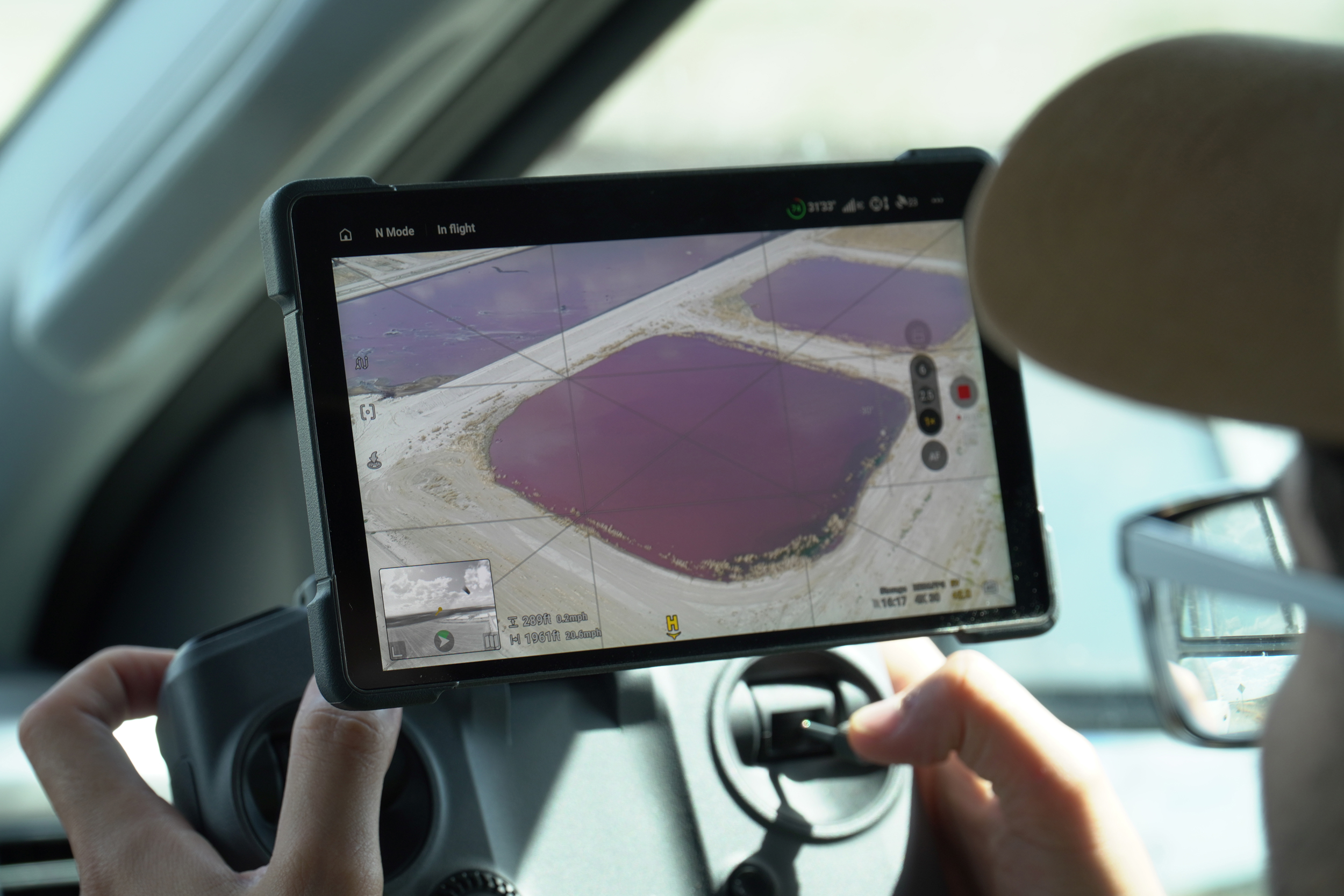


Countless manure lagoons on dairy farms across California’s San Joaquin Valley will be vulnerable to serious flooding during what is likely to be a fierce and historic El Niño this winter.
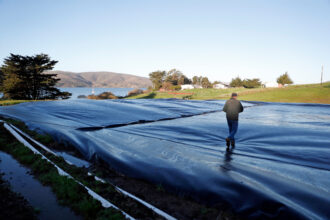
These pools of cow feces and urine are commonly how dairies store waste on-site. When the lagoons overflow, any number of contaminants in the solid and liquid slurry—which contains high concentrations of chloride and nitrogen as well as pathogens—can pollute the environment and communities nearby.
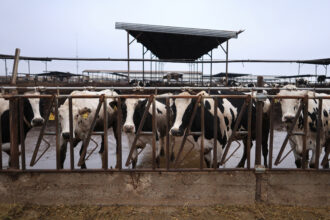
The San Joaquin Valley has upwards of 1,000 dairy farms, the most in any part of the state. The total number of waste lagoons in the valley and statewide—dairies can have more than one—is unknown.
The current El Niño, which will ramp up heading into December, could bring devastating flooding to waste lagoons, leading to environmental problems like contamination of drinking water and the spread of manure sludge through rural neighborhoods, experts warned.
It wouldn’t be the first time the weather phenomenon has battered the state. Along the coast and throughout Southern California, families and farmers saw record-breaking storms in the El Niños of 1982-83 and 1997-98. The current El Niño is likely the strongest in over a millennium, a recent study in Science found.
Three years ago, the San Joaquin Valley was pummeled by atmospheric rivers that forced the evacuation of hundreds of thousands of cows from dairy farms. How overflow from manure lagoons impacted the many rural communities that sit beside dairies is impossible to know, as a true accounting of the effects has never been completed.
“Much of what we saw [in 2023] focused on protecting the cows … which certainly helps save the animals’ lives. However, I feel we saw very little regarding the issue of manure and the pollution that originates from all those farms,” said J. Pablo Ortiz-Partida, director of innovation and collaboration at the nonprofit Union of Concerned Scientists.
Ortiz-Partida, who has a degree in environmental engineering from Instituto Tecnológico y de Estudios Superiores de Occidente in Mexico, is concerned about families who live in proximity to dairy lagoons. Communities in central California, many majority Hispanic, are known to bear a disproportionate amount of the negative health harms from concentrated animal feeding operations.
He said that even without flooding, pools of manure from CAFOs have contaminated the groundwater and air in some areas and pose health risks to people nearby.
Typically, cow waste from lagoons is applied to land, converted into biogas or trucked away.
Learning from Experience
Justin Leyendekker, a 36-year-old dairy farmer in the San Joaquin Valley, counted himself lucky for not having had significant damage when the region flooded in 2023.
“I know one dairy was as deep underwater as like 15 or 20 feet,” said Leyendekker, whose family—back to his grandfather in the 1960s—runs eleven other dairy farms in California.
The experience three years ago was instructive for Leyendekker when considering what extreme rain could bring.
“That gave us an idea of some I guess you could call them ‘weak points’ or ‘maintenance points’ that we needed to take care of. So once I heard the news that we’d potentially be getting another El Niño, those gave me some nice focus points to work on,” Leyendekker said, of Hoppy Cows Dairy, which he’s been running for about a decade and is named for his love of home brewing.
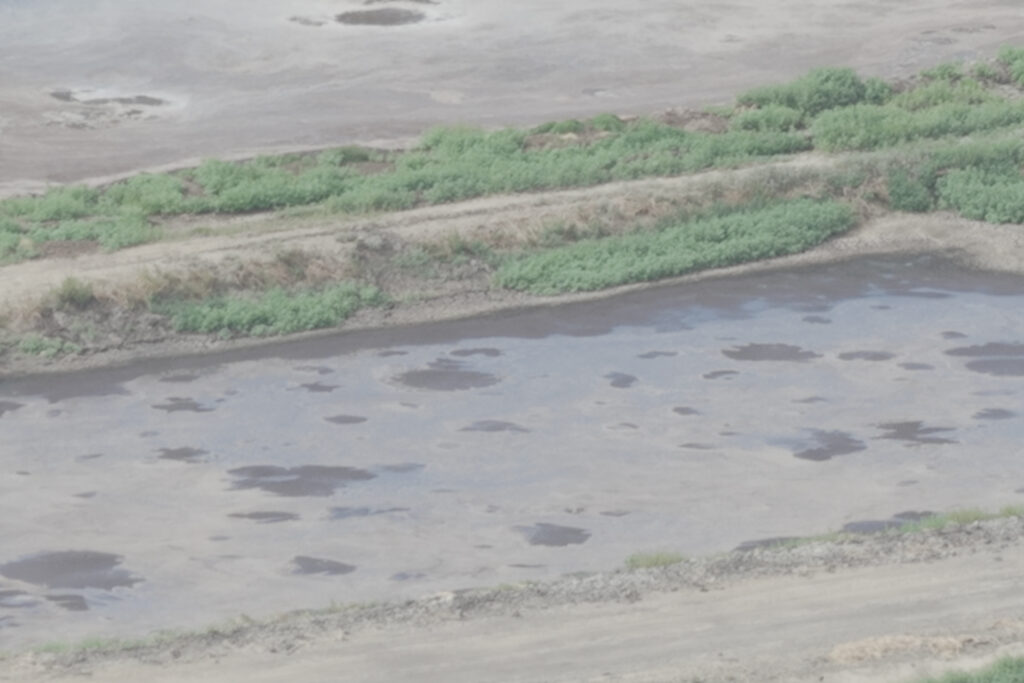
The dairy in Kingsburg, which has about 2,000 cows, has a sizable waste lagoon that fills up to roughly 15 feet deep.
“Each year we try and drain it down to as low as we can go,” said Leyendekker, who noted that El Niño has been extra motivation to keep the lagoon as empty as possible.
Ortiz-Partida said he remains worried that residents in areas adjacent to waste lagoons don’t truly know what’s in store for this winter.
Besides nitrates, he said bacteria, heavy metals and other water contaminants could escape from lagoons at dairies facing more stormy weather and rainfall.
The unknowns—what makes up these pools of waste and where runoff could flow as weather patterns worsen—also concern him. “We don’t know where all that will end up,” he said.
Lewis Bernier, an advocate with Direct Action Everywhere, said the impacts of the winter of 2022-23 have led the grassroots group to prepare for the current El Niño, which should peak over the coming months.
“We’re looking to this winter as well, trying to have response plans ready in advance,” Bernier said. “These open pits of waste are like ticking time bombs of massive amounts of pollutants.”
Dairies in California have been getting ready for El Niño, said Scott Hatton, supervising water resource control engineer for the Central Valley Regional Water Quality Control Board.
The water board, which is providing online resources for dairy farmers, requires them to submit a report in the event any waste discharge could threaten human health or the environment. They are also required to inform the board if cattle need to be moved to higher ground, Hatton said.
“The Water Boards are preparing for a very heavy rainfall year, with significant flood concerns,” Hatton said in an email to Inside Climate News. “We are encouraging all dischargers to review their storm and flood preparedness … The dairy industry, in particular, has sent out suggested guidelines in a recent newsletter.”
This story is funded by readers like you.
Our nonprofit newsroom provides award-winning climate coverage free of charge and advertising. We rely on donations from readers like you to keep going. Please donate now to support our work.
Donate NowThe October newsletter, which features a cartoon of four cows on an ark-like boat, was released by California Animal Response Emergency Support, or CARES, a unit within the California Department of Food and Agriculture.
“Models predict most of the state is headed for at least 150 percent of normal rainfall,” Michael Payne, a dairy outreach coordinator at the University of California, Davis, and director of the California Dairy Quality Assurance Program, wrote in the newsletter.
According to Payne and Sonia Brown, an emergency manager for CARES, “there is more heat energy being measured in the Pacific Ocean now than at any time since modern recording began in 1950.”
State and regional officials have expressed specific concerns about the potential for the severe weather in central California to increase flood risks and impact agricultural land.
Out-of-Date Data Could Hinder Preparations
To prepare for El Niño, dairies could ensure they have emergency plans on hand, inspect facility equipment before storms arrive, test backup generators, ensure they can handle evacuations properly and assess risks such as the chances of flooding based on available FEMA mapping, according to the CDQAP newsletter.
Deanne Meyer, a livestock waste management specialist at the University of California, Davis, said farmers should ensure channels and canals are free of debris and sand and that all pumps are serviced and ready to run for extra hours.
Other experts suggest readying waste lagoons by confirming that above-ground ponds have space for their levels to rise at least 2 more feet and in-ground ponds can rise 1 more foot. It is also important, the CARES guidelines suggest, that there is adequate capacity in the lagoons for a “25-year, 24-hour storm event,” which varies by dairy.
Emily Miller, an attorney at nonprofit Food & Water Watch, is concerned dairies are using an old technical paper to determine what qualifies as a “25-year storm.” That standard—the amount of rain that would fall in 24 hours in a storm likely to occur once in 25 years—is a measurement of the probability of extreme weather. But many areas are seeing that intensity of rainfall more often than every 25 years.
“That report is from 1961,” Miller, whose legal work has focused on farm regulations, said of Technical Paper No. 40. “Analyzing data from decades before.”
Climate change has fueled increasingly wet storms over the years, leading to more extreme weather and heavier, sometimes torrential, rainfall, according to scientists.
“As you might imagine, our weather has become increasingly more intense, with more frequent extreme events than what we were seeing in the ’60s,” Miller said.
“I think there’s a risk that these lagoons are not in fact built to withstand these frequent and intense storms that we are now seeing.”
— Emily Miller, Food & Water Watch
Hatton, with the state’s regional water board, said that while the 25-year, 24-hour storm definition remains the regulatory standard, “more recent precipitation data should be used to determine the amount of rainfall associated with such an event.”
Dairies had to use storm-event data dating as far back as 1973 in the waste management plans they were required to submit in 2010, the water board said, and operations using that standard will be considered in compliance, despite its reliance on older data.
The San Joaquin Valley’s “dairy general order,” a set of regulations adopted by the State Water Resources Control Board in 2013, allows more recent rainfall-frequency data in calculations of precipitation amounts during such a storm, regulators noted. A new valley dairy order—which includes more specific manure-retention-pond capacity requirements—was proposed but has not been adopted.
Dairy farmers are used to managing water, which is key to their operations, Meyer said.
It would take persistent, intense rain to fill some of the waste lagoons, said Meyer, who also works at the University of California’s Agriculture and Natural Resources division. The coming El Niño’s storms could produce precipitation that heavy, but she said just how much rainfall dairies might get by the time winter is through is still up in the air.
“The dairy men in the San Joaquin Valley, they have been paying key attention to the weather reports for months,” she said.
Food & Water Watch has warned of the risks of similar flooding on CAFOs in the past. In 2018, both Iowa and North Carolina saw manure lagoons on livestock operations overflow with what the group described as “fecal soup” spilling into neighborhoods, flooding homes and contaminating drinking water wells with E. coli.
“I think there’s a risk that these lagoons are not in fact built to withstand these frequent and intense storms that we are now seeing,” said Miller, “which just really increases the risk that they will overflow or fail altogether in some catastrophic way.”
Nobody knows how many dairy farm waste lagoons in the San Joaquin Valley are ready for what are likely to be significant downpours and strong storms this winter. There is no requirement for dairies to notify water board regulators as to how their lagoons are prepared for El Niño.
About This Story
Perhaps you noticed: This story, like all the news we publish, is free to read. That’s because Inside Climate News is a 501c3 nonprofit organization. We do not charge a subscription fee, lock our news behind a paywall, or clutter our website with ads. We make our news on climate and the environment freely available to you and anyone who wants it.
That’s not all. We also share our news for free with scores of other media organizations around the country. Many of them can’t afford to do environmental journalism of their own. We’ve built bureaus from coast to coast to report local stories, collaborate with local newsrooms and co-publish articles so that this vital work is shared as widely as possible.
Two of us launched ICN in 2007. Six years later we earned a Pulitzer Prize for National Reporting, and now we run the oldest and largest dedicated climate newsroom in the nation. We tell the story in all its complexity. We hold polluters accountable. We expose environmental injustice. We debunk misinformation. We scrutinize solutions and inspire action.
Donations from readers like you fund every aspect of what we do. If you don’t already, will you support our ongoing work, our reporting on the biggest crisis facing our planet, and help us reach even more readers in more places?
Please take a moment to make a tax-deductible donation. Every one of them makes a difference.
Thank you,

Steven Rodas
Reporter, California
Steven Rodas covers water, wildfires and agriculture throughout California for Inside Climate News. Based in Los Angeles, he previously reported on the environment in New Jersey, covering energy, pollution, wildlife and development. Steven’s work has appeared in the San Francisco Chronicle, NJ.com/The Star Ledger and Grist. He worked as a copywriter at Google. Steven has a master’s degree from Syracuse University’s S.I. Newhouse School Of Public Communications. He is fluent in English and Spanish (and welcomes your tips).