

SUNBURY, Ohio—A proposal for a large data center has upended politics in this Republican-leaning suburb of Columbus.
That could spell trouble for U.S. Sen. Jon Husted, a longtime fixture in state Republican politics who was appointed to his seat in 2025 after former Sen. J.D. Vance became vice president. Husted is running against Sherrod Brown, a Democrat who served three terms in the Senate before losing his seat two years ago.
In Sunbury, the Senate race is on the same ballot as a referendum that would ban large data centers. Supporters of the measure say they don’t trust either party to stand up to the influence of technology companies, but they have less faith in Republicans.
That sentiment extends across much of the state and could prove consequential in an election that may determine whether Democrats take control of the chamber.
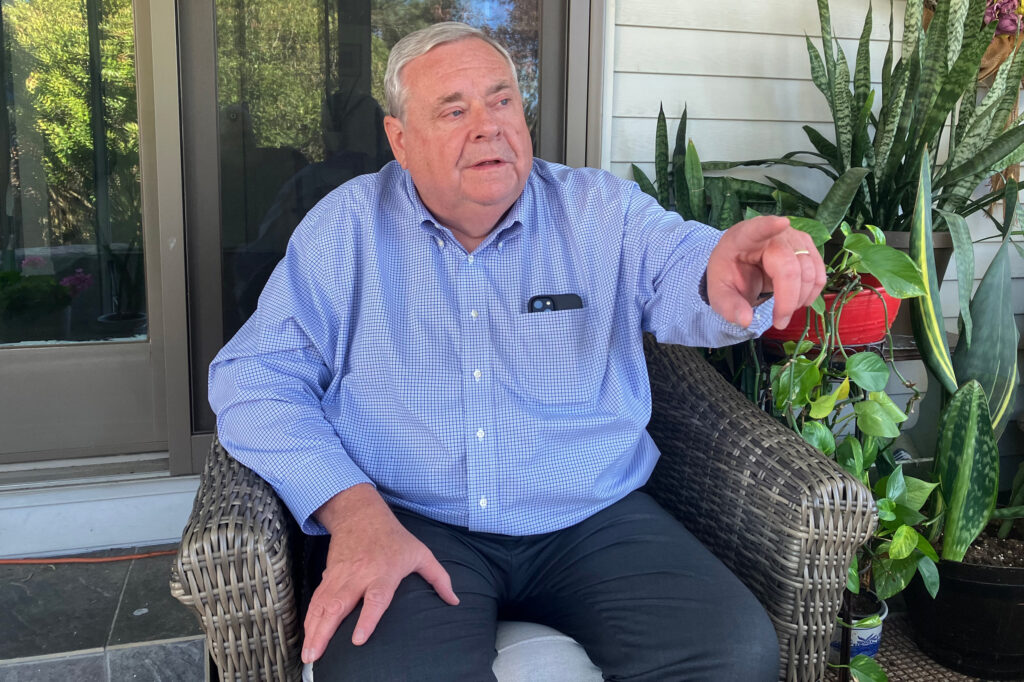
“I’m very disappointed in both parties’ approach to my problem,” said Larry Thode, a Sunbury-area resident who voted Republican most of his life and whose property is next to a planned Amazon Web Services data center.
Thode blames Republicans more than Democrats because they’re the ones in power, he said. The party has controlled Ohio’s government for more than a decade, with Husted serving as lieutenant governor from 2019 to 2025. Republicans also control the federal government, with President Donald Trump supporting development of AI data centers.
Alicia Doty, Thode’s neighbor, shares this frustration. She has mainly voted for Democrats in the past, but feels like the party needs to be clearer in opposing large data centers.
That said, her concerns about Democrats are small compared to her disappointment that Republicans welcomed development. Husted’s campaign has said he supports thoughtful data center planning, with protections for consumers and respect for local communities, but Doty remains unconvinced.
“I don’t believe Jon Husted for a second,” she said.
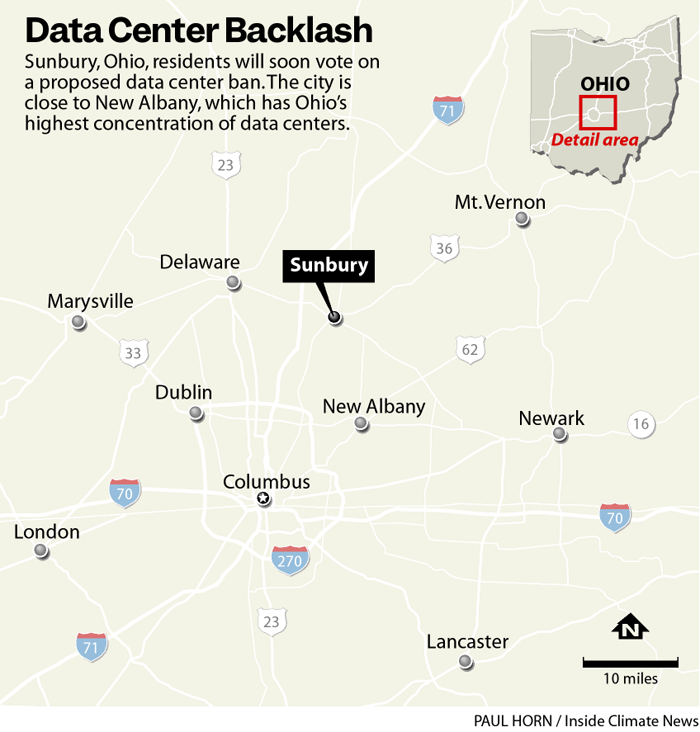
Sunbury, a city of about 9,000, sits near the northeast edge of Columbus’ suburbs, where housing subdivisions fade into farmland and woods. The city is in Delaware County, which has Ohio’s highest median household income and a history of supporting Republicans.
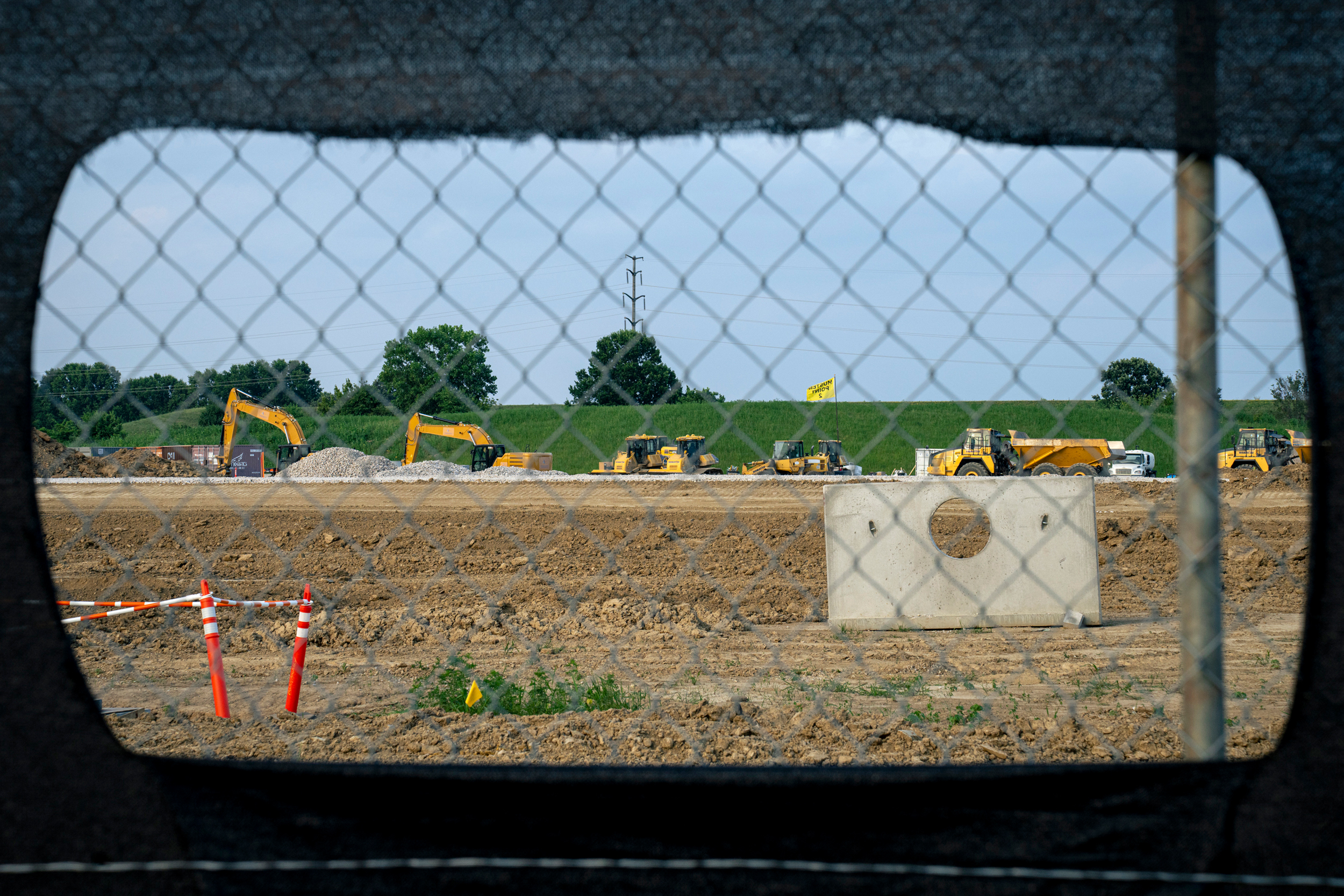
Amazon Web Services is proposing to build a data center with electricity demand of several hundred megawatts in a farm field between Thode and Doty’s properties. Under the plan, Sunbury would annex the AWS land and allow it to be developed.
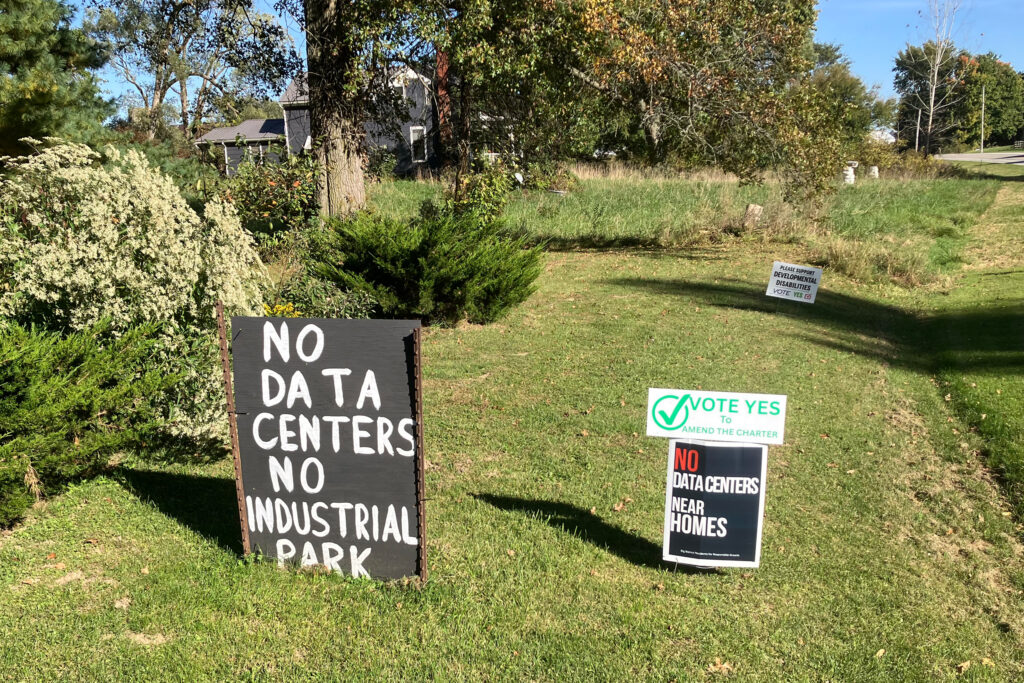
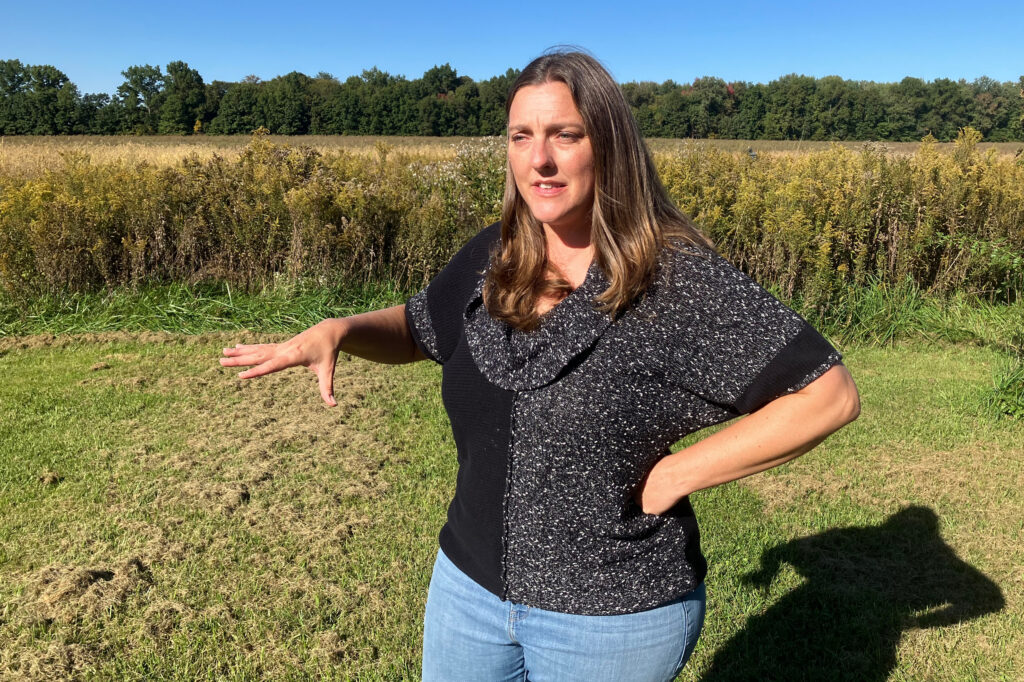
Alicia Doty’s property is next to the site of a proposed Amazon Web Services data center. She opposes the development, and it’s playing a role in how she thinks about voting in November. Credit: Dan Gearino/Inside Climate News
Opponents gathered enough signatures to put a measure on the local ballot that would bar data centers with electricity demand of at least 25 megawatts.
The backlash has been intense partially because Sunbury residents have watched how data centers transformed the farmland of New Albany, a city about 15 miles away. New Albany now has some of the densest concentration of data centers in the country.
“Decimated” is how Doty describes the nearby city, and she wants to avoid the same fate.
She noted the Sunbury proposal begins with one data center but planners have discussed building an industrial park south of her property that may attract additional data centers.
“Tin Ear”
Many communities across Ohio are pushing back on data centers and that opposition often overlaps with a distrust of politicians.
“There’s this kind of pitchfork populism about data centers that has really emerged,” said Kyle Kondik, managing editor of Sabato’s Crystal Ball from the University of Virginia Center for Politics.
Brown has seized on the issue, while Husted is running in a party led by Trump, who supports data center companies and criticizes opponents of development.
Trump has misread public opinion on data centers, responding to voter anger with what Kondik called “a tin ear.” The response marks a departure from Trump’s past knack for tapping into political undercurrents, Kondik said.

Opposition to data centers is stronger in Ohio than other places. For example, 3 percent of Ohio voters in a recent New York Times/Siena poll said artificial intelligence and data centers were their top issue in the election, the most of any state with a competitive U.S. Senate race. In the same poll, Ohio voters said they trusted Democrats on the issue by 11 points, again the most of any state with a competitive Senate race.
Husted has said he welcomes development if a community wants it and rules are in place to avoid harm to residents. But he has struggled to advance legislation, including a bill he co-sponsored to curb data centers’ impact on consumer electricity prices that failed to pass the Senate.
“Let’s rise above the politics that often drag this place down and deliver for the American people and do our jobs,” Husted said on the Senate floor on Sept. 30, about the bill.
The measure fell short of the 60 votes it needed to overcome a filibuster. Most Democrats opposed the plan, saying its requirements were not strong enough to do much good.
A few days later, Brown announced his campaign was behind billboards declaring Husted is “The Face of Data Centers,” for the state government’s use of tax breaks to attract the projects.
“Ohioans shouldn’t be forced to subsidize these costs and Ohioans—not Jon Husted and his billionaire friends—should get to decide if data centers are built in their community,” Brown said in a statement.
Husted’s campaign did not respond to requests for comment.
Opponents of data centers in Sunbury, including Thode and Doty, said they feel like Brown’s focus on the issue feels more like a political calculation than a deeply held belief. Still, they credit Brown with responding to public concerns more effectively than Husted.
This story is funded by readers like you.
Our nonprofit newsroom provides award-winning climate coverage free of charge and advertising. We rely on donations from readers like you to keep going. Please donate now to support our work.
Donate NowCrucial Race
Husted and Brown have decades of experience in office and long resumes on energy and environment issues, built well before data centers emerged as a major concern in those areas.
During Husted’s four years leading the Ohio House of Representatives, he worked with Gov. Ted Strickland, a Democrat, to draft Senate Bill 221, a landmark measure that became law in 2008, setting a goal for Ohio to get 25 percent of its electricity from renewable or advanced sources by 2025.
Since then, Husted has distanced himself from parts of the bill and supported his party’s successful efforts to weaken and eventually repeal most of its provisions.
Husted has a record of supporting nuclear power, including House Bill 6, a 2019 nuclear bailout measure that Gov. Mike DeWine, a Republican, signed while Husted was lieutenant governor. The bill became the focus of a bribery investigation that led to jail time for former state House Speaker Larry Householder. Political opponents have highlighted Husted’s advocacy for the bill, while he maintains he did nothing wrong.

Brown was a recent college graduate in 1974 when he won an election for a seat in the Ohio House of Representatives. Over a long political career in the House, as Ohio Secretary of State, in the U.S. House and the Senate, he gained a reputation for supporting workers’ rights.
On energy issues, Brown has backed measures that would expand renewable energy, such as the Inflation Reduction Act in 2022. At times, he has supported Ohio’s fossil fuel industries, including his criticism of a rule change under President Joe Biden that forced coal-fired power plants to reduce emissions.
For decades, Brown found ways to win even as his party lost nearly every other statewide office. But, in 2024, he lost to now-Sen. Bernie Moreno by 4 percentage points.
If Brown can win again, it would be an important step toward Democrats reaching the 51 seats they need to control the Senate. The party would have the power to block Trump’s legislative agenda and oppose his federal judicial appointments, including to the U.S. Supreme Court.
Those are huge stakes compared to a city’s referendum on data centers, but local concerns may play an unusually large role this year, Kondik said.
“When there’s a sudden and dramatic change in public opinion, which is what I would describe on data centers, the smart politicians adjust to that,” he said.
About This Story
Perhaps you noticed: This story, like all the news we publish, is free to read. That’s because Inside Climate News is a 501c3 nonprofit organization. We do not charge a subscription fee, lock our news behind a paywall, or clutter our website with ads. We make our news on climate and the environment freely available to you and anyone who wants it.
That’s not all. We also share our news for free with scores of other media organizations around the country. Many of them can’t afford to do environmental journalism of their own. We’ve built bureaus from coast to coast to report local stories, collaborate with local newsrooms and co-publish articles so that this vital work is shared as widely as possible.
Two of us launched ICN in 2007. Six years later we earned a Pulitzer Prize for National Reporting, and now we run the oldest and largest dedicated climate newsroom in the nation. We tell the story in all its complexity. We hold polluters accountable. We expose environmental injustice. We debunk misinformation. We scrutinize solutions and inspire action.
Donations from readers like you fund every aspect of what we do. If you don’t already, will you support our ongoing work, our reporting on the biggest crisis facing our planet, and help us reach even more readers in more places?
Please take a moment to make a tax-deductible donation. Every one of them makes a difference.
Thank you,

Dan Gearino
Reporter, Clean Energy
Dan Gearino covers the business and policy of renewable energy and utilities, often with an emphasis on the midwestern United States. He is the main author of ICN’s Inside Clean Energy newsletter. He came to ICN in 2018 after a nine-year tenure at The Columbus Dispatch, where he covered the business of energy. Before that, he covered politics and business in Iowa and in New Hampshire. He grew up in Warren County, Iowa, just south of Des Moines, and lives in Columbus, Ohio.