

A proposed amendment to the Florida Constitution on the ballot this November is aimed at cutting property taxes. But the amendment would also affect funding for local governments and the state agencies responsible for flood control and water supply and conservation across this vulnerable, low-lying peninsula.
Amendment 3 would raise the homestead property tax exemption, available on permanent residences, from $50,000 to $150,000 in 2027 and to $250,000 in 2028, with further increases based on inflation. Tax hikes on non-homestead properties also would be limited. The Legislature approved the measure in June during a two-day special session called by Gov. Ron DeSantis, a term-limited Republican whose second term ends in January 2027. At least 60 percent of voters must approve the amendment for it to be added to the state constitution.
The amendment’s financial impact on local non-school property tax revenues is projected to be $5 billion in fiscal year 2027-2028 and $9 billion in fiscal year 2028-2029, according to a bill analysis prepared for the Legislature. The recurring impact is estimated to be $12 billion annually, affecting roads, public transportation and safety, libraries, parks and other services. The amendment has drawn a diverse array of detractors, from the Florida State Fraternal Order of Police, Florida Sheriffs Association and Florida Fire Chiefs’ Association to the League of Women Voters of Florida, Florida Library Association and 1000 Friends of Florida, a conservation group.
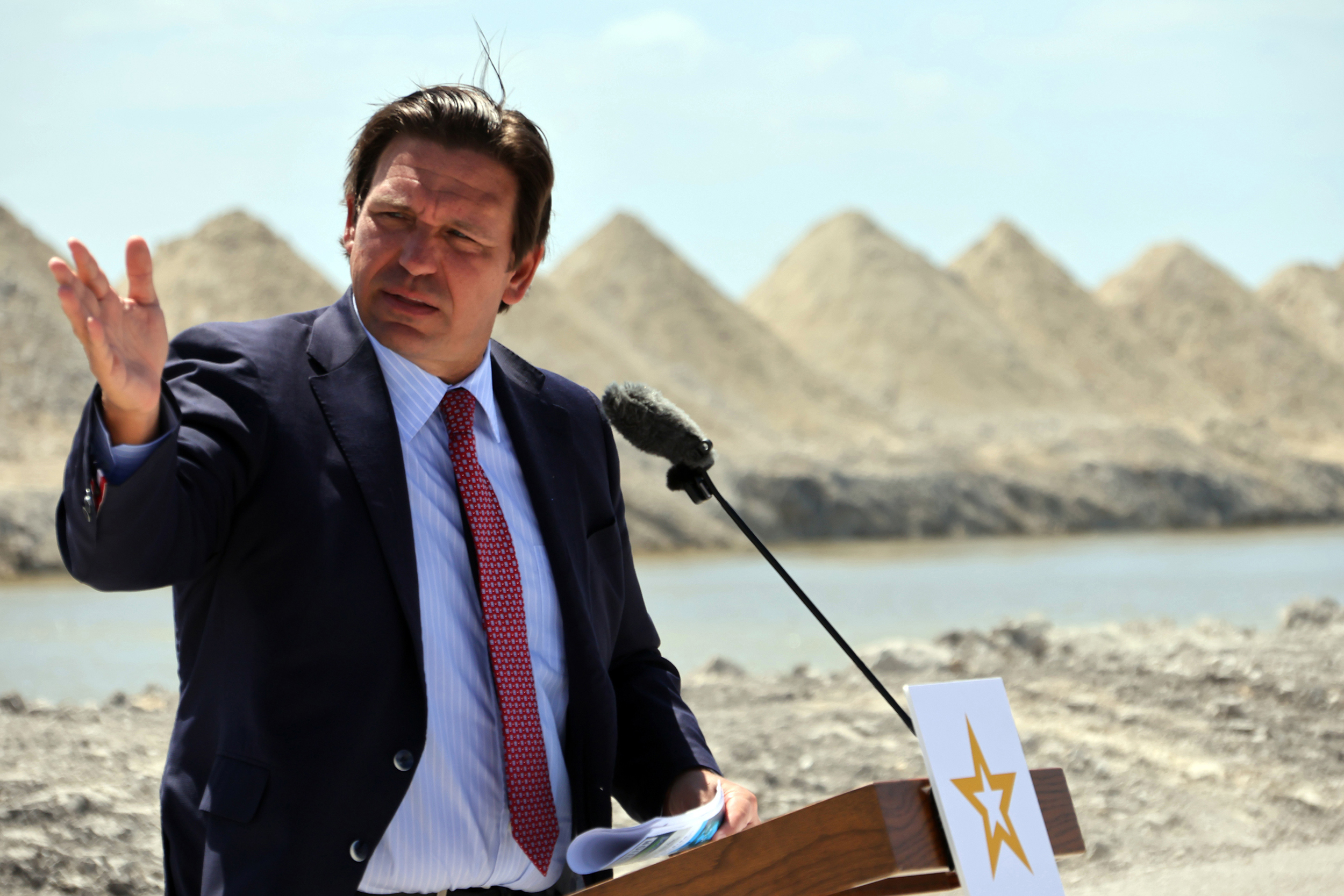
During an Oct. 21 roundtable discussion on Amendment 3 in Miami, attended by local officials and a representative of the Florida Realtors Association, DeSantis said the amendment would provide much-needed tax relief for Floridians and that local governments could afford it.
“If you have more money in people’s pockets, if they’re not having to pay more money to local governments just to live in their primary residences, that money is going to do better in the economy,” he said. “It’s going to expand the economic base, and then what will happen, you will end up getting revenue through the normal sources, not raising taxes, just like we’ve done in Florida. We’ve cut taxes. We’ve even eliminated taxes, and yet we continue to get more revenue every year. It’s because we’ve expanded the economic base.”
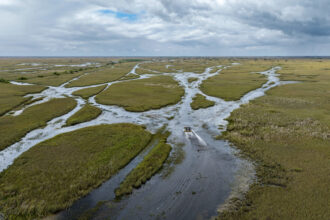
The state’s five water management districts, with boundaries defined by the watersheds they serve, are the stewards of Florida’s iconic water resources, from world-renowned springs to the vast Everglades. The fragile waters face growing pressures as the state’s population soars and the global climate warms, leading to hotter temperatures, rising seas and more damaging storms. Amendment 3’s financial impact on the water management districts, whose budgets are based on federal and state funds and local property tax revenues, is projected to be $89.5 million in 2027 and $160 million in 2028, climbing to $218 million in 2031, according to an analysis prepared for the Legislature by the Office of Economic & Demographic Research.
“The water management districts are one of those government functions that nobody pays attention to and everybody depends on. They help ensure that our communities don’t flood in storms. They are helping us to address the effects of climate change: blue-sky flooding in our coastal communities, crazy rainfall events that cause flooding inland. They are protecting our water supply, so making sure there is enough water to drink,” said Julie Wraithmell, executive director of Audubon Florida, which opposes Amendment 3. “They also help us with permitting of new development and making sure that sprawl is steered away from the most vulnerable wetland resources. And they are a really important part of the equation in how our state grows.”
At the South Florida Water Management District, the largest of the water management districts and the state agency charged with overseeing Everglades restoration, the impact in 2027 would amount to some 3 percent of the $1.6 billion budget for fiscal year 2026-2027. At the Suwanee River Water Management District, responsible for the more rural Big Bend region, the impact in 2027 would represent some 2 percent of the $70 million budget for fiscal year 2026-2027. The situation represents a continued “bleeding” of the water management districts, after cuts under former Republican Gov. Rick Scott, DeSantis’ predecessor and now a U.S. senator, said Jacqui Thurlow-Lippisch, a former board member for the South Florida Water Management District.
This story is funded by readers like you.
Our nonprofit newsroom provides award-winning climate coverage free of charge and advertising. We rely on donations from readers like you to keep going. Please donate now to support our work.
Donate Now“It’s not going to gut us. It’s not going to kill us. But it’s going to bleed us,” she said. “We’re going to watch our house go to hell in a handbasket, meaning it will still be there but it’s just not going to be as safe or as nice because there’s going to be a lot of pooling water and mildew and problems. And then if we do have a big hurricane, it could mean people’s lives.”
Despite investments in environmental programs under DeSantis, funding for the water management districts remains depleted, Thurlow-Lippisch said. At the Southwest Florida Water Management District, the budget for fiscal year 2026-2027 is $251.5 million, compared with $298.9 million in fiscal year 2009-2010, when Scott took office as governor. The water management districts all declined to comment on Amendment 3 or did not respond when contacted by Inside Climate News.
Wraithmell said the water management districts’ revenue should be allowed to grow as property values increase because that enables the water management districts to provide services such as flood control that become more complicated and expensive with population growth.
“It’s kind of grim to think about what they are going to cut,” she said. “It’s a terrible choice to make, and it’s one that is not going to be favorable for Florida writ large, in a state where our environment is our economy and our environment is tied to our prosperity and quality of life.”
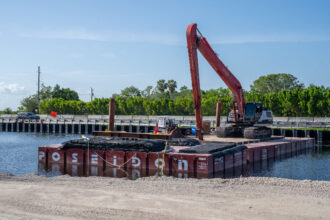
Thurlow-Lippisch pointed out Amendment 3 would affect the monumental effort to restore the Everglades and a massive reservoir under construction south of Lake Okeechobee that DeSantis has characterized as the “crown jewel” of the restoration effort. The reservoir, a priority of the governor’s, is scheduled to be complete in 2029, but before it can operate at full capacity a new water quality standard must be met for five years, a responsibility of the South Florida Water Management District. The standard has not been met, she said. She also said the amendment would not help much with Florida’s affordability problems or skyrocketing insurance rates.
“These guys are not thinking,” she said. “If DeSantis really wanted to help people save money, they should have addressed the insurance problem in the state.”
About This Story
Perhaps you noticed: This story, like all the news we publish, is free to read. That’s because Inside Climate News is a 501c3 nonprofit organization. We do not charge a subscription fee, lock our news behind a paywall, or clutter our website with ads. We make our news on climate and the environment freely available to you and anyone who wants it.
That’s not all. We also share our news for free with scores of other media organizations around the country. Many of them can’t afford to do environmental journalism of their own. We’ve built bureaus from coast to coast to report local stories, collaborate with local newsrooms and co-publish articles so that this vital work is shared as widely as possible.
Two of us launched ICN in 2007. Six years later we earned a Pulitzer Prize for National Reporting, and now we run the oldest and largest dedicated climate newsroom in the nation. We tell the story in all its complexity. We hold polluters accountable. We expose environmental injustice. We debunk misinformation. We scrutinize solutions and inspire action.
Donations from readers like you fund every aspect of what we do. If you don’t already, will you support our ongoing work, our reporting on the biggest crisis facing our planet, and help us reach even more readers in more places?
Please take a moment to make a tax-deductible donation. Every one of them makes a difference.
Thank you,

Amy Green
Reporter, Florida
Amy Green covers the environment and climate change from Orlando, Florida. She is a mid-career journalist and author whose extensive reporting on the Everglades is featured in the book MOVING WATER, published by Johns Hopkins University Press, and podcast DRAINED, available wherever you get your podcasts. Amy’s work has been recognized with many awards, including a prestigious Edward R. Murrow Award and Public Media Journalists Association award.