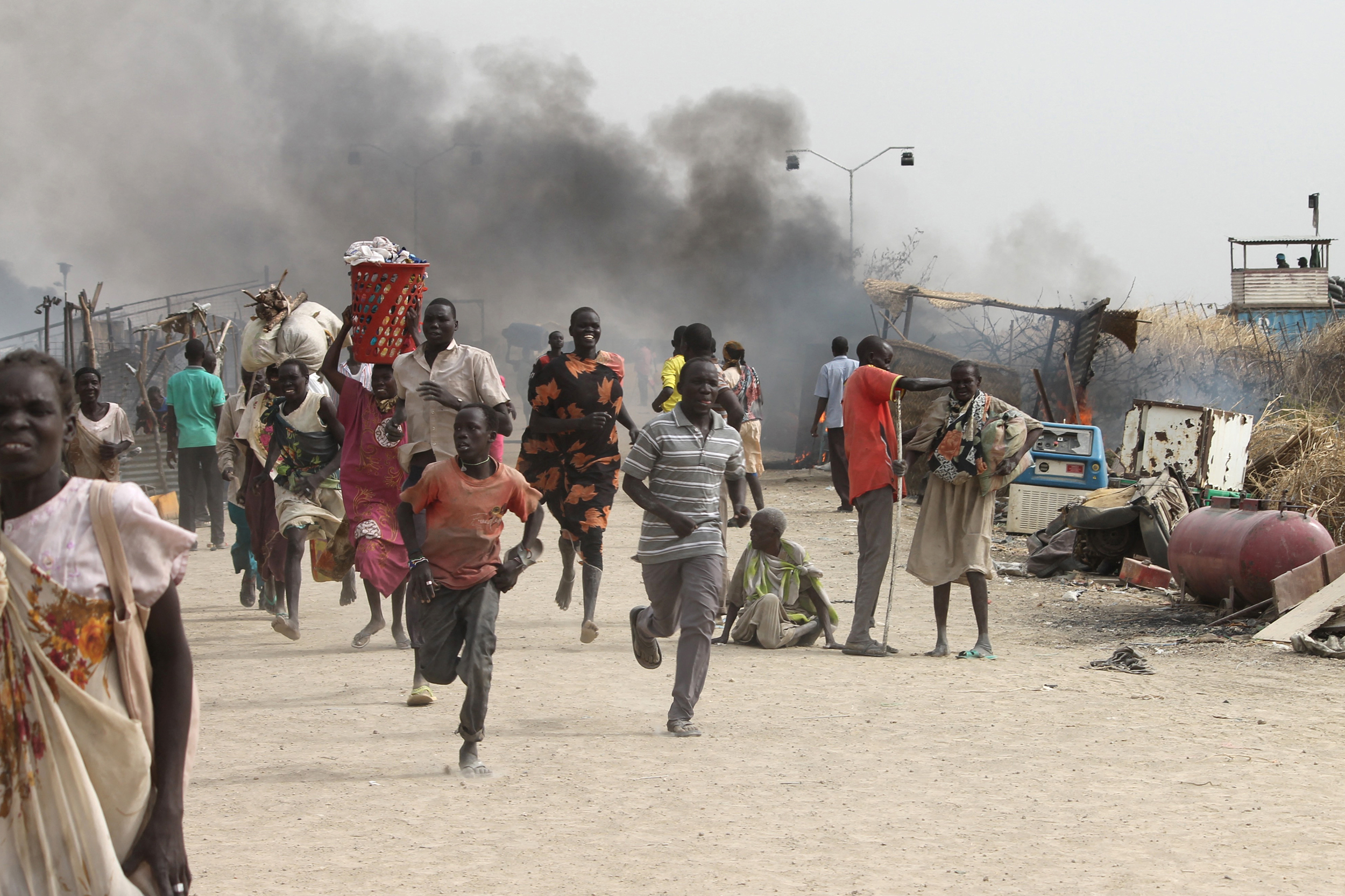


New research reinforces scientific evidence that climate extremes can raise the risk of armed conflict, especially when drought conditions pass critical thresholds in vulnerable regions, including parts of Africa and Southeast Asia.
The study, published today in the Proceedings of the National Academy of Sciences, analyzed detailed climate and armed-conflict data from 1950 to 2023. The researchers said they found statistically significant links between conflicts and climate impacts from two well-documented natural climate cycles: El Niño in the Pacific Ocean and the Indian Ocean Dipole.
Both are cyclical ocean temperature shifts that alter rainfall, storm and drought patterns across large parts of the planet; scientists say human-caused global warming is intensifying many of their extreme impacts. Intense climate shocks have shaped societies for millennia, but it’s been challenging to disentangle the effects of climate from factors such as demographic changes, national histories and other economic and social pressures.
The new study seeks to clarify the connections by treating climate oscillations as a natural climate experiment spanning decades of conflict data. The analysis found links between climate patterns and changing conflict risks at both global and regional scales, with three main findings related to El Niño.
First, the risk of armed conflict generally increased during El Niño periods compared with La Niña periods. Second, conflict risk did not rise gradually as climate impacts became stronger. The data suggest that violence becomes more likely only after drought conditions pass certain thresholds. However, that signal changed depending on whether they analyzed large national regions or smaller local areas. And third, heightened conflict risk is associated mainly with El Niño-driven droughts, which are particularly vulnerable to such impacts, including in Central America and southern Africa.
Drought is key because human well-being requires water above all else, said study co-author Justin Mankin, an associate professor at Dartmouth College and principal investigator of the university’s climate modeling and impacts group.
“Dry conditions are innately more stressful,” Mankin said in an email. “The paleoclimate and archaeological record is littered with stories of societal stress from prolonged or severe droughts.” Prolonged dry conditions can undermine local economies and livelihoods, making recruitment for armed groups easier in already unstable regions, he said.
A key takeaway from the study, he added, “is that we are poorly adapted to the climate we already have,” let alone climate change supercharged by human-caused warming.
On the conflict side, he said, the most important work on violence prevention and peacebuilding happens outside climate research, since sociopolitical, economic and demographic factors are far stronger determinants of conflict risk than climate. A 2019 study in Nature determined that socioeconomic development, state capability and intergroup inequality are more likely to drive conflict, he added.
“What climate variability does is shift when and where existing vulnerabilities translate into violence,” he said, cautioning against broadly framing climate impacts as a security problem, which “invites militarized responses to what should be development, governance and humanitarian problems.”
Mankin said that attributing conflict mainly to climate impacts shifts the focus away from more important factors, such as poor government planning, corruption and institutional failures, which more often determine whether environmental stress triggers violence.
Understanding the impacts from known modes of climate variability like El Niño “provides a foothold for predictability in an otherwise chaotic climate system,” he said. “With better forecasts, you could imagine more rapid anticipatory humanitarian financing,” focused on areas vulnerable to drought, rather than waiting until lives are disrupted and people are displaced.
The climate patterns tracked in the study are part of a much larger Earth system that still holds surprises, said co-author Sylvia Dee, head of the Climate and Water Lab at Rice University.
Even studying a small slice of the puzzle, like regional climate-driven conflicts, requires collaboration across research fields, and the new paper is a step in that direction, said Dee, who specializes in climate-model data comparison.
“People have been saying climate change contributes to conflict for a long time,” she said. But really trying to pin it down requires input from climate scientists, statisticians, political scientists and social scientists working directly with affected populations, she added.
“I don’t have any doubt that it can be solved,” Dee said. “But I don’t know if it’s going to happen unless people can add together in their minds all the things that are happening.”
She added, “We have shown that humanity, when pressed with enough urgency, can solve really critical problems.”
About This Story
Perhaps you noticed: This story, like all the news we publish, is free to read. That’s because Inside Climate News is a 501c3 nonprofit organization. We do not charge a subscription fee, lock our news behind a paywall, or clutter our website with ads. We make our news on climate and the environment freely available to you and anyone who wants it.
That’s not all. We also share our news for free with scores of other media organizations around the country. Many of them can’t afford to do environmental journalism of their own. We’ve built bureaus from coast to coast to report local stories, collaborate with local newsrooms and co-publish articles so that this vital work is shared as widely as possible.
Two of us launched ICN in 2007. Six years later we earned a Pulitzer Prize for National Reporting, and now we run the oldest and largest dedicated climate newsroom in the nation. We tell the story in all its complexity. We hold polluters accountable. We expose environmental injustice. We debunk misinformation. We scrutinize solutions and inspire action.
Donations from readers like you fund every aspect of what we do. If you don’t already, will you support our ongoing work, our reporting on the biggest crisis facing our planet, and help us reach even more readers in more places?
Please take a moment to make a tax-deductible donation. Every one of them makes a difference.
Thank you,

Bob Berwyn
Reporter, Austria
Bob Berwyn is an Austria-based reporter who has covered climate science and international climate policy for more than a decade. Previously, he reported on the environment, endangered species and public lands for several Colorado newspapers, and also worked as editor and assistant editor at community newspapers in the Colorado Rockies.