


Nearly everyone in Washington, D.C.’s Navy Yard neighborhood turned their eyes toward the Washington Monument, waiting for the record-breaking fireworks show that capped off the America 250 Independence Day celebration. As the sky lit up, one could hear a chorus of “wows” from viewers gathered at rooftop parties and in the streets.
But in the hours following the show, the nation’s capital briefly recorded the worst air quality of any major city in the world, according to AirNow, an Environmental Protection Agency website. An analysis of D.C. air quality data captured by Clarity Movement monitors showed that hourly PM2.5 concentrations peaked at 6.7 times higher than normal pre-fireworks levels and the pollution remained elevated for approximately five hours after peaking at 4 a.m. on Sunday, July 5. Air monitors maintained by the D.C. Department of Energy and the Environment (DOEE) recorded the highest particle pollution levels in Southwest D.C., near Navy Yard.
City officials issued a Code Red alert around 9 a.m. on Sunday, urging people to limit their time outside. An overnight rain storm helped to disperse much of the residual July 4 smoke and, by late morning, PM2.5 concentrations had normalized to pre-firework levels, according to Clarity Movement’s analysis.
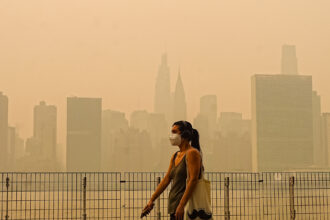
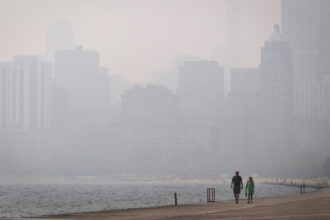
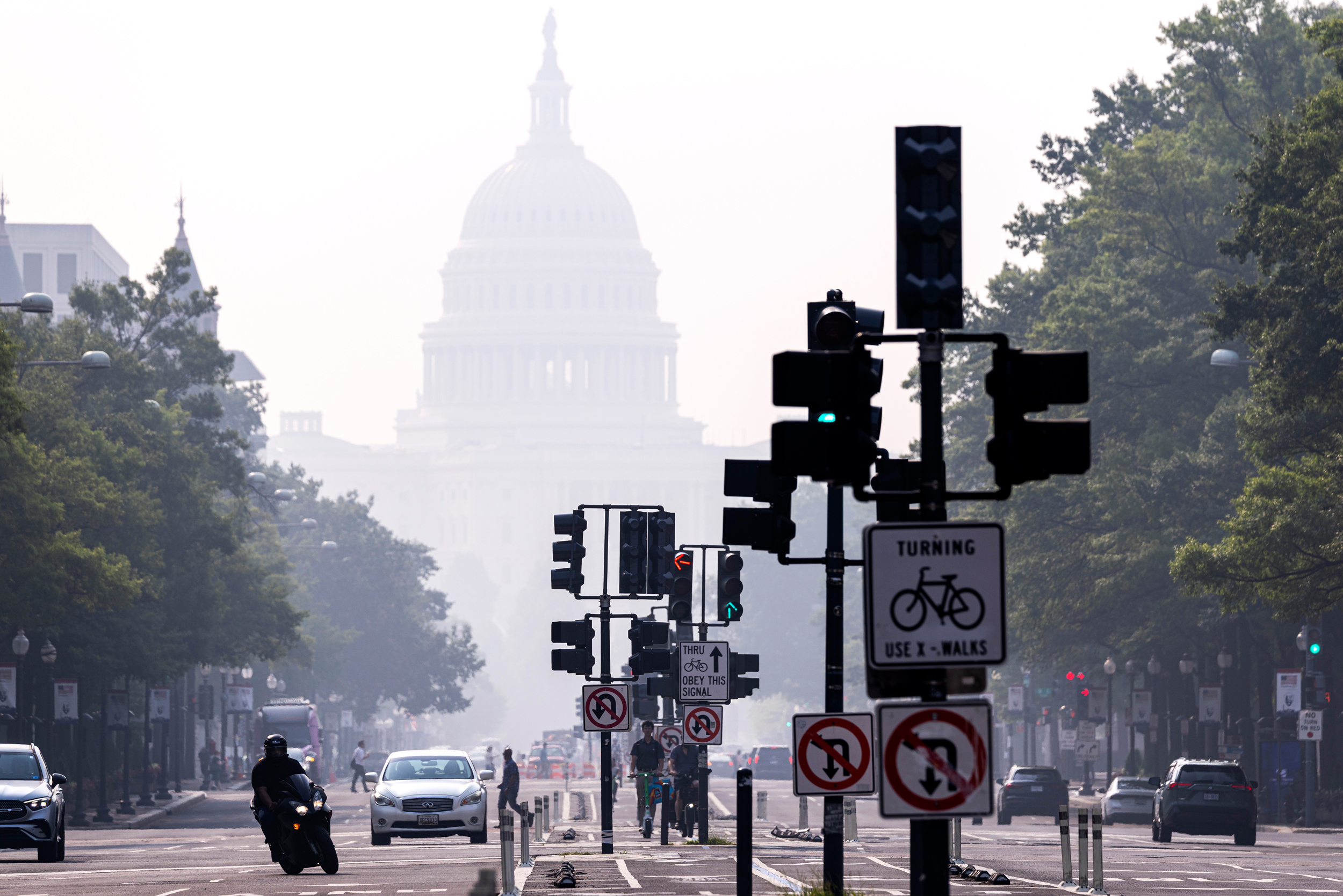
But even pyrotechnic displays as large as those that lit up the National Mall earlier this month aren’t D.C.’s only air quality concern—or even its biggest. For instance, air quality in the District has worsened in recent summers as a result of smoke drift from Canadian wildfires. Conditions were so bad last week, the Metropolitan Washington Council of Governments issued a code purple alert, urging people to consider rescheduling outdoor events or moving activities indoors.
“All DC Gov outdoor activities cancelled; outdoor pools and spray parks are closed,” said D.C. Mayor Muriel Bowser in an X post.
The Fourth of July fireworks came right after the East Coast was hit by a heat dome, a weather phenomenon caused when the atmosphere traps hot air in a region, preventing precipitation. The phenomenon is projected to become more frequent in North America due to climate change.
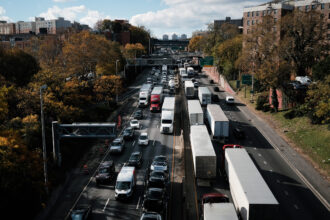
Temperatures in the greater D.C. area reached triple digits on July 2 and 3, leading to moderate- to-unhealthy concentrations of ground ozone. On hot days, the pollutant associated with lung diseases and other health risks forms when chemicals emitted from car exhaust are bombarded with strong ultraviolet rays.
Ozone concentrations are a recurring issue within the District. The EPA’s National Ambient Air Quality Standards set ground-level ozone measures at a 70 parts per billion maximum. It evaluates this requirement for cities by taking into account the yearly fourth-highest daily maximum 8-hour concentration and averaging it over three years.
According to the most recent D.C. air quality summary report for 2025, the District does not currently meet the ground-level ozone standard. It has, however, drastically reduced the number of days when it exceeded the standard.
Taney Simon, a public information officer at DOEE, said the District has increased inspections of local pollution sources, such as gas stations and auto body shops, and funding for the electrification of diesel vehicles. She said the District is also currently pursuing stricter standards for ozone-forming pollution from home products.
According to the American Lung Association’s 27th annual State of the Air report, since 2010 the number of high ozone days in the District has sharply decreased, from around 28 to only 4 and a half days. The number of high PM2.5 days has fallen, from 19 to 3 and a half, over the same period, despite a growing trend since 2014.
Kevin Stewart, director of environmental health at the American Lung Association, attributed the reductions to the Clean Air Act, the development of technologies to control air pollution and state and local implementation plans that have enforced emissions reductions from different sectors. He said, however, that for about the past decade or so, those improvements have either stagnated or been eroded—in part by climate change and the increase in frequency of wildfires.
This story is funded by readers like you.
Our nonprofit newsroom provides award-winning climate coverage free of charge and advertising. We rely on donations from readers like you to keep going. Please donate now to support our work.
Donate Now“As temperatures increase, this tends to make ozone more likely to form even if the amount of precursor pollutants remains the same,” Stewart said. “Where precursor pollutant emissions have been reduced, higher temperatures mean we’ve been fighting a holding action against ozone formation. With fewer controls on emissions, the concentration of ozone can be expected to be more likely to increase over the ensuing years.”
The District still does not receive a “passing grade” on either daily PM2.5 or high-ozone days. The ALA grades are based on the number of days a county reaches 9 micrograms per cubic meter of PM 2.5 in its air, the threshold standard set out by the EPA. Counties at or above 9.1 micrograms per cubic meter are given a grade of “fail.”
The ALA report estimates almost 140,000 of D.C.’s roughly 700,000 residents have lung and cardiovascular conditions.
Laura Kate Bender, vice president of nationwide advocacy and public policy at the American Lung Association, said particle pollution, like the kind the city is seeing this summer, is damaging over the long term and repeated spikes or day-in, day-out exposure at lower levels are harmful. According to the World Health Organization, air pollution can affect almost all organs and systems of the body, impacting respiratory, cardiovascular, cerebrovascular, reproductive and metabolic systems.
“Even if the spike is behind us, which is a good thing, it still adds to that overall burden,” Bender said.
Simon said DOEE uses monitoring data to identify pollution sources that require additional controls and to focus enforcement actions, including cracking down on illegal engine idling and unpermitted generators.
The District has also expanded neighborhood-level air monitoring by installing park bench monitoring stations and growing its networks of PurpleAir sensors and Clarity node sensors.
While PurpleAir sensors only measure PM2.5, Clarity node sensors can also detect nitrogen dioxide, a gas indirectly linked to the formation of acid rain. David Lu, chief executive officer of the Clarity Movement, the company responsible for the Clarity nodes, said the monitors in the District are equipped with extra upgrades to also detect ozone and carbon dioxide.
About This Story
Perhaps you noticed: This story, like all the news we publish, is free to read. That’s because Inside Climate News is a 501c3 nonprofit organization. We do not charge a subscription fee, lock our news behind a paywall, or clutter our website with ads. We make our news on climate and the environment freely available to you and anyone who wants it.
That’s not all. We also share our news for free with scores of other media organizations around the country. Many of them can’t afford to do environmental journalism of their own. We’ve built bureaus from coast to coast to report local stories, collaborate with local newsrooms and co-publish articles so that this vital work is shared as widely as possible.
Two of us launched ICN in 2007. Six years later we earned a Pulitzer Prize for National Reporting, and now we run the oldest and largest dedicated climate newsroom in the nation. We tell the story in all its complexity. We hold polluters accountable. We expose environmental injustice. We debunk misinformation. We scrutinize solutions and inspire action.
Donations from readers like you fund every aspect of what we do. If you don’t already, will you support our ongoing work, our reporting on the biggest crisis facing our planet, and help us reach even more readers in more places?
Please take a moment to make a tax-deductible donation. Every one of them makes a difference.
Thank you,

Gabriel Matias Castilho
Fellow
Gabriel Matias Castilho is an Inside Climate News fellow reporting on the Washington, D.C. area. Previously, he worked for Capitol News Illinois, covering environmental policy, energy and utilities across the state. He is currently a master’s student at Northwestern University.